

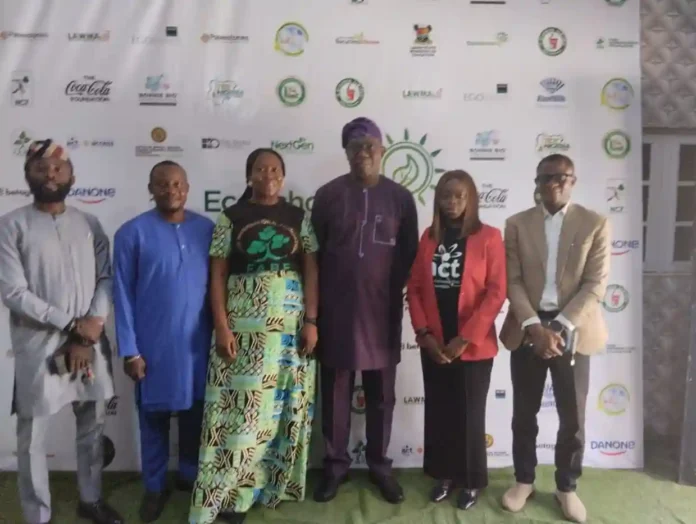
The Foundation for a Better Environment (FABE) says it has trained over 130,000 students across 174 public schools in climate education, sustainability and practical eco-skills, as part of efforts to prepare young Nigerians for environmental challenges and green economy opportunities.
The disclosure was made by the Chief Executive Officer and founder of FABE, Mrs Temitope Okunnu, during the EcoSchoolsNG Youth Climate & Circular Economy Summit and Annual Closeout & Innovation Showcase 2026 held in Lagos.
According to her, the initiative is not just about classroom learning but about equipping young people with real, practical solutions to pressing environmental problems. She described the programme as a deliberate investment in a generation that can respond to climate realities with innovation and responsibility.
“Today is not another event. Today is a moment that represents possibility, progress, and the future of Nigeria,” Okunnu said.
She stressed that Nigeria already has the human capacity to tackle climate change, noting that many of the solutions are already emerging from schools involved in the programme.
“Nigeria is not lacking solutions to the climate crisis. Nigeria is full of them. They are sitting in classrooms. They are standing in school gardens,” she said.
The EcoSchoolsNG programme, a 10-month intensive training initiative, focuses on environmental education, circular economy principles and hands-on skills such as gardening, recycling and waste management. It is implemented by FABE in partnership with the Aspire Coronation Trust (ACT) Foundation, which has supported the programme since 2021.
Okunnu pointed out that students are not only learning concepts but actively applying them within their schools and communities.
“They are building recycling systems, growing food through eco-gardens, and turning waste into compost,” she said.
She added that participants are also gaining exposure to alternative energy practices, including the production of biogas and digestate from organic waste, further positioning them as contributors to a growing green economy.
Beyond skills acquisition, the programme is also shaping leadership and behavioural change among young people. Okunnu emphasised that the impact is already visible in how students are driving sustainability efforts at the grassroots level.
“Young people are not leaders of tomorrow, I have often said they are leaders of today,” she stated.
She further described the initiative as a pipeline for Nigeria’s future workforce in the green economy, noting that students are being introduced to systems thinking, innovation and environmental responsibility at an early stage.
“To our partners and stakeholders, what you are witnessing here is the pipeline of Nigeria’s green economy workforce; a generation that understands sustainability, innovation and responsibility,” she said.
She also highlighted the scale of environmental challenges facing the country, including rising waste generation, flooding, food insecurity and poor waste management, insisting that early education remains a critical response.
“Across Nigeria today, we are facing serious environmental challenges… but here is what gives us hope; through EcoSchoolsNG, over 130,000 students… are already taking action,” she noted.
On her part, Mrs Abiodun Owo, Project Manager at ACT Foundation, said the organisation’s support for FABE aligns with its focus on sustainable development across key sectors.
“At ACT Foundation, we support non-profits that work in health, entrepreneurship, environment and leadership,” she said.
She explained that FABE was selected as a partner based on its long-term impact and measurable outcomes, particularly in building sustainability-driven mindsets among young people.
“When we look out for partners, we want those that will do things that would be sustainable down the line. Five years down the line, we are seeing the tangible results,” Owo added.
She noted that the programme is already creating ripple effects beyond the classroom, with some students beginning to explore entrepreneurial opportunities linked to environmental solutions.
“You can see what they’re doing with the students, and the students are even becoming entrepreneurs,” she said.

