

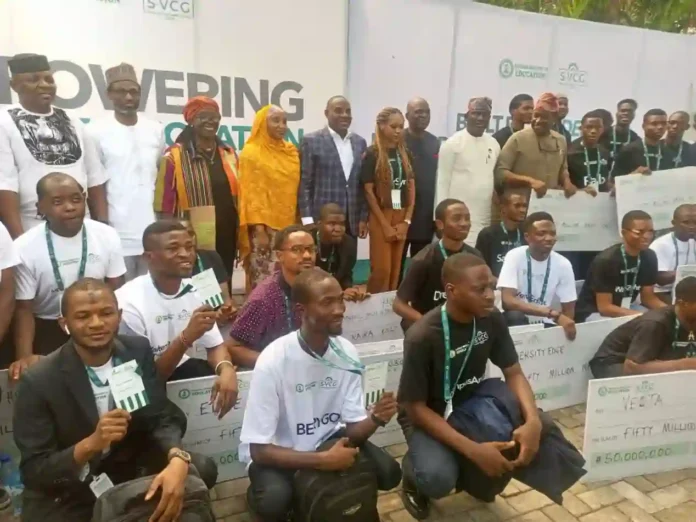
The Federal Government has disbursed N2.25 billion to 45 students across tertiary institutions to fund innovation-driven start-ups under the newly introduced Student Venture Capital Grant (S-VCG), marking a major push to turn students into entrepreneurs and job creators.
The beneficiaries, drawn from universities, polytechnics and colleges of education, emerged from a highly competitive process that attracted over 30,000 applications from more than 400 institutions nationwide. They were selected after making it to the final stage, where 65 students participated in an intensive three-week bootcamp held in Lagos.
Cheques were presented to the winners by the Minister of Education, Dr. Olatunji Alausa, alongside the Minister of State for Education, Prof. Suwaiba Ahmad; Minister of Communications, Innovation and Digital Economy, Dr. Bosun Tijani; and Chairman of the Senate Committee on TETFund, Senator Mohammed Muntari.
Speaking at the event, Alausa described the initiative as a decisive shift in how education is positioned in Nigeria, moving beyond certificates to real economic impact.
“Today is not just another programme event. We are activating a new future. A new vision for Nigerian students,” he said.
He noted that for years, tertiary institutions have largely been viewed as centres for certification, but the current administration is changing that narrative. According to him, institutions must now evolve into “centres of innovation, engines of enterprise, and launchpads for global solutions.”
Alausa explained that the Student Venture Capital Grant is designed to unlock the entrepreneurial potential of Nigerian students by providing not just funding, but also structured support systems.
Through the programme, beneficiaries can access up to ₦50 million in equity-free funding, alongside incubation, mentorship, and exposure to advanced digital tools, including AI-driven evaluation systems. He stressed that the initiative is one of the boldest interventions aimed at building a pipeline of young innovators capable of driving economic growth.
“This is how nations rise — not by consuming ideas, but by creating them,” Alausa stated.
Also speaking, Tijani commended the Ministry of Education for introducing the initiative, describing it as a timely intervention in strengthening Nigeria’s innovation ecosystem. He urged the beneficiaries to make prudent use of the funds and remain focused on building scalable solutions.
Senator Muntari echoed similar sentiments, noting that President Bola Tinubu is committed to empowering Nigerian students to translate ideas into viable enterprises.
The programme is expected to position Nigeria as a hub for innovation-driven growth, while equipping students with the tools and resources needed to create jobs, solve real-world problems, and compete globally.

