

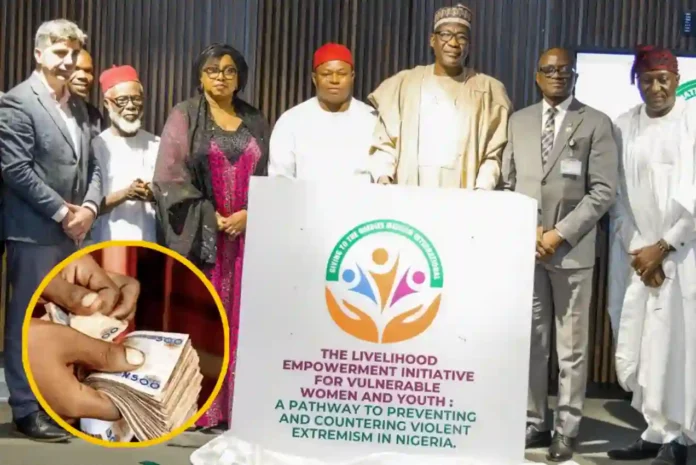
The Federal Government has launched the Livelihood Empowerment Initiative (LEI) to support about 10,000 vulnerable Nigerians with agricultural training, inputs and start-up grants, in a move expected to generate up to 20,000 jobs.
The programme, unveiled on 26 March 2026 in Abuja, is being implemented by the National Counter Terrorism Centre (NCTC) under the Office of the National Security Adviser (ONSA), in collaboration with Giving to the Needy Mission International (GINMI). It is designed as a non-kinetic strategy to address the economic conditions that often fuel insecurity across the country.
At the launch, officials described the initiative as a major shift in Nigeria’s counter-terrorism approach, placing economic empowerment at the centre of efforts to reduce vulnerability among young people and women.
Speaking on behalf of the National Security Adviser, Nuhu Ribadu, the National Coordinator of the NCTC, Major General Adamu Laka, represented by Ambassador Abimbola Wonosikou, said the programme goes beyond traditional security interventions.
He said, “This initiative is more than a livelihood programme; it is a strategic security intervention designed to replace vulnerability with capability and despair with opportunity.”
According to him, while military operations remain important in combating terrorism and banditry, long-term stability depends on addressing deeper structural challenges such as poverty, unemployment and social exclusion.
He explained that these conditions have created an enabling environment for extremist and criminal groups to recruit, especially in communities facing economic hardship and displacement.
“Sustainable security goes beyond kinetic responses and must address the underlying drivers of vulnerability and instability,” he added.
The LEI programme aims to equip beneficiaries with practical agricultural skills, provide them with high-quality inputs and offer financial support to establish sustainable livelihoods. It also includes guaranteed market access through structured partnerships with major agro-processing companies.
Officials said the focus on agriculture was deliberate, given its central role in Nigeria’s economy and its potential to absorb a large number of unemployed youths.
The initiative will cover key agricultural value chains, including cassava processing, rice and maize cultivation, poultry farming and fish production. Beneficiaries will receive intensive training in modern agronomic practices, alongside support to integrate into organised production and distribution systems.
Chairman of GINMI, Dr Reuben Uche Egwu, described the programme as a response to the economic realities driving insecurity across different regions of the country.
He said, “The Livelihood Empowerment Initiative is a proactive, non-kinetic security strategy that addresses these economic drivers head-on.”
Egwu noted that insecurity in Nigeria, ranging from insurgency in the North-East to banditry in the North-West and communal conflicts in the North-Central, cannot be effectively addressed without improving the economic conditions of affected populations.
He emphasised that many young people are drawn into violent networks due to a lack of opportunities, making economic empowerment a critical part of national security planning.
According to him, the programme will run between 2026 and 2028, with a phased rollout across twelve states and the Federal Capital Territory. Implementation will begin in Ebonyi State before expanding to other states including Nasarawa, Adamawa, Akwa Ibom, Kaduna, Borno, Gombe, Enugu, Niger, Lagos and Plateau.
To ensure sustainability, the initiative has secured partnerships with private sector players such as Olam Nigeria and Dangote Rice, creating off-take arrangements that guarantee markets for produce generated by beneficiaries.
These partnerships are expected to reduce post-harvest losses, stabilise incomes and encourage long-term participation in agricultural activities.
Egwu said the programme is projected to create about 20,000 jobs, both directly and indirectly, as value chain activities expand.
Also speaking at the event, Dr Iyke Ezeugo of the DoGood Foundation for the Needy in the United States highlighted the link between economic deprivation and extremism.
He said, “When we invest in the livelihoods of youth and women, we are not just supporting economic development; we are strengthening communities and fortifying them against extremist ideologies.”
Ezeugo noted that extremist groups often exploit poverty, unemployment and marginalisation as recruitment tools, making interventions like LEI essential in dismantling those pathways.
Similarly, Borno State Commissioner for Information and Internal Security, Prof Usman Tar, welcomed the initiative as a complementary strategy to ongoing military operations.
He stressed that poverty and lack of education remain major drivers of insecurity and called for sustained investment in programmes that address these root causes.
The initiative also aligns with Nigeria’s broader Preventing and Countering Violent Extremism framework, which emphasises community-based approaches, economic inclusion and early intervention.
Former Director-General of the National Orientation Agency, Dr Mike Omeri, pointed out that insecurity is driven by a mix of ideological, social and economic factors.
He said tackling violent extremism requires a whole-of-society approach that goes beyond single-sector solutions, adding that programmes like LEI should be expanded to include social reorientation and identity-based interventions.
Officials at the launch reiterated that the programme is not just about providing temporary relief but creating lasting economic pathways for vulnerable populations.
Ambassador Wonosikou, in her remarks, said the initiative represents a deliberate move towards preventive security.
She said efforts must focus on building resilience within communities and ensuring that individuals have access to opportunities that reduce their susceptibility to radicalisation.
Stakeholders at the event also called for continued collaboration between government agencies, development partners, civil society organisations and the private sector to ensure successful implementation.
The LEI programme is expected to serve as a model for integrating development strategies into national security frameworks, particularly in regions most affected by conflict and economic instability.
With its combination of skills training, financial support and market integration, the initiative seeks to transform vulnerable populations into economically productive groups, while simultaneously addressing one of the key drivers of insecurity in Nigeria.
“This initiative is more than a livelihood programme,” Laka reiterated. “It is a strategic security intervention designed to replace vulnerability with capability and despair with opportunity.”

