

 Add us on Google
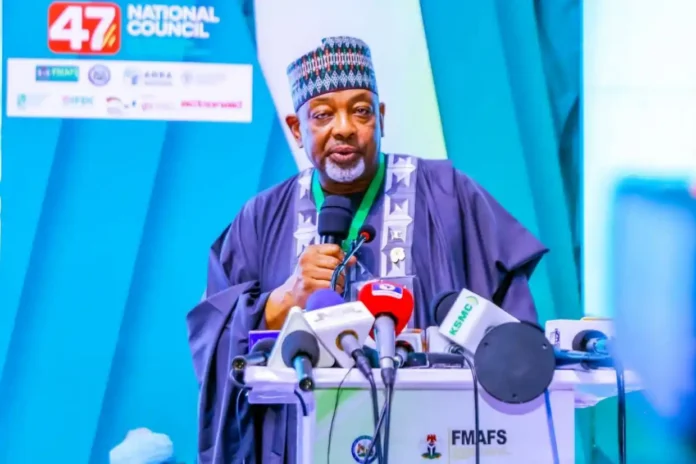
The Federal Government has said that the recent decline in the prices of key food commodities across Nigeria is linked to targeted market interventions, increased food production, and sustained agricultural investment. The Minister of Agriculture and Food Security, Sen. Abubakar Kyari, made this statement during the 47th Regular Meeting of the National Council on Agriculture and Food Security, held in Kaduna on Thursday, 6th November 2025.
According to him, the reforms under President Bola Ahmed Tinubu’s administration are driven by a firm commitment to achieve food sovereignty. He stated that the goal is to ensure Nigeria produces what it consumes, while also making food accessible, available, and affordable for households in both urban and rural areas. Kyari noted that the reforms are already having measurable effects.
In his words, “As we continue along this path, we are already beginning to witness a decline in food prices across several commodities, a reflection of targeted market interventions. While we are not yet where we want to be, this positive trend confirms that we are moving in the right direction.”
The Minister emphasized that achieving food sovereignty starts with consistent, high-yield crop production. He said this requires timely access to quality and affordable agricultural inputs. To support this, the Ministry, in collaboration with the African Development Bank and State Governments, has strengthened the National Agricultural Growth Scheme-Agro-Pocket (NAGS-AP), which he described as Nigeria’s flagship programme for improving input distribution and boosting farm productivity.
Kyari explained that wheat production in Nigeria has continued to expand under this programme. Wheat cultivation moved from 15 participating states in the 2023/2024 dry season to wider coverage in the 2024/2025 farming cycle. He stated that this growth is a sign of the government’s commitment to improving agricultural productivity and achieving self-sufficiency in major staple crops.
He highlighted a recent milestone in October with the introduction of rainfed wheat cultivation in Kuru, Plateau State. This innovation, developed by the Lake Chad Research Institute (LCRI), has extended wheat farming beyond irrigated zones. “With rainfed varieties now proven viable across the highlands of Plateau, Taraba, and Cross River States, Nigeria is charting a new course toward all-year farming and self-sufficiency in wheat production, bringing us closer to meeting our national demand from within,” Kyari stated.
To address price stability and reduce post-harvest losses, the Minister announced the Nigeria Postharvest Systems Transformation Programme (NiPHaST). The programme, developed in partnership with the Alliance for a Green Revolution in Africa (AGRA), focuses on improving storage, preservation, and processing systems. He said the programme was presented earlier this year during the Africa Food Systems Forum in Dakar, Senegal.
Kyari also noted investments in drought-tolerant crop varieties, integrated pest management, and the Nigerian Farmers’ Soil Health Scheme. The soil health scheme is designed to support farmers by ensuring fertiliser use is based on the specific soil needs of different regions.
He further disclosed that the Bank of Agriculture has been approved for N1.5 trillion recapitalisation and an additional N250 billion financing window to support smallholder farmers. This move, he said, will expand access to credit and boost rural economic development.
In partnership with Heifer Nigeria, the Federal Government has introduced a national agricultural mechanisation programme, targeting youth and women-led mechanisation service centres across all six geopolitical zones. “Mechanisation will become a national service that modernises production, raises yields, and creates sustainable rural employment,” the Minister said.
Speaking at the event, the Minister of State for Agriculture and Food Security, Sen. Dr Aliyu Sabi Abdullahi, stressed the importance of climate-smart agriculture for Nigeria’s future. He explained that adopting climate-resilient practices is key to maintaining productivity under changing weather conditions. “We must adopt climate-smart practices that increase crop yields while building resilience,” he said.
He highlighted key government initiatives including the 500,000-hectare Dry Season Farming Scheme, renewable energy-powered irrigation projects, and the Every Home a Garden programme led by the First Lady, Senator Oluremi Tinubu, which encourages household food production.
Both ministers noted that Nigeria holds the largest agricultural production potential in West Africa and can become a leading food supplier in the region through sustained reforms and investments.
Declaring the Council Meeting open, the Executive Governor of Kaduna State, Sen. Uba Sani, described the gathering as timely and critical. He said, “This year’s session unfolds at a defining moment in our collective journey, one in which the very notion of food security has transcended policy and entered the realm of national survival.”
According to him, Nigeria must secure food supply and also build an agricultural economy capable of supporting long-term prosperity. He acknowledged the transformation under the Renewed Hope Agenda, stating that agriculture has been repositioned at the center of the nation’s economic planning. “These are not isolated policies; they are the scaffolding of a new era of shared growth and self-reliance,” he said.
The governor added that Kaduna State is aligning closely with the Federal Government’s strategy by expanding access to credit, improving input delivery, modernizing logistics infrastructure, and supporting agribusiness. He described agriculture as the foundation of rural transformation and a driver of inclusive development.
The Council served as a platform for stakeholders to exchange ideas on strengthening agricultural value chains, enhancing market linkages, and improving youth participation in agribusiness. Participants discussed the role of private sector partners in sustaining food systems development.
Earlier in the visit, the Ministers and stakeholders toured several agricultural facilities, including De-Branch Farmers, the Afrexim Bank Quality Assurance Centre under construction, Olam Agri, Tomato Jos, and TMDK Agro Park. These visits showcased examples of innovation, value addition, and job creation in Kaduna’s agricultural sector.
The event concluded with the presentation of awards to outstanding farmers and agricultural stakeholders.

