

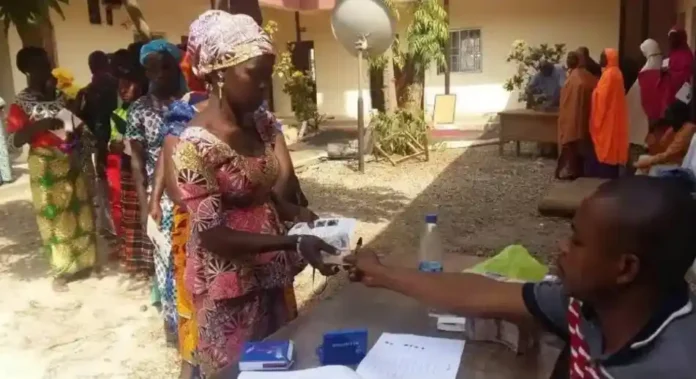
The Federal Government has disclosed that not all of the 17.9 million vulnerable households captured in the National Social Register will benefit from the ongoing conditional cash transfer programme being implemented in partnership with the World Bank to cushion economic shocks.
The Minister of Humanitarian Affairs and Poverty Reduction, Dr Bernard Doro, made this known during an interview on Arise Television on Friday. He explained that although millions of households have been identified as vulnerable across the country, not all of them qualify for direct financial support under the current programme.
According to him, “We are currently offering conditional cash assistance in conjunction with the World Bank, but this money is actually meant as a shock response. And so not everyone within the 17.9 million households in the register is in the Benefit Register. The Benefit Register is around 15 million vulnerable households.”
Doro stated that the National Social Register currently contains about 17.9 million vulnerable households identified through community-based assessments and socio-economic data. He stressed that beneficiaries for specific interventions are selected separately based on the objectives of each programme.
He noted that the conditional cash assistance is designed as a temporary relief measure for households facing economic hardship and is not meant to serve as a universal payment for everyone listed in the broader social register.
The minister had earlier disclosed that about 70 million Nigerians have been captured as vulnerable persons in the National Social Register as part of efforts to drive targeted poverty reduction interventions. He explained that the 70 million individuals translate to approximately 17.9 million vulnerable households currently identified nationwide.
He said, “Every poor person at the moment in the country that has been captured because the target started with the poorest of the poor. At the moment we have about 17.9 million vulnerable households that have been captured in the register, which translates to around 70 million individuals in that register. We are continuing to expand the register to capture as many people as possible.”
Doro explained that the register focuses on identifying the poorest of the poor through community engagement and socio-economic assessments. He noted that local communities play a key role in identifying vulnerable individuals within their areas.
According to him, “Communities will guide us based on the questions that we have and the criteria that we have to be able to identify who is poor amongst them. And then we take steps also to validate these when we visit their homes, we look at the condition of the homes, we also look at their own personal data and we use this to be able to target who is the poorest of the poor.”
He clarified that being listed in the National Social Register does not automatically qualify a household for financial support. He said beneficiaries are selected through a separate Benefit Register depending on the programme being implemented.
“Our desire is to ensure that every Nigerian is captured in the National Social Register. And just for context, there is a difference between the National Social Register and the Benefit Register. So when programmes are planned, you then target individuals based on the nature of the programme that you are delivering,” he added.
The minister further stated that the Federal Government will continue expanding the National Social Register while ensuring that targeted interventions reach those most affected by economic shocks and vulnerabilities.

