

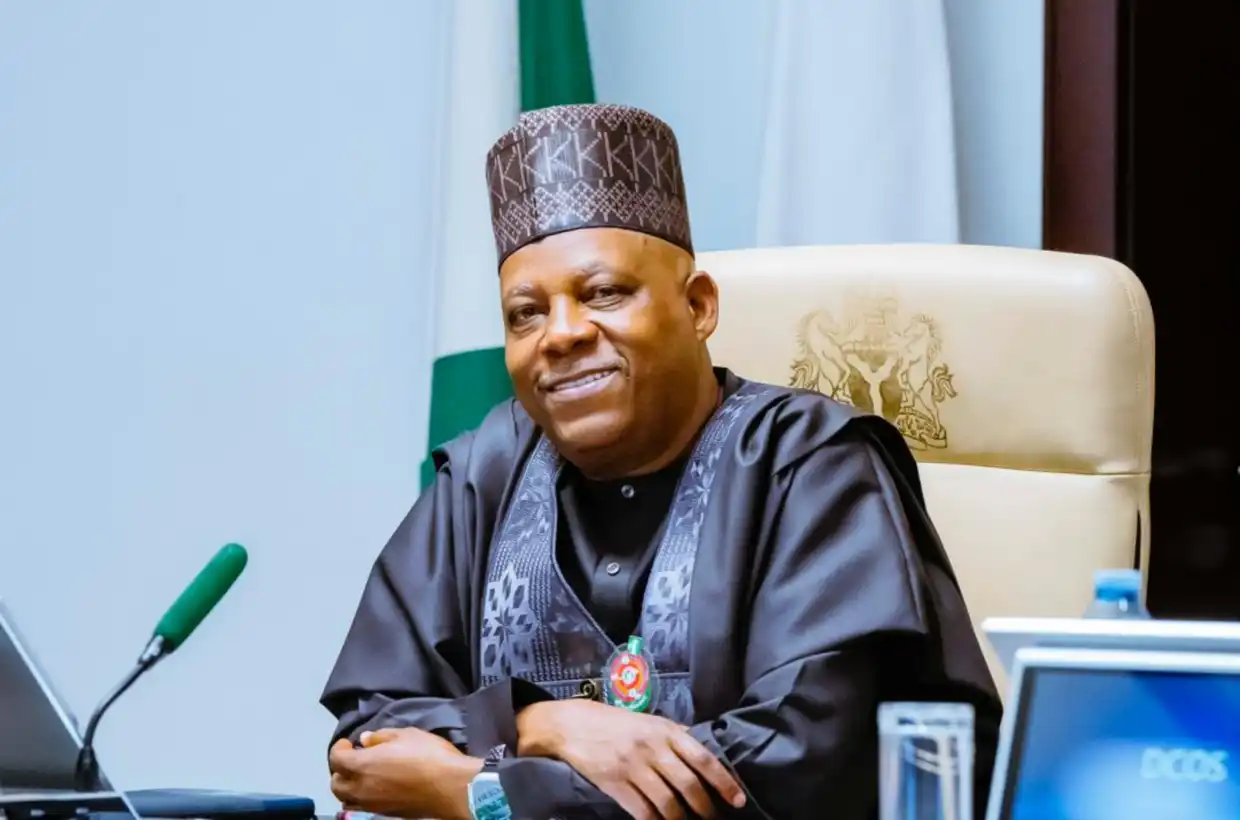
Nigeria’s education sector received another major push as the Federal Government increased the 2025 budget for the Ministry of Education to ₦3.52 trillion, rising sharply from ₦1.54 trillion in 2023. Vice President Kashim Shettima announced the figures on Tuesday in Abuja, describing the situation of out-of-school children as a national emergency that demands immediate and united action from both government and private-sector stakeholders.
Speaking at the opening of the 2025 Nigeria Education Forum, VP Shettima, who was represented by the Special Adviser to the President on General Duties (Office of the Vice President), Dr. Aliyu Modibo Umar, said the administration of President Bola Ahmed Tinubu has demonstrated an unwavering commitment to building an enlightened and globally competitive population through increased education spending. The event was organised by the Nigeria Governors’ Forum, the Federal Ministry of Education, and the Committee of States’ Commissioners of Education, and focused on the theme Pathways to Sustainable Education Financing: Developing a Synergy Between Town and Gown in Nigeria.
Senator Shettima highlighted the broader national implications of weak education systems, saying, “Nothing threatens a civilisation more than an uneducated generation. Nations rise when the people, regardless of circumstance, are equipped with the knowledge to imagine a better future and the skills to build it.” He explained that Nigeria has reached a critical inflection point where traditional government-only funding models can no longer meet the country’s growing educational needs, stressing the importance of a transition toward collaborative, innovative, and resilient financing structures.
According to him, “The burden cannot rest on government alone. We must enlist private sector actors, industry leaders, alumni networks, philanthropists, and communities to co-invest in laboratories, research centres, vocational hubs, innovation clusters, and endowment funds.” He noted that this approach is central to ensuring a sustainable and responsive education system under the Renewed Hope plan.
Providing details on the administration’s investments, VP Shettima said the Tertiary Education Trust Fund budget rose from ₦320.3 billion in 2023 to ₦683.4 billion in 2024, and has climbed to ₦1.6 trillion in 2025. He added that the Universal Basic Education Commission distributed ₦92.4 billion in matching grants to 25 states and the Federal Capital Territory. Another ₦19 billion supported teacher development programmes across 32 states and the FCT, while ₦1.5 billion went directly to more than 1,147 communities. He also stated that UBE grants to individual states have increased from about ₦1.3 billion to over ₦3.3 billion, enabling states to access more than ₦6.6 billion through counterpart funding.
The Vice President further explained the progress of the Nigerian Education Loan Fund, a new initiative created under the Student Loans Act of 2024. He said NELFUND has already disbursed ₦86.3 billion to more than 450,000 students in 218 tertiary institutions nationwide. According to him, “This Fund signals a new era where no Nigerian is denied tertiary education for lack of money.”
He added that solving the learning crisis also requires improving learning environments and strengthening teacher welfare. “The learning crisis cannot be solved without safe and well-equipped schools, from basic classrooms to technical laboratories. Teachers must enjoy adequate training, welfare, and professional recognition if they are to deliver the outcomes our children deserve.”
Shettima called for stronger collaboration across all levels of government, urging local governments and traditional institutions to support school infrastructure, maintenance, security, and teacher welfare. He concluded by saying, “We are here today because we do not treat education as just a line item in the national budget. We treat it as the foundation of our national identity, the engine of our economic transformation, and the shield of our collective security.”

