

The federal government has restated its commitment to increasing agricultural productivity, improving livelihood opportunities, and promoting wealth creation across Nigeria.
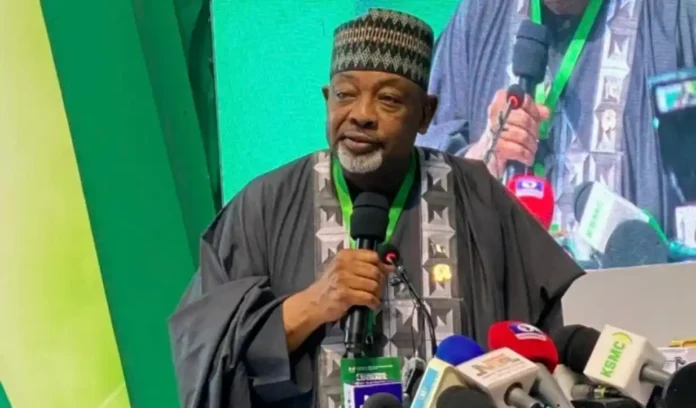
Abubakar Kyari, the minister of agriculture and food security, made this known on Tuesday during the ministerial sectoral retreat themed “Performance Improvement and Strategic Alignment” held in Abuja.
Kyari said that agricultural transformation through strategic leadership was aimed at enhancing agricultural development and ensuring food security in the country. He recalled that President Bola Tinubu, at the beginning of his administration, declared a state of emergency in the agricultural sector to allow the Council of State to include water and food as high-priority areas.
“It is to make us transit from subsistence to a commercial farming system, since food sufficiency contributes to national sovereignty and stability,” Kyari stated.
He explained that the ministry was collaborating with several international partners to secure funding and technical expertise to support its agricultural programs. According to him, the government’s ongoing efforts are focused on ensuring farmers’ safety, managing agricultural landscapes, providing rural infrastructure, and promoting research and innovation.
“Our Ministry is committed to leveraging technology, innovation and climate-smart agriculture to boost productivity and resilience. We are also delivering the National Food Reserve Programme of mopping-up excess production, balancing price volatility and enabling farm output,” he said.
Kyari further disclosed that both the federal and state governments are partnering with Belarus Messrs, John Deere, and Brazil to manufacture agricultural machinery that would help close the tractorisation gap in Nigeria.
“In this respect, we are collaborating with stakeholders to stimulate and accelerate the production and processing of leading agricultural commodities. Let us recommit to our mission to feed Nigeria, create jobs and drive economic growth through sustainable agriculture,” the minister added.
He emphasized the need to make farming more competitive, highlighting the importance of agricultural production, industrial integration, and profitable agribusiness. Kyari also encouraged the culture of “Eating What We Produce and Producing What We Eat,” stressing the importance of self-reliance in food production.
In his remarks, Aliyu Abdullahi, the minister of state for agriculture and food security, explained that the retreat was designed to enhance capacity building, research, and innovation within the sector.
“The central aim of the ministry is to promote sustainable agriculture and achieve food security in Nigeria. The directorate cadre is pivotal in advancing this agenda,” Abdullahi said.
Earlier, Marcus Ogunbiyi, the permanent secretary of the ministry, described the retreat as both timely and strategic. He said the event provided an opportunity for reflection and strategic repositioning of the ministry and its agencies to ensure greater effectiveness in fulfilling their mandate.
In a goodwill message, Didi Esther Walson-Jack, head of the civil service of the federation (HoCSF), stated that the theme of the retreat reflected the core values of the Federal Civil Service.
She noted that agriculture remains a key driver of food security and economic growth in Nigeria. Walson-Jack was represented at the event by Alfred Abah, the senior special assistant to President Tinubu on civil service matters.

