

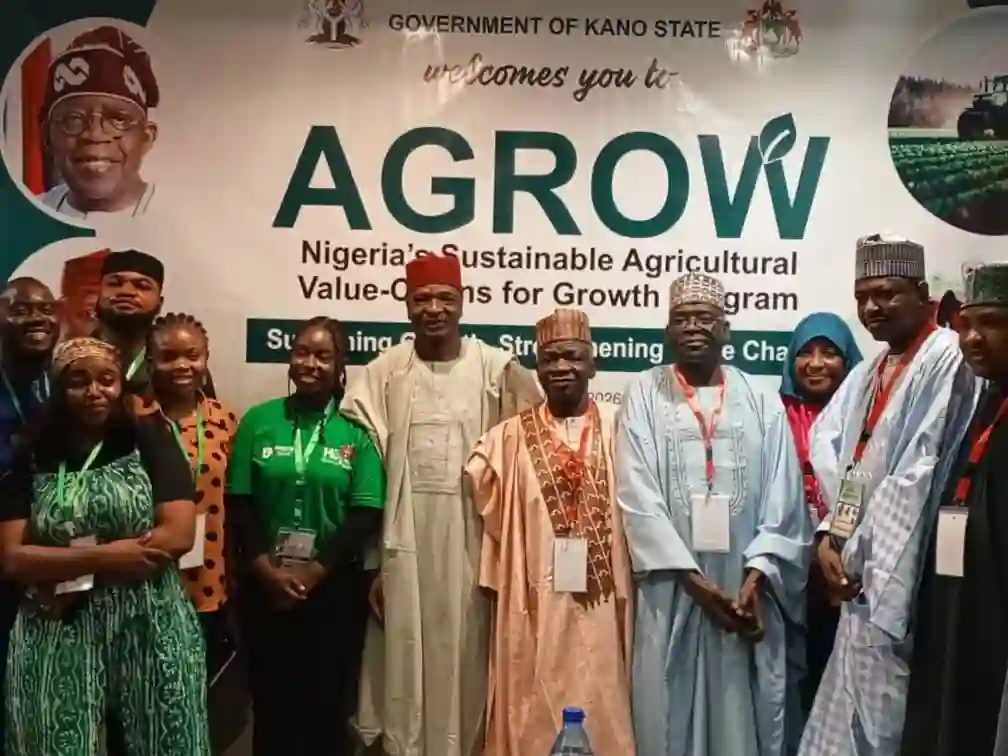
The Federal Government has said that the $500 million Agricultural Value Chains for Growth Programme (AGROW) will directly support farmers through modern, market-based and farmer-driven initiatives designed to boost food production and strengthen food security.
The Manager, Research, Data and Impact Assessment at the Presidential Food Systems Coordinating Unit (PFSCU), Mr. Eniola Akindele, stated this during the AGROW Agroecological Zonal Workshop held in Kano under the Nigeria Sustainable Agricultural Value Chains for Growth Programme.
Akindele said the government is committed to ensuring that farmers play an active role in shaping agricultural policies. He explained that the current administration is adopting a farmer-driven, market-oriented and results-based approach to agriculture that prioritises real field experiences over top-down decision-making.
According to him, AGROW focuses on key value chains such as rice, wheat, tomato, sesame and sorghum, describing them as essential to Nigeria’s food security and economic growth. He said the $500 million initiative is homegrown and led by Nigeria, developed jointly by the three tiers of government, and supported by private sector players and development partners with technical input from the World Bank.
He said previous agricultural programmes were weakened by fragmented public spending, blanket input subsidies, government-controlled implementation, weak land systems and numerous informal trade levies. The new AGROW framework, he explained, will address these challenges by promoting state-level support, targeted investment and financial incentives linked to market outcomes.
Other key areas include encouraging private sector participation, improving land administration transparency and ensuring smooth interstate agricultural trade.
Akindele said the programme will operate through three major components: stronger private sector linkages with smallholder farmers, modernised on-farm production systems and an effective monitoring and evaluation mechanism for projects.
He also outlined criteria for states to qualify for AGROW, including transparent land-based investment processes, digital farmer registries, openness in interstate trade levies, reduced dependence on subsidies and better support for agricultural cooperatives.
In his remarks, the Permanent Secretary of the Kano State Ministry of Agriculture and Natural Resources, Alhaji Bashir Sunusi, said the workshop supports the state’s goal of enhancing agricultural productivity.
He announced that Kano has recruited 1,038 agricultural extension workers, provided tractors and power tillers, and established three mechanisation centres in Gaya, Dambatta and Kadawa.
Participants were drawn from Sudan Savannah states including Kano, Katsina, Bauchi, Gombe, Kebbi, Sokoto and Zamfara.

