

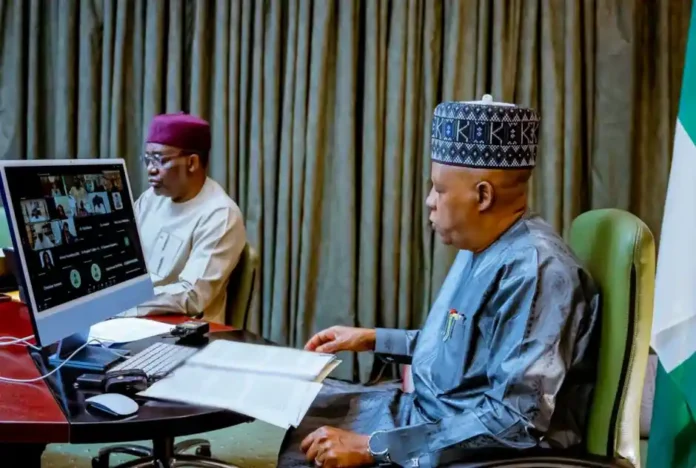
The Federal Government, led by Kashim Shettima, has created a special committee to design a clear plan for how Nigeria will properly fund nutrition programmes across the country.
The committee was set up by the National Council on Nutrition (NCN) during its recent meeting, where leaders discussed the urgent need for stronger financial support for nutrition interventions. The council resolved that without a clear funding structure, many policies aimed at improving nutrition outcomes in Nigeria may fail to produce real impact.
The newly created body, known as the Nutrition Financing Subcommittee, has been given the responsibility of developing a roadmap that will guide how nutrition programmes are funded, monitored, and implemented. The committee has been asked to deliver its financing framework within 30 days.
The subcommittee is chaired by the Coordinating Minister of Health and Social Welfare, Muhammad Ali Pate, and includes representatives from several key ministries. These include the Ministries of Education, Water Resources, Women Affairs, and Science and Technology, alongside senior officials from the Presidency.
The Federal Ministry of Budget and Economic Planning will serve as the secretariat of the committee, helping coordinate its work and ensuring that the financing framework aligns with national economic priorities.
Vice President Shettima explained that the creation of the committee reflects the government’s determination to close the gap between policy commitments and actual improvements in the lives of Nigerians.
“Council recognizes the importance of establishing a strong legal and institutional framework to sustain coordination, financing, and accountability across sectors,” Shettima said.
He stressed that the success of Nigeria’s nutrition strategy will depend largely on how well programmes are financed and monitored.
According to him, the major challenge facing the sector is no longer awareness but proper funding and accountability.
“The central reform issue before us is financing, not as theory, but as execution,” the Vice President stated.
He emphasized that funding commitments must go beyond paper allocations in government budgets.
“Budgeting without release is not financing. Allocation without predictability is not reform. Nutrition must be protected,” he said.
The Vice President also called for “ring-fencing” funds allocated for nutrition programmes. Ring-fencing means protecting the money so it cannot be diverted to other projects.
According to Shettima, this is necessary to ensure that nutrition funding is not lost within complex government spending systems.
“Without ring-fencing nutrition financing, the gap between promises made and lives changed will continue to widen,” he said.
The committee’s work will also involve tracking how funds are spent across ministries, departments, agencies, and state governments.
Shettima stressed that government institutions must be able to account for how every naira allocated for nutrition programmes is used.
“There must be clarity on how funds are budgeted, released, ring-fenced, and tracked,” he noted.
He added that government agencies must be responsible not only for spending funds but also for delivering measurable results.
“Every MDA must now account not just for figures on paper but for measurable changes in the lives of Nigerians,” the Vice President said.
In addition to federal institutions, the committee will also engage development partners and private sector organizations to strengthen financing for nutrition programmes.
Among the partners expected to support the initiative is the Aliko Dangote Foundation, a major philanthropic organization that has been involved in several health and nutrition projects in Nigeria.
The NCN believes that partnerships with organizations like the UNICEF and other development agencies will help close funding gaps and accelerate implementation of key programmes.
One of the programmes highlighted during the meeting was the Accelerating Nutrition Results in Nigeria (ANRiN) 2.0 project. The programme focuses on improving nutrition services in states with high rates of malnutrition.
The Vice President urged state governments to take urgent steps to ensure that funds allocated to such programmes are used effectively.
“State governors must fast-track the necessary actions at the state level to ensure timely implementation and effective utilization of the available resources,” he said.
Shettima also noted that improving nutrition outcomes requires strong participation from communities and local institutions.
“If our efforts are to succeed, they must not stop at the federal level,” he explained.
“Nutrition outcomes are ultimately determined within households and communities. This requires stronger subnational ownership and deeper grassroots engagement.”
The council emphasized that state governments, local government authorities, community leaders, and frontline workers must all play active roles in implementing nutrition programmes.
Another major focus of the government’s strategy is ensuring that women are placed at the center of nutrition planning and decision-making.
The Vice President said women play a critical role in household nutrition, childcare, and food systems, making their involvement essential for long-term success.
“Women must remain at the center of these efforts because they are the backbone of household nutrition, childcare, and food systems,” he said.
Shettima added that women’s voices must be fully integrated into policy planning and programme implementation.
“Their voices, leadership, and participation must be fully integrated into planning, decision-making, and programme delivery.”
During the meeting, members of the council also reviewed reports on Nigeria’s national nutrition budgeting outlook, which highlighted progress made so far and areas where funding gaps still exist.
Officials were informed that several states have already begun strengthening their nutrition governance systems through the establishment of State Councils on Nutrition.
States that have inaugurated their councils include Abia State, Adamawa State, Borno State, Cross River State, Jigawa State, Plateau State, Rivers State, Yobe State, and Zamfara State.
More states are expected to follow as the federal government expands the Nutrition 774 initiative, which aims to deliver nutrition interventions across all 774 local government areas in Nigeria.
Officials also recommended stronger collaboration among ministries that work on nutrition-related programmes. This includes aligning priorities and setting measurable targets for ministries involved in health, food systems, education, and social welfare.
The Minister of Education, Morufu Tunji Alausa, also supported the push for a structured financing model.
He recommended the creation of a sustainable funding structure that would support the Federal Government’s long-term nutrition strategy and ensure that interventions continue to receive adequate funding.
Through the newly established committee, the Federal Government hopes to develop a reliable financing framework that will ensure nutrition programmes are properly funded, effectively implemented, and closely monitored across Nigeria.

