

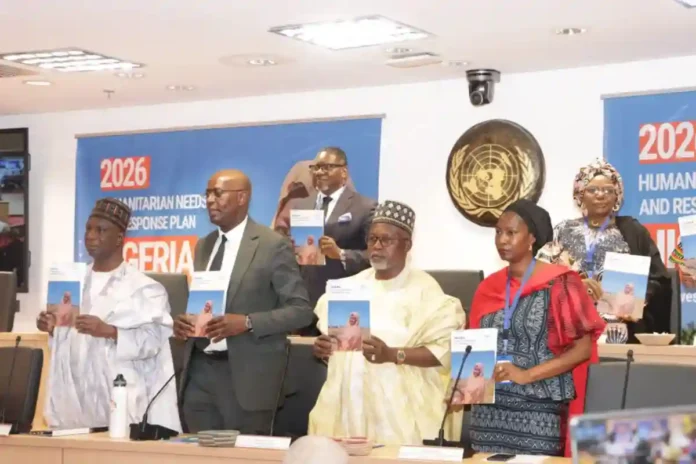
Millions of Nigerians affected by conflict, food insecurity and climate shocks could see a shift in how aid reaches them as the Federal Government unveiled the 2026 Nigeria Humanitarian Needs and Response Plan in Abuja, signalling a move away from repeated emergency interventions toward longer-term solutions.
The Government of Nigeria said it has taken full leadership and ownership of humanitarian coordination and response within the country, a decision that shaped the direction of the 2026 Nigeria Humanitarian Needs and Response Plan. The plan reflects a shared commitment to prioritise prevention, resilience, recovery and sustainable solutions in line with national policies and development objectives.
The Honourable Minister of Humanitarian Affairs and Poverty Reduction, Dr. Bernard M. Doro, made this known at the official launch of the 2026 plan at the UN House Auditorium in Abuja. He was represented at the event by the Honourable Minister of State in the ministry, Dr. Yusuf Tanko Sununu.
According to the minister, humanitarian action has continued to play a critical role in reducing the impact of conflict, climate shocks, displacement and food insecurity across the country, particularly in Borno, Adamawa and Yobe States, where communities remain highly vulnerable.
He explained that one of the major policy shifts under the Renewed Hope Agenda is the strong emphasis on prevention and preparedness. This, he said, requires Nigeria to address underlying risks, strengthen early warning systems, adopt risk-informed planning and take anticipatory action before crises escalate.
Dr. Doro noted that through the Federal Ministry of Humanitarian Affairs and Poverty Reduction, the government would continue to provide policy direction, coordination and leadership to ensure humanitarian efforts align with broader national reforms. These reforms, he said, are aimed at reducing poverty, strengthening human capital and building resilient communities.
He added that localisation remains a core priority of the government, stressing that Nigerian institutions, civil society organisations, community structures, as well as women-led and youth-led groups, are central to effective humanitarian response and lasting recovery.
Earlier, the United Nations Resident and Humanitarian Coordinator, Mr. Mohammed Malick Fall, described the 2026 plan as a collective commitment to address urgent humanitarian needs while strengthening coordination, accountability and overall impact.
Mr. Fall said insecurity across Nigeria continues to deepen vulnerability and restrict access to lifesaving assistance, noting that about two million people remain internally displaced and unable to return to their homes due to ongoing violence.
He further explained that widespread insecurity has disrupted agricultural activities, severely affecting livelihoods and contributing to rising food insecurity. Climate change, he added, is worsening humanitarian needs nationwide by intensifying floods, droughts and other shocks that disproportionately affect the most vulnerable communities.
The highlight of the event was the formal launch of the 2026 Nigeria Humanitarian Needs and Response Plan. Other dignitaries present included representatives of the Yobe and Adamawa State governors, the Executive Director of Sirri Care Foundation, the Director of the Nigeria INGO Forum, Mr. Ndubisi Anyanwu, and members of the press.
Read Also: Apply: Sakharov Fellowship Programme 2026

