

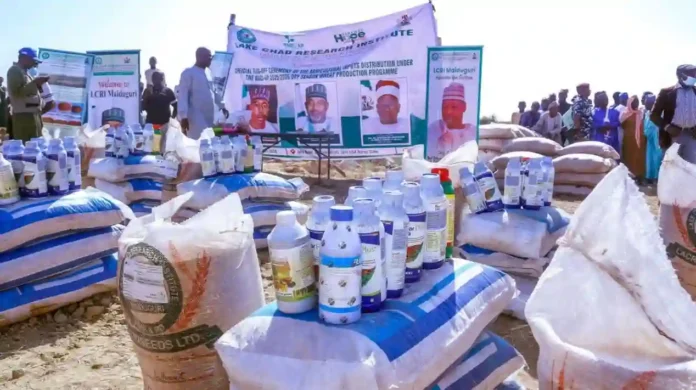
The federal government has announced plans to generate an output value of about N160 billion from wheat production during the 2025/2026 dry season, as part of efforts to strengthen food sovereignty and reduce reliance on imported grains.
The Minister of Agriculture and Food Security, Sen. Abubakar Kyari, disclosed this at the flag-off of the Subsidised Agricultural Inputs Distribution for the 2025/2026 dry season wheat production programme under the National Agricultural Growth and Agro Pocket Project, NAGS-AP, held in Jere Local Government Area of Borno State in Northeastern Nigeria.
Kyari explained that through the NAGS-AP programme, 40,000 hectares of land have been earmarked nationwide for dry season wheat production, while 80,000 farmers have been registered for the current season, with an expected output value of approximately ₦160 billion.
He said that of the total land set aside, 3,000 hectares were allocated to Borno State, with 6,000 registered wheat farmers expected to participate in the programme across the state.
Recalling achievements from previous seasons, the minister said, “Under the 2023/2024 dry season wheat production programme, a total of 107,429 registered farmers were supported with critical subsidised inputs, resulting in an output valued at ₦474,628,000 billion. During the 2024/2025 dry season, 279,297 registered farmers received support, with an output valued at ₦893,750,004 billion.”
He noted that “for the current 2025/2026 season, the programme is targeting 80,000 registered farmers with an expected output value of approximately ₦160 billion,” adding that the focus remains on improving productivity and farmer income.
Kyari stated that the NAGS-AP programme would deploy Agricultural Extension Agents to guide farmers on modern agronomic practices and provide continuous advisory services at the field level throughout the production cycle.
He added that “Fertiliser and Seed Quality Control Officers will be mobilised to ensure that all inputs delivered to farmers meet the required standards, thereby guaranteeing higher productivity and improved yields.”
According to the minister, “the wheat component of the NAGSAP programme covers sixteen states of the federation,” listing Adamawa, Bauchi, Borno, Cross River, Gombe, Kaduna, Kano, Kebbi, Niger, Plateau, Sokoto, Taraba, Yobe, and Zamfara.
He explained that the inclusion of Cross River State in the previous year marked the first expansion of wheat production into the southern region, strengthening national capacity to diversify production across different ecological zones.
Kyari further pointed out that the project was designed to promote inclusion, noting that women and young people were key beneficiaries of the programme’s training and agricultural opportunities.
“NAGS- AP is deliberately designed to leave no one behind. The programme ensures that farmers across communities, including women and young people who play vital roles in our agricultural workforce, have equitable access to inputs, training, and opportunities,” he said.
The minister stressed that input quality remained central to the success of the programme, stating that “the success of any agricultural season depends on the quality of inputs that reach our farmers.”
He said, “Without certified seeds, accurate fertiliser blends, and timely access to crop protection products, no level of effort in the field can deliver the yields we require as a nation.”
“This is why NAGS- AP places strong emphasis on input quality, traceability, and transparent delivery systems, ensuring that every farmer receives the right inputs at the right time to achieve higher productivity and better returns,” Kyari added.
In his remarks, the Governor of Borno State, Prof. Babagana Zulum, appreciated the federal government for its continued support for irrigation development and agricultural growth.
He stated that “Mr President’s commitment to food security and national productivity provides the foundation upon which programmes like this are built.”
Zulum noted that “Borno State, with its vast arable and irrigable land, especially within the Lake Chad Basin, remains one of Nigeria’s most promising agricultural frontiers.”
He said the event symbolised progress, adding, “Today is more than a ceremony; it is a celebration of hope, resilience, and our unwavering commitment to ensuring that no family in Borno State goes hungry and no farmer is left behind.”
Despite challenges such as displacement, insecurity, and climate shocks, the governor said the state remained committed to growing its own food and empowering farmers.
Zulum reaffirmed his administration’s commitment to sustaining all-season farming through the provision of infrastructure, logistics, modern machinery, improved seeds, fertilisers, agrochemicals, and other essential inputs.
He added that “Borno State has achieved remarkable milestones under our people-centred agricultural vision,” noting that input support programmes had reached thousands of smallholder farmers.

