

 Add us on Google
The Federal Government has reaffirmed its commitment to transforming Nigeria into an upper middle-income country by 2050, as it advances work on the Medium-Term National Development Plan 2026–2030.
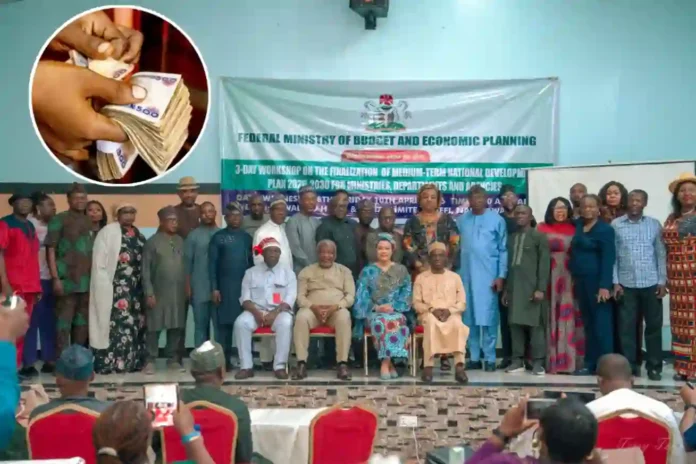
The Minister of State for Budget and Economic Planning, Doris Uzoka-Anite, disclosed this during the opening of a three-day workshop for Ministries, Departments and Agencies held in Keffi, Nasarawa State.
She said the plan forms a critical part of the implementation framework for the Nigeria Agenda 2050, the country’s long-term development blueprint. According to her, the initiative is designed to reposition Nigeria from a low-income to an upper middle-income economy within the next 25 years.
Uzoka-Anite explained that the ongoing process involves the active participation of MDAs, providing them with the opportunity to review sectoral contributions, update relevant data, and align their programmes with national priorities. She stressed that such coordination is essential to achieving measurable outcomes.
The minister urged stakeholders to adopt a results-driven approach by setting realistic targets and designing policies and programmes capable of delivering timely results. She added that Nigeria must leverage its vast natural resources alongside shifting global geopolitical and economic trends to strengthen domestic production, boost consumption, and improve citizens’ welfare.
In her remarks, the Permanent Secretary of the ministry, Deborah Odoh, described the workshop as part of broader efforts to strengthen institutional capacity and improve coordination across government agencies.
She noted that the current National Development Plan 2021–2025, aligned with the Renewed Hope Agenda of President Bola Ahmed Tinubu, provides a foundation for sustainable and inclusive growth. According to her, the ongoing engagement is aimed at ensuring that the next phase of planning builds on existing progress.
Odoh added that the workshop specifically targets Planning, Research and Statistics Departments of MDAs, enabling them to finalise inputs into the 2026–2030 plan while ensuring coherence, accuracy, and alignment with national objectives.
Also speaking, the Director of Plans and Projects, Onyemaechi Kwujeli, said the document was in its final stage and reflects key priorities of the Renewed Hope Agenda, including the ambition of achieving a $1tn economy by 2030.
He explained that the plan is the second in a series of six medium-term strategies designed to drive the Nigeria Agenda 2050, with a focus on attaining double-digit economic growth and significantly expanding the nation’s economic base.
Kwujeli added that the workshop would guide MDAs in structuring sectoral inputs, agreeing on policy initiatives, and defining performance indicators to ensure a comprehensive and implementable national plan.

