

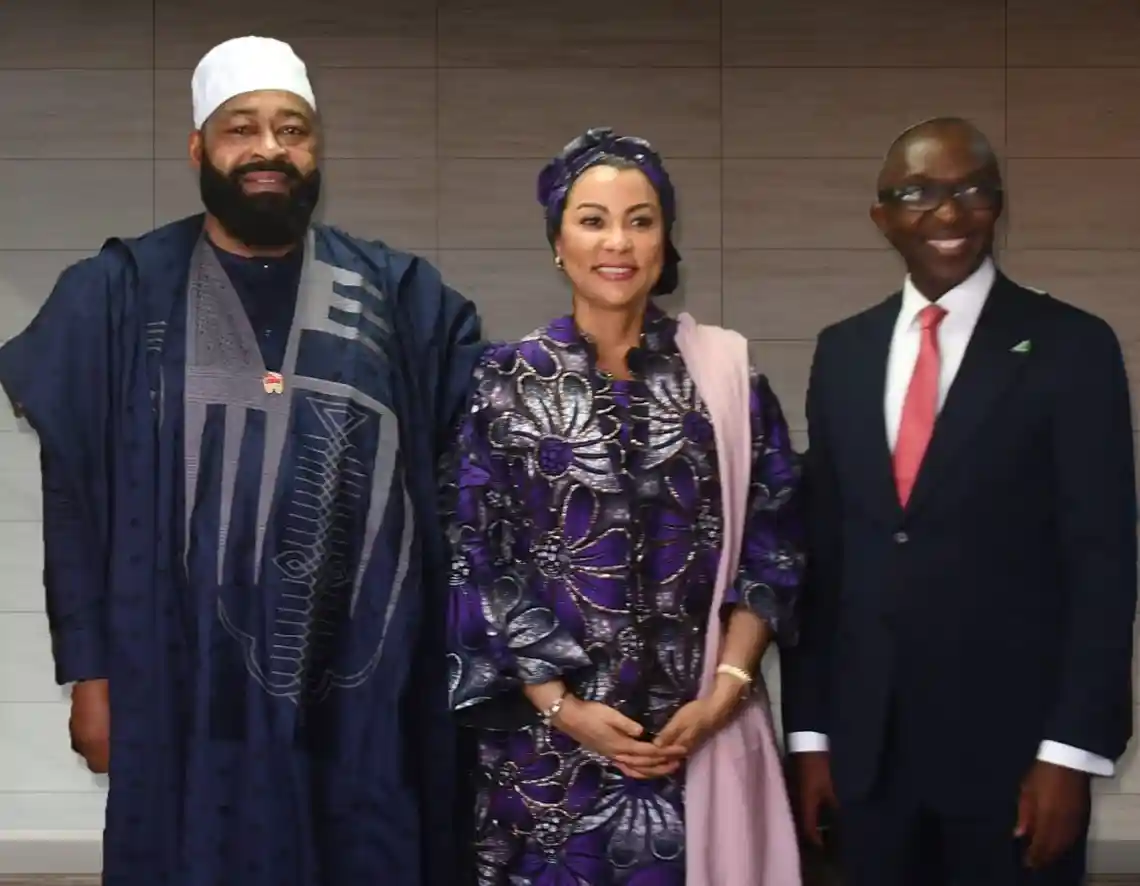
The Federal Government has partnered with the Niger State Government to build organised settlements that will link farmers directly to large-scale agriculture. The partnership was formalised through the signing of a Memorandum of Understanding between the Niger State Government and the Ministry of Finance Incorporated, with the Federal Ministry of Finance anchoring the agreement for the implementation of a Mass Housing and Agricultural Settlement Project in Niger State.
The MoU signing sets the policy and operational framework for the project, which combines housing development with agricultural production and rural infrastructure. The agreement outlines how federal and state institutions, working with private sector partners, will collaborate to deliver planned settlements designed to support farmers and improve agricultural productivity.
Speaking at the MoU signing ceremony, the Honourable Minister of State for Finance, Dr. Doris Nkiruka Uzoka-Anite, described the agreement as a landmark initiative. She said it underscores the Federal Government’s commitment to cooperative federalism, inclusive economic growth, and strategic alignment with President Bola Ahmed Tinubu’s Renewed Hope Agenda.
With the Federal Ministry of Finance serving as the anchor institution, the project is expected to benefit from strong policy coordination, financial credibility, and institutional oversight. According to the Minister, this arrangement is intended to ensure that the initiative is effectively guided from the agreement stage through implementation and delivery.
Dr. Uzoka-Anite explained that the project is designed to integrate housing delivery with agricultural productivity, rural stability, and economic empowerment. She noted that in Niger State, housing challenges are closely linked to agricultural outcomes, food security, and rural livelihoods.
“Housing is a fundamental pillar of development. In Niger State, housing also intersects directly with agriculture, food security, and rural livelihoods. This project is therefore structured not merely as a housing intervention, but as a settlement framework for farmers aimed at strengthening agricultural value chains,” the Minister stated.
Niger State is one of Nigeria’s most agriculturally endowed states, with vast arable land and a large farming population. Despite this advantage, the state continues to face challenges such as insecure settlements, rural-urban migration, and limited rural infrastructure. These factors have constrained productivity and affected the sustainability of farming communities.
The Mass Housing and Agricultural Settlement Project seeks to address these challenges by providing secure and well-planned housing settlements for farmers. The settlements are to be strategically located to support agricultural production, storage, processing, and access to markets, enabling farmers to live and work within organised communities.
The Honourable Minister emphasised that anchoring farmers in stable communities with access to basic infrastructure would improve productivity and reduce post-harvest losses. She added that improved security and living conditions would encourage youth participation in agriculture and make farming more efficient, attractive, and profitable.
Sustainability and affordability were highlighted as core pillars of the initiative. The project will include integrated renewable energy solutions, such as solar-powered homes and community facilities. These solutions are intended to ensure reliable power supply, reduce energy costs, and support agro-processing and storage activities within the settlements.
In addition to renewable energy, the project will prioritise efficient land use, access roads, water infrastructure, and environmentally responsible building practices. These elements are designed to support long-term functionality and improve the quality of life in rural communities.
Reacting to the sustainability focus of the project, the Governor of Niger State, Mohammed Umaru Bago, expressed optimism about its transformative impact. He said affordability is central to sustainability and welcomed the emphasis on renewable energy solutions.
“When you say sustainability, affordability is very important. When I heard that a mini-grid has been deployed in Jos, it’s because it’s affordable. Diesel is not sustainable because it’s not affordable. For considering the factor of affordability in this project, we’re grateful,” the Governor said.
Governor Bago also announced the state’s commitment to the project by providing land for its implementation. He disclosed that Niger State has made available 100,000 hectares of land to support the housing and agricultural settlements.
“So, Honourable Minister, Niger State is bringing forward 100,000 hectares of land for this project. I want to assure you that with this initiative, you have solved 80 percent of our problems,” he said.
Drawing a direct link to the Federal Government’s development agenda, the Governor said the project aligns with the goal of transitioning citizens from poverty to prosperity. He noted that structured development and investment have helped other societies achieve economic growth.
“We’ve gone across the world and seen how people transit from poverty to prosperity. And I think the goal of the President, my father, is for us to transition our people out of poverty in the next four years, by the grace of God,” Governor Bago added.
The Managing Director and Chief Executive Officer of the Ministry of Finance Incorporated, Dr. Armstrong Ume Takang, also addressed stakeholders at the ceremony. He attended alongside other critical stakeholders, including the building contractor, and reaffirmed MOFI’s commitment to quality delivery and agricultural productivity.
Dr. Takang assured the Niger State Government of the contractor’s competence and credibility in delivering mass housing projects. He stressed that affordability would not result in compromised standards.
“We want affordable and decent houses. The fact that they are located in rural communities does not mean the quality should be compromised,” he said.
Beyond housing delivery, Dr. Takang highlighted MOFI’s role in strengthening the agricultural component of the settlements through partnerships. He said arrangements are being made to ensure farmers have access to essential agricultural inputs.
“We have partners who will supply affordable fertilisers imported in large quantities. We will also work with other partners to ensure access to key agricultural inputs, not only fertilisers, but also pesticides, high-quality seeds, and elements of mechanisation,” he added.
The project adopts an innovative financing model that blends public assets with private investment. This model is designed to ensure sustainability, transparency, and shared risk, while allowing government to focus on policy direction and oversight and leverage private sector efficiency and capital.
Beyond improving food security, the Mass Housing and Agricultural Settlement Project is expected to stimulate economic activity and generate employment across construction, agriculture, agro-processing, renewable energy, logistics, and community services. The initiative is also expected to support local industries such as cement, steel, transportation, and agro-allied enterprises.
Affordability and inclusiveness remain central to the project’s design. The settlements are tailored to the income realities of farmers and low- to middle-income earners, supported by transparent allocation mechanisms and governance structures to ensure benefits reach the intended beneficiaries.
The MoU sends a signal to the investment community that Niger State, working in alignment with the Federal Ministry of Finance and MOFI, is open to credible and impact-driven investment. Reaffirming federal commitment, the Honourable Minister assured stakeholders of continued coordination, fiscal discipline, and policy support to ensure the project moves from signing to execution and delivery.
“Through this partnership, we are not just building houses; we are creating stable farming communities, strengthening food security, and laying the foundation for sustained prosperity in Niger State,” she said.

