

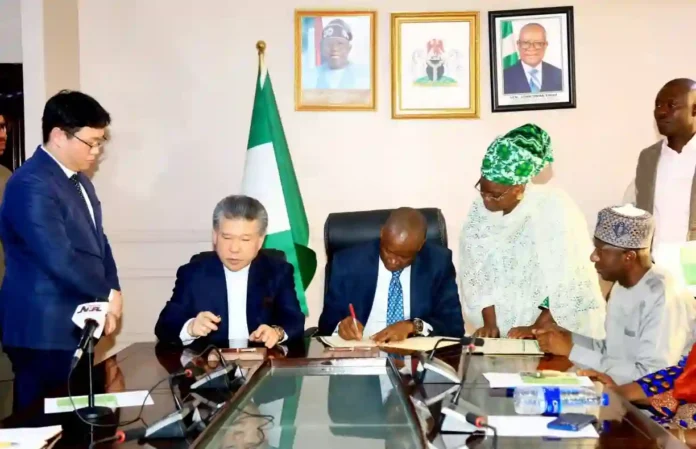
The Federal Government is set to create about 10,000 direct and indirect jobs for Nigerians following a major agreement on electric vehicle manufacturing signed in Abuja. Nigeria is expected to become Africa’s first electric vehicle manufacturing nation and one of the leading automotive manufacturing countries globally through the initiative.
On January 30, 2026, the Federal Government, through the office of the Hon. Minister of State for Industry under the Federal Ministry of Industry, Trade and Investment (FMITI), signed a memorandum of understanding with South Korea’s Asia Economic Development Committee (AEDC). The agreement covers the establishment of an Electric Vehicle (EV) manufacturing plant and the development of charging infrastructure across Nigeria.
According to officials, the MoU aligns with the Federal Government’s National Energy Transition Plan (ETP) and the National Automotive Industry Development Plan (NAIDP). These policies are designed to build a strong ecosystem for EV infrastructure development, expansion, and adoption, while supporting cleaner energy use and local industrial growth.
The project will be implemented in phases. Phase I will focus on building a complete EV assembly plant, while phase II will involve the establishment of facilities capable of full in-house production. When completed, the plant is expected to have a production capacity of 300,000 vehicles annually. The scale of production is also projected to generate about 10,000 jobs nationwide.
Government officials said the economic benefits of the initiative are significant. Increased EV adoption is expected to reduce the estimated $10 billion Nigeria spends each year on refined fuel imports. The project is also expected to stimulate nationwide economic growth through the expansion of related industries such as auto parts manufacturing, charging infrastructure deployment, and vehicle maintenance services.
Speaking at the signing, the AEDC Chairman, Yoon Suk Hun, expressed strong commitment to the partnership and the long-term development of Nigeria’s automotive industry. “We will devote all of our capabilities to ensuring that Nigeria’s EV industry is built in the most economically viable manner and operated with maximum efficiency, while achieving global competitiveness,” he said. He added, “Drawing on Korea’s spirit and development experience, our goal is to elevate Nigeria’s automotive industry to world-class standards within 20 to 30 years, an achievement that took advanced economies 150 years and Korea 60 years to accomplish.”
The Minister of State for Industry, FMITI, Senator John Owan Enoh, pledged to work closely with AEDC to ensure the rapid completion of Africa’s first advanced, world-class EV manufacturing plant. He affirmed that the Federal Government would provide full cooperation and mobilize all available resources to ensure the project becomes a major driver of Nigeria’s industrial development.
Emphasizing the importance of the MoU, the minister said the project aligns strongly with President Tinubu’s Nigeria First Policy, which focuses on boosting local production and strengthening industrial development. He noted that the agreement reflects the Federal Government’s commitment to building a diversified economy driven by domestic manufacturing.
The Director General of the National Automotive Design and Development Council (NADDC), Otunba Oluwemimo Joseph Osanipin, represented by the Head of Policy, Planning and Statistics, Mr. Nura Sidi, said the collaboration would focus on technology transfer, investment promotion, human capital development, and research and design.
He explained that the council had earlier initiated an EV development policy that led to the introduction and adoption of various EVs in Nigeria, with some assembled locally while others are imported.
Through the green energy initiative, Nigeria aims to transform its economy into a high value-added manufacturing base powered by green energy, with plans to expand charging infrastructure and battery production across different regions of the country nationwide

