

 Add us on Google
The Federal Government has commenced efforts to guide Nigerian institutions through the application process of its ₦12 billion National Digital Economy Research Clusters initiative, under Project BRIDGE.
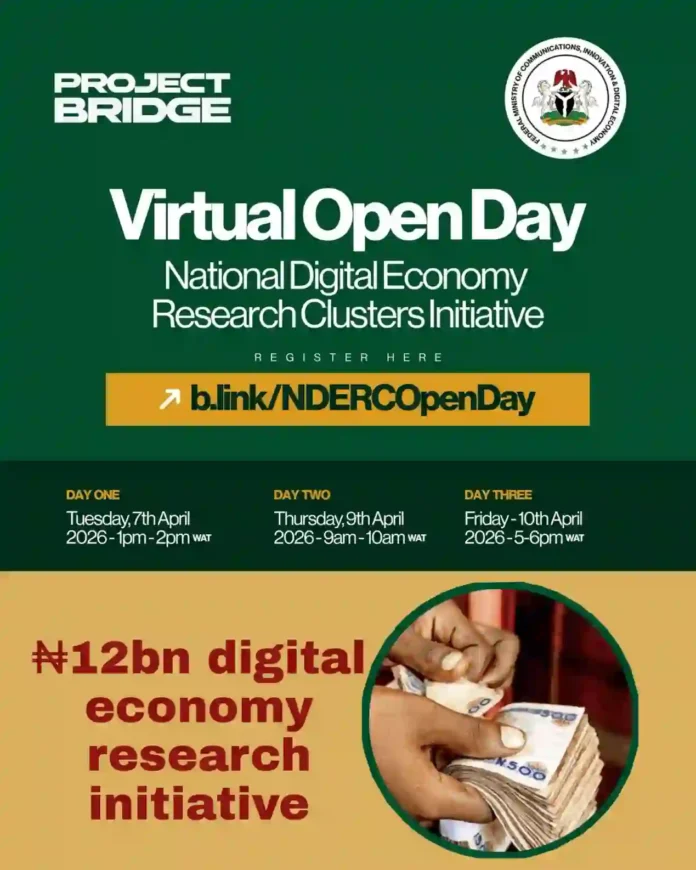
This follows a Saturday announcement by the Minister of Communications, Innovation and Digital Economy, Bosun Tijani, who disclosed that a series of Virtual Open Days will be held to support interested applicants.
According to Tijani, the sessions are designed to provide clarity on the application process, outline expectations, and help institutions build strong research consortia capable of delivering impactful results.
The Open Days are scheduled as follows: Tuesday, April 7, 2026 (1pm–2pm WAT); Thursday, April 9, 2026 (9am–10am WAT); and Friday, April 10, 2026 (5pm–6pm WAT). Interested participants are required to register ahead of the sessions, while the deadline for submission of Expressions of Interest has been fixed for April 13, 2026.
The National Digital Economy Research Clusters initiative, domiciled under the Federal Ministry of Communications, Innovation and Digital Economy, is a major government-backed programme aimed at positioning Nigerian universities at the centre of solving critical digital challenges.
With a funding pool of ₦12 billion, the initiative will focus on key areas including connectivity and access, digital public infrastructure, digital skills development, job creation within the digital economy, online trust and safety, as well as artificial intelligence and emerging technologies.
The programme forms part of a broader digital transformation agenda supported by the World Bank, including plans to expand Nigeria’s fibre optic network to 90,000 kilometres nationwide.
Under the framework, universities and accredited research institutions are expected to lead various clusters, collaborating with both local and international partners. Each cluster is required to comprise between four and six institutions, with at least one Nigerian university serving as the lead.
Officials noted that beyond research outputs, the initiative is expected to strengthen Nigeria’s long-term academic and innovation capacity by supporting doctoral and post-doctoral research, while also addressing gaps in digital inclusion.
The government emphasised that the programme will prioritise solutions targeting underserved populations, including rural communities, women, youth, small businesses, and informal sector players.
Tijani urged Vice-Chancellors, Rectors, and research leaders across the country to take advantage of the Open Days and participate actively in shaping Nigeria’s digital future through evidence-based research and collaboration.

