

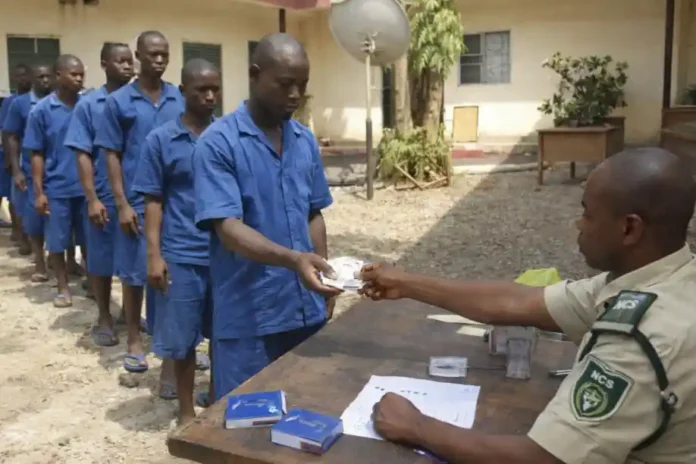
The Federal Government is set to include inmates and ex-inmates in its social intervention programmes, particularly conditional cash transfers and empowerment schemes, as part of efforts to expand access to support for vulnerable populations.
This direction was outlined by the Honourable Minister of Humanitarian Affairs and Poverty Reduction, Dr. Bernard M. Doro, during a meeting with the leadership of the Nigerian Correctional Service in Abuja, where discussions centred on strengthening collaboration to improve rehabilitation and reintegration outcomes.
Dr. Doro made it clear that inmates and former inmates are now being recognised as part of the vulnerable population category that government interventions are designed to support. According to him, “this serves as a critical reminder of the need to pay closer attention to a segment of vulnerable Nigerians that is often overlooked,” stressing that social protection must be inclusive and non-discriminatory.
At the core of the new direction is the planned integration of correctional populations into existing social intervention frameworks, including conditional cash transfers and structured empowerment programmes. The Minister noted that one of the major challenges in previous interventions has been the inability to effectively reach all intended beneficiaries, particularly those outside conventional community settings.
He explained that collaboration with the Nigerian Correctional Service provides a practical solution to this gap, allowing government to extend its safety net to individuals within correctional facilities as well as those transitioning back into society.
Dr. Doro also highlighted the role of the National Social Register in driving this inclusion. He described it as “a critical tool for identifying and reaching vulnerable populations,” adding that it already captures over 19.7 million households nationwide. By incorporating data from correctional facilities into the Register, the government aims to ensure that inmates and ex-inmates are systematically identified and enrolled for relevant support programmes.
This integration is expected to improve transparency, targeting, and accountability, while ensuring that no eligible group is excluded from government interventions. It also creates a pathway for inmates to be onboarded into conditional cash transfer schemes and other forms of financial assistance, particularly as they prepare for reintegration into society.
Beyond cash transfers, the government is placing strong emphasis on empowerment as a long-term solution. The Minister outlined the Ministry’s poverty graduation framework, which is designed to move beneficiaries from dependency to economic self-sufficiency. He noted that the approach goes beyond basic skills training to include access to productive assets, business mentorship, financial inclusion, and continuous monitoring.
According to him, “past interventions have shown that skills alone are insufficient without the necessary support systems,” explaining that many beneficiaries previously relapsed into poverty due to lack of follow-up and structured support. The current framework, he said, ensures that individuals are not only trained but also equipped with the tools and guidance needed to succeed.
For inmates and ex-inmates, this means that empowerment programmes will be closely tied to real economic opportunities, including vocational training, agricultural initiatives, and small business support. These interventions are expected to reduce the likelihood of re-offending by providing a stable means of livelihood after release.
The Minister also acknowledged proposals from the Nigerian Correctional Service, particularly in areas such as certification, vocational development, and post-release reintegration strategies. He welcomed the suggestion to establish a joint technical committee to develop and implement these initiatives, noting that coordinated action is key to achieving measurable results.
The Comptroller-General of the Nigerian Correctional Service, Mr. Sylvester Ndidi Nwakuche, in his remarks, emphasised the importance of sustained institutional collaboration to strengthen rehabilitation programmes. He expressed appreciation for the Ministry’s willingness to open up its social intervention platforms to correctional populations.
Similarly, the Permanent Secretary of the Ministry, Mr. Olubunmi Olusanya, underscored the role of correctional centres not just as custodial institutions but as centres for rehabilitation and reintegration. He noted that aligning correctional programmes with national social protection efforts will significantly improve outcomes for inmates and ex-inmates.
With this shift, the Federal Government is broadening the scope of its social intervention programmes to ensure that even those within the correctional system are not left behind in efforts to reduce poverty and promote inclusive economic participation.

