

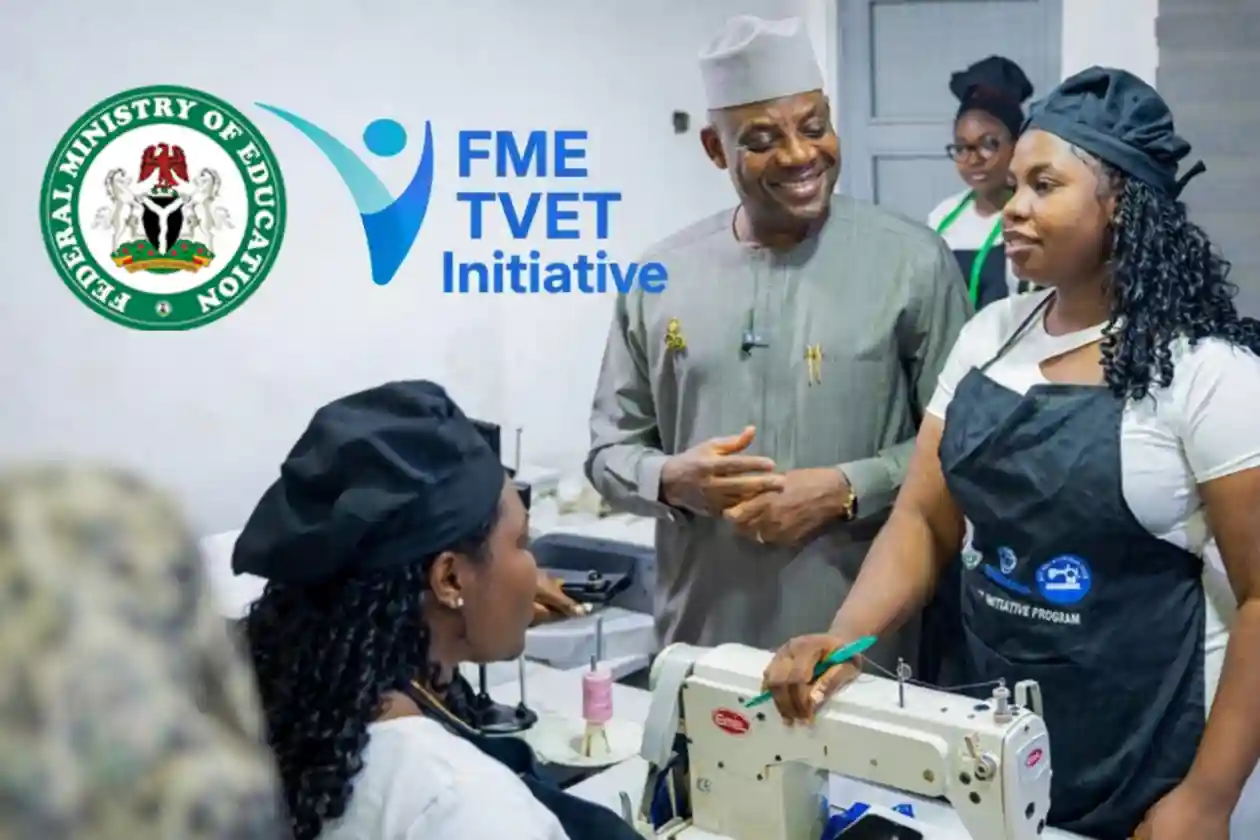
The Federal Government has announced plans to train one million Nigerians in 28 vocational skills over the next two to three years as part of a renewed push to revive Technical and Vocational Education and Training (TVET) and reduce the country’s reliance on imported technical labour.
Speaking during an interview on Channels Television, the Minister of Education, Morufu Olatunji Alausa, said the programme was designed to address long-standing skills gaps that left Nigeria dependent on foreign technicians despite its large youth population.
He said, “It is very appalling that a country of over 200 million people, with more than 70 per cent of the population below the age of 30, still has to import technicians because we could not get enough skilled Nigerians, and that is why we had to move quickly to bring technical and vocational education back to the centre of our education system.”
Alausa said the government is targeting the training of one million Nigerians within two to three years, beginning with an initial batch of 250,000 trainees, explaining that the scale was intentional and necessary to close labour gaps across critical sectors of the economy.
He said, “We are targeting about one million Nigerians in the next two to three years, and we started with the first quarter of 250,000 youths because we needed to scale quickly to address the gaps we identified through proper labour analysis, not guesswork or assumptions.”
The minister said the selection of the 28 vocational skills was based on a detailed labour gap analysis, stressing that training would focus only on areas where there was clear demand from industry.
He said, “We did not just pick these skills by throwing darts in the dark. We carried out a proper gap analysis with professional consultants to identify where the shortages were, and that is why we are focusing on skills that matter to the economy.”
Alausa listed fashion and garment making, livestock and animal husbandry, computer repairs and networking, solar photovoltaic installation and maintenance, plumbing, electrical works, air conditioning and refrigeration repairs, and CNG retrofitting and maintenance as some of the priority skills under the programme.
He said trainees under the TVET programme are paid monthly stipends to support learning and remove financial barriers, while training centres are also funded per student to strengthen capacity and infrastructure.
He said, “Each trainee is getting about ₦22,500 every month while they are training, and the training centres are also being paid per student because we want to incentivise learning and make sure these centres can invest in better equipment and modern workshops.”
Alausa said technical education is now free in federal technical colleges, adding that students are not required to pay tuition or workshop fees as government has taken responsibility for funding facilities and equipment.
He said, “Today, if you are admitted into a federal technical college, the only thing you need to do is to show up to learn, because we have spent over ₦100 billion in the last two years rehabilitating workshops and upgrading facilities to modern standards.”
The minister said the renewed investment in TVET is already changing attitudes, with many young Nigerians, including university graduates, returning to acquire practical skills that match labour market needs.
He said, “What we are seeing now is that young people are coming back to learn skills, even those who already went to universities, because all they needed was access and opportunity to learn something practical that can change their lives.”
Alausa said the strategy is to deliberately train large numbers of skilled Nigerians to reduce reliance on foreign labour and strengthen productivity across key sectors of the economy.
He said, “We are deliberately saturating the system with skills because that is the fastest way to stop importing technicians, create opportunities for our youths, and ensure that the skills we train people in are the skills Nigeria truly needs going forward.”
The minister said the programme is funded under a structured framework to ensure sustainability, accountability, and continuity beyond short-term cycles.
He said, “This is a long-term national strategy built on structure, funding, and continuity, because skills development cannot succeed if it stops halfway or depends on short-term thinking or temporary programmes alone nationwide today only.”

