

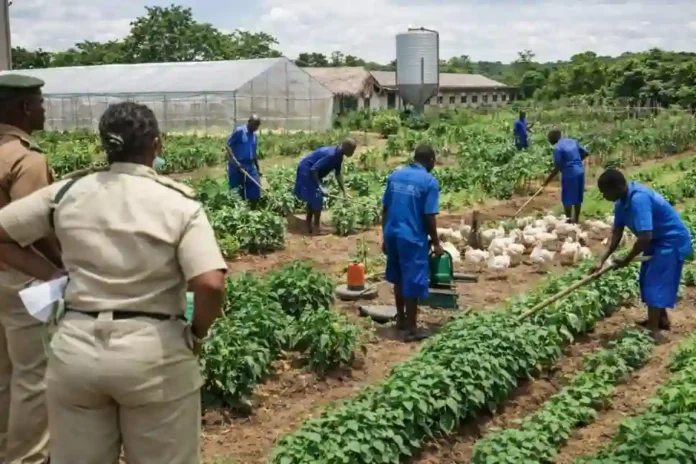
The Federal Government is moving to transform Nigeria’s correctional centres into agribusiness hubs, positioning agriculture as a central tool for inmate rehabilitation, skills development and economic productivity through strategic public-private partnerships.
This shift reflects a broader effort to reposition the country’s correctional system away from a purely custodial model towards one that actively prepares inmates for reintegration into society. Speaking in Abuja at a stakeholders’ roundtable on Optimising Correctional Farm Centres and Public-Private Partnership Pathways for Inmate Reformation, the Minister of Interior, Dr Olubunmi Tunji-Ojo, made it clear that the new direction is intentional and necessary.
Represented by the Permanent Secretary in the ministry, Dr Magdalene Ajani, the minister emphasised that correctional facilities must evolve into centres that create value, both for inmates and the wider economy. According to him, “Correctional centres are no longer just places of custody, they are platforms for transformation, rehabilitation and a new lease of life. The goal is to produce disciplined, skilled and productive citizens who can return to society as assets, not liabilities.”
At the core of this transformation is the integration of agriculture into correctional operations, not just as a means of feeding inmates but as a structured economic and vocational system. The government sees correctional farm centres as untapped assets that can be developed into full-scale agribusiness hubs, exposing inmates to modern farming methods, agro-processing and agricultural value chains.
Tunji-Ojo stressed that achieving this vision would require strong collaboration with the private sector. “It is clear that the government alone cannot unlock the full potential within our correctional system. Public-private partnerships are therefore not optional but a strategic imperative,” he said. Through these partnerships, correctional facilities are expected to benefit from innovation, funding and technical expertise needed to upgrade infrastructure and improve productivity.
The Nigerian Correctional Service is already laying the groundwork for this transition. Controller-General Sylvester Nwakuche disclosed that the service operates 18 farm centres and 10 cottage industries spread across about 10,000 hectares nationwide. These facilities currently support agricultural activities including crop production, fishery, poultry and piggery.
“Our facilities produce crops such as maize, rice, cassava, yams, soybeans, millet and sorghum. These activities support inmate welfare and serve as platforms for skills acquisition,” Nwakuche said. However, he acknowledged that the full economic potential of these assets remains largely untapped without structured private sector involvement.
Under the new approach, these existing resources are expected to be scaled into commercially viable operations aligned with market realities. The goal is not only to improve food production within correctional centres but also to equip inmates with practical, employable skills that extend beyond their time in custody. “Through PPPs, we can enhance productivity, introduce modern agricultural practices and align our programmes with market realities to ensure inmates acquire relevant, employable skills,” he added.
Civil society organisations are also playing a key role in advancing this agenda. Hope Behind Bars Africa, with support from the European Union and the Rule of Law and Anti-Corruption programme, is already implementing initiatives that align with the government’s vision. Its Farming Justice Project focuses on using agriculture as a pathway for rehabilitation while addressing food needs within custodial centres.
Executive Director of the organisation, Funke Adeoye, explained that the initiative is grounded in the Nigerian Correctional Service Act 2019, which prioritises rehabilitation and encourages partnerships beyond government. According to her, inmates involved in the programme undergo structured training that combines behavioural reform, financial literacy and hands-on agricultural practice.
“Inmates are engaged in structured programmes covering behavioural change, financial literacy and crop cultivation, while also participating in agricultural production such as pepper, okra, watermelon and maize farming, as well as fish production,” she said.
The project is already operational in facilities such as Kuje, Kirikiri Female, Dukpa and Oko, with measurable impact across Abuja, Lagos and Edo. Adeoye noted that beyond improving conditions within correctional centres, the initiative is beginning to produce long-term outcomes for participants.
“What we are witnessing is that when systems invest in people, outcomes change. Inmates are producing food, gaining skills and, in some cases, going on to establish their own agribusinesses after release,” she said.
By embedding agribusiness into correctional reforms and leveraging private sector expertise, the Federal Government is redefining the role of prisons in Nigeria, turning them into active centres of production, learning and economic contribution.

