

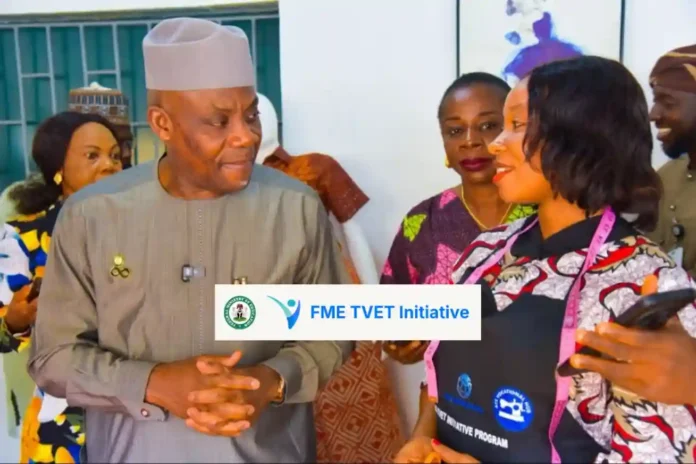
The federal government may spend about N79 billion on the first batch of 250,000 Technical and Vocational Education and Training (TVET) trainees, based on approved stipend rates, training support and other programme costs tied to the rollout. The estimate was highlighted during an inspection tour of the AFS Vocational Hub in Garki, Abuja.
Tunji Alausa, minister of education, said the programme is designed to reach one million youths nationwide in phases, with more than 250,000 already enrolled in the first cohort across 2,600 training centres spread across the country. He explained that the initiative is aimed at equipping young Nigerians with practical skills that align with current economic needs.
According to the minister, the education ministry streamlined the skill areas offered under the programme from 86 trades to 28 priority sectors considered critical to the Nigerian economy. He listed approved trades to include fashion, livestock production, mobile phone repair, plumbing, tiling and modern farming, among others.
Alausa said the TVET curriculum is structured to be 90 percent practical and 10 percent theoretical, noting that the approach is intended to ensure hands-on experience and accountability for participants.
The minister disclosed that the national portal for the programme received over 1.3 million applications, out of which 960,000 were successfully verified using the National Identification Number (NIN) and Bank Verification Number (BVN) as of October 2025. He said the verification process was put in place to enhance transparency and reduce abuse.
He further said training centres involved in the programme are funded directly by the federal government to eliminate fraud and ensure accountability. According to information from the ministry, each participant is entitled to a monthly stipend of N22,500, broken down into N17,500 for upkeep and N5,000 for transportation, while training centres receive N45,000 per trainee for instructional support.
With training durations ranging from six to 12 months depending on the trade, stipends alone for the first batch of trainees could amount to about N67.5 billion. In addition, payments to more than 600 participating training centres, alongside other operational and administrative expenses, are expected to push the total estimated cost of the first batch to roughly N79 billion.
Official records show that the first tranche of the programme, which covered more than 42,000 trainees, cost about N4.7 billion, inclusive of stipends and training centre support. The TVET programme is structured in phased cohorts, with the current batch forming the first phase of a broader plan to train one million youths over a two-year period.
Alausa said funding for the initiative is being sourced from incremental federal allocations, a five percent share of the Tertiary Education Trust Fund (TETFund) earmarked for technical and vocational education, and post-training support mechanisms. These include starter packs and low-interest loans to be provided through the Bank of Industry (BoI).
At an estimated cost of N79 billion for 250,000 trainees, the programme translates to an average expenditure of about N316,000 per participant for the first batch. If scaled to the government’s target of one million trainees, total costs could rise to approximately N316 billion, excluding inflationary pressures, administrative expansion and additional post-training support.
Taiwo Owoeye, a professor of economics at the Federal University, Oye-Ekiti, warned that sustaining such spending levels would require predictable multi-year funding and tighter cost controls. He said that with competing fiscal demands and rising recurrent expenditure, it is important that the programme delivers value for money and does not become a budgetary strain.
With Nigeria’s youth unemployment rate estimated at 5.1 percent by the World Bank, Debo Adeniran, national director of the Centre for Anti-Corruption and Open Leadership, said the success of the TVET initiative could help bridge skills gaps, reduce pressure on the job market and boost small-scale enterprise creation. He, however, noted that sustained funding, quality control and post-training support would be critical to achieving impact.
The TVET initiative was launched in October 2025 as part of the federal government’s strategy to create entrepreneurs rather than job seekers.

