

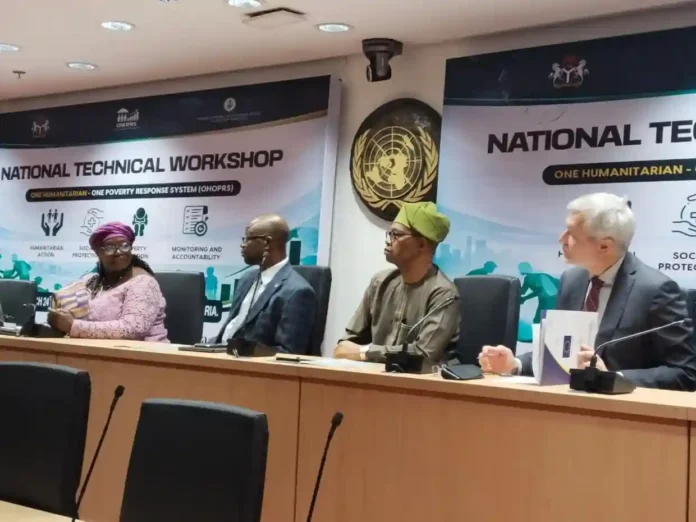
The Federal Government has unveiled a unified national poverty reduction system aimed at lifting 50 million Nigerians out of poverty by 2030 through coordinated interventions and real-time accountability.
The initiative, known as the One Humanitarian, One Poverty Response System (OHOPRS), was officially rolled out on Tuesday in Abuja as part of a broader strategy to address Nigeria’s deepening poverty crisis. The system is designed to bring together fragmented efforts across ministries, departments, agencies, state governments, and development partners into one coordinated national framework.
At the heart of the plan is a strong financial structure projected to run between 2026 and 2030. The government aims to mobilise N16 trillion within this period, with an estimated annual funding pool of N3.2 trillion. Contributions will come from multiple sources, including N1.5 trillion from the Federal Government, N800 billion from development partners, N600 billion from the private sector and impact finance, and N300 billion from climate and global funds.
These funds are expected to be supported by major global institutions such as the World Bank, European Union, United Nations, and other bilateral donors and foundations. The government also plans to establish a National Humanitarian and Poverty Reduction Trust Fund to drive innovative and blended financing models.
Speaking at the launch, the Minister of Humanitarian Affairs and Poverty Reduction, Dr Bernard Doro, explained that the new system is not just another intervention but a complete shift in approach. According to him, the country has long struggled with disjointed programmes that fail to deliver meaningful impact.
“We put in a lot of money to curb poverty but the impact is not there. There is a gap that needs to be corrected,” he said. “Over 63 per cent of Nigerians face multidimensional poverty and there is chronic fragmentation across MDAs, States, and Local Governments.”
He stressed that the new system will focus on real-time data, coordinated response, and a people-centred approach to ensure that resources are used effectively and reach those who need them most.
“It is obvious that Nigeria does not lack interventions; Nigeria lacks systems and that is why the OHOPRS is launched,” he added.
Dr Doro further revealed that the directive from President Bola Ahmed Tinubu was clear and uncompromising, with a strong emphasis on measurable results and accountability.
“President Tinubu’s vision is uncompromising. He wants 50 million Nigerians out of poverty by 2030. He wants us to implement real-time digital accountability,” he said. “He wants us to align every stakeholder to a single national system.”
The OHOPRS is therefore structured to serve as a national backbone that integrates humanitarian relief, long-term development, and social protection programmes. It is expected to eliminate duplication, improve targeting, and ensure that interventions produce visible outcomes.
To guarantee transparency and effective governance, the government has introduced multiple layers of oversight. These include a National Steering Committee made up of government officials and partners, independent audit systems, results-based financing mechanisms, and real-time digital transparency tools.
Dr Doro warned that failure to adopt a unified system could worsen the country’s poverty situation. “If we do not unify now, we are choosing to perish,” he stated.
Development partners have also expressed strong support for the initiative, noting the urgency of Nigeria’s current economic and humanitarian challenges. Representing the United Nations, Mohamed Fall, through UNDP Country Representative Elsie Attafuah, described poverty in Nigeria as a crisis that requires immediate and coordinated action.
“With 62 percent of Nigerians living in poverty and 33 million facing acute food insecurity, there is need for a systems change that integrates humanitarian response, social protection, and economic inclusion,” he said.
He emphasised that the new system presents an opportunity not just to increase spending but to improve how resources are deployed.
“This is not simply an opportunity to spend more, but an opportunity to invest best. It is an opportunity to ensure that resources are targeted with precision, that they address the root causes of poverty and vulnerability, and that they translate into measurable improvement in people’s lives,” he added.
The importance of accurate data and coordination was also highlighted by the Statistician General of the Federation, Prince Adeyemi Adeniran. He noted that about 63 percent of Nigerians, representing roughly 133 million people, are multidimensionally poor based on the National Bureau of Statistics 2022 report.
According to him, tackling such a complex problem requires strong collaboration across all sectors.
“No single institution can address the complexity of poverty and humanitarian needs alone,” he said.
He stressed that high-quality data will play a central role in the success of the new system, particularly in identifying beneficiaries and tracking progress.
“High quality data is crucial for precise targeting and for fostering public trust in the system,” Adeniran explained. “Any unified humanitarian and poverty response system must facilitate seamless data exchange across ministries, agencies, and programmes.”
The National Bureau of Statistics, he added, is committed to ensuring system interoperability and the adoption of national data standards to support the initiative.
With its strong financial backing, emphasis on coordination, and focus on real-time accountability, the OHOPRS represents a major policy shift in Nigeria’s approach to poverty reduction, placing systems, data, and collaboration at the centre of national efforts.

