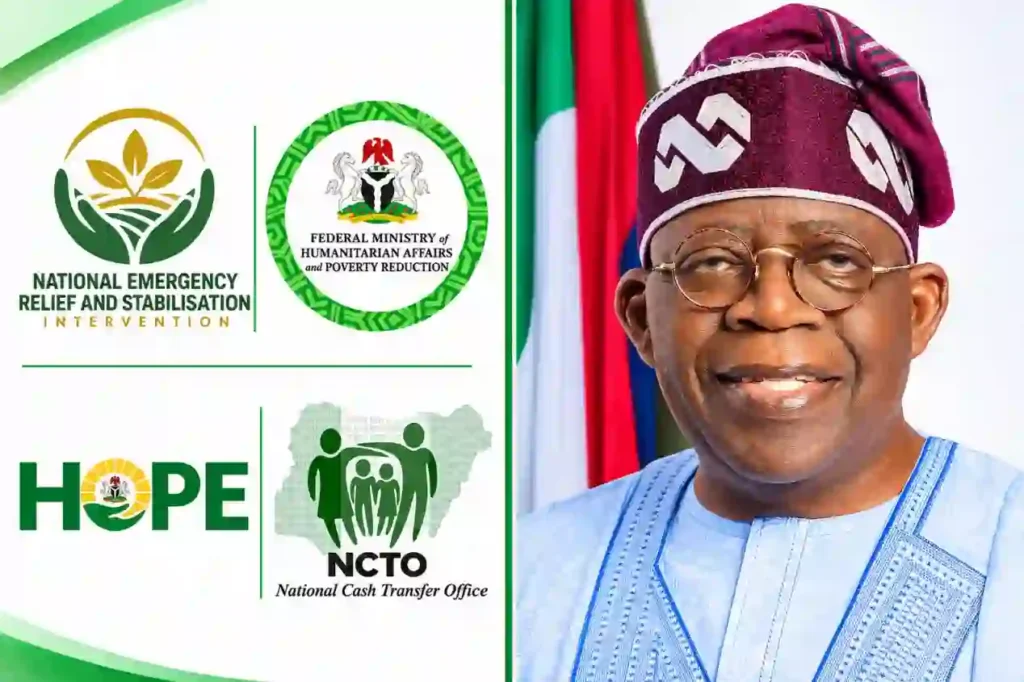
The Federal Government uses household records to identify Nigerians who may qualify for interventions, including the National Emergency Relief and Stabilisation Intervention (NERSI), which provides selected households with ₦50,000.
 Follow us on Google News
The process uses the National Social Register (NSR), a database of poor and vulnerable households coordinated by the National Social Safety-Nets Coordinating Office (NASSCO). It helps agencies identify people who may need assistance.
The Federal Government announced NERSI on October 30, 2026. Humanitarian Affairs Minister Dr Bernard Doro said it would provide relief to vulnerable households facing rising living costs.
The ministry later clarified that beneficiaries are selected from the National Social Register and verified national identity records, using poverty and vulnerability criteria. Selection covers all six geopolitical zones, while notifications and payments are made in phases. Therefore, beneficiaries may not receive messages at the same time.
How the National Social Register identifies households
The register is not a public list where anyone can enter a name to qualify. Household identification involves officials, enumerators and community participation.
NASSCO explains that four approaches guide the process: geographic targeting, community ranking, community-based targeting and Proxy Means Testing (PMT).
Geographic targeting helps identify areas with higher poverty levels. States assess local government areas using poverty information and give priority to places facing greater hardship.
Community ranking identifies communities needing attention first. Access to roads, schools, healthcare and water helps show where deprivation is severe.
Under community-based targeting, residents help identify poor and vulnerable households. Trained Community-Based Targeting Teams engage communities, while enumerators collect information about the households identified.
The information is then assessed through Proxy Means Testing. This statistical method estimates a household’s welfare using details such as housing conditions, household size, education and other living conditions. An algorithm processes the information and ranks households according to their estimated poverty levels.
Households are ranked in deciles, with the first decile representing the poorest group. For some interventions, households within the first to sixth deciles may be considered, depending on the programme’s rules. Inclusion in the register does not guarantee selection for every government benefit.
The ranking does not mean every household in those groups receives money automatically. It helps programme managers identify households for checks and match assistance to the needs and funding of each intervention carefully.
Why the register matters
The register helps government identify where assistance is needed and reduce the risk of support going to the wrong people. Without reliable information, vulnerable families could be overlooked and limited resources might not reach those facing the greatest hardship.
The register also supports planning for health, education, agriculture and humanitarian programmes. Each agency or partner sets its own eligibility rules, so registration does not guarantee every benefit.
How Nigerians are selected for the ₦50,000 NERSI grant
For NERSI, selection is based on the National Social Register and verified national identity records. The programme is not open to fresh individual applications. There is no registration portal where Nigerians can pay or submit their names to become beneficiaries.
Selected people receive SMS notifications from approved payment providers: ALAT by Wema Bank, MoMo Payment Service Bank (PSB), NairaGram, OPay or Moniepoint. The message explains how to accept the support. Beneficiaries must give consent before payment is made.
The ₦50,000 is a grant, not a loan, and the ministry says the full amount is credited without deductions. A basic mobile phone is sufficient; a smartphone or internet connection is not required for the relevant Unstructured Supplementary Service Data (USSD) steps.
How Nigerians can check and stay safe
Nigerians should keep their National Identification Number (NIN) and household details accurate. A NIN alone, however, does not guarantee selection.
Anyone who receives a genuine notification should follow only the instructions from the authorised payment provider. The ministry warns that selection cannot be bought or influenced by agents or other individuals. Do not pay anyone promising to add your name or speed up payment. Never disclose your Personal Identification Number (PIN), One-Time Password (OTP) or Bank Verification Number (BVN).
For enquiries or complaints, the ministry lists the NERSI helpline as 0700-022-2222. Nigerians can also consult the official programme information at fmhapr.gov.ng/nersi.