

A total of 94,000 on- and off-farm jobs have been supported across northern Nigeria through a large-scale agriculture and environment project funded by the Global Environment Facility (GEF), marking one of the most visible outcomes of efforts to link food production with sustainable land use.
The initiative has also expanded climate-smart agriculture practices, including the planting of 44,800 seedlings under agroforestry systems, leading to a 44 percent increase in standing tree cover. In addition, 115,000 smallholder farmers have been reached, with women accounting for 45 percent, improving soil fertility, crop yield, food security, and livelihoods.
The GEF-funded initiative is being implemented by the United Nations Development Programme (UNDP) and is officially titled Fostering Sustainability and Resilience for Food Security in the Savanna Zones of Northern Nigeria, identified as GEF ID 9143. Nigeria is the beneficiary country under the Food-IAP programme. The project is supported by $8.0 million in GEF financing and $57.0 million in co-financing aimed at expanding coverage and long-term impact.
Project data show that 273,000 hectares of farmland have been brought under integrated sustainable land and water management and climate-smart agriculture practices. These interventions target declining productivity in a region where agriculture remains the backbone of rural livelihoods. “The goal is to improve productivity while protecting ecosystems that farmers depend on,” the project stated, noting that environmental restoration and food production are being pursued together.
Northern Nigeria’s agricultural sector supports more than 70 percent of the population and contributes about 23 percent to national GDP, yet it continues to face declining yields. Environmental degradation, soil infertility, and low adoption of sustainable practices have reduced output over time. Rainfed smallholder systems dominate the region, while population growth, climate variability, and insecure land tenure worsen soil erosion, water scarcity, and land degradation.
Unsustainable farming practices have further weakened the natural resource base, limiting yields and threatening food security, while increasing reliance on food imports. Women and youth farmers, who often manage smaller plots with limited access to inputs and finance, are disproportionately affected. Farmer–herder conflicts and weak institutional coordination have also added pressure on already vulnerable communities. Addressing these challenges, according to the project, requires integrated interventions that raise efficiency, strengthen resilience, and promote sustainability across landscapes.
Results recorded so far include significant environmental and production gains. Soil erosion was reduced by 22 percent on 36 hectares through targeted interventions involving 10,600 farmers trained in erosion control techniques. Crop production increased by 25 percent for rice, groundnut, cassava, maize, and sorghum. National and state-level policies were also harmonized into the National Sustainable Food Security Resilience Framework to improve coordination and policy alignment.
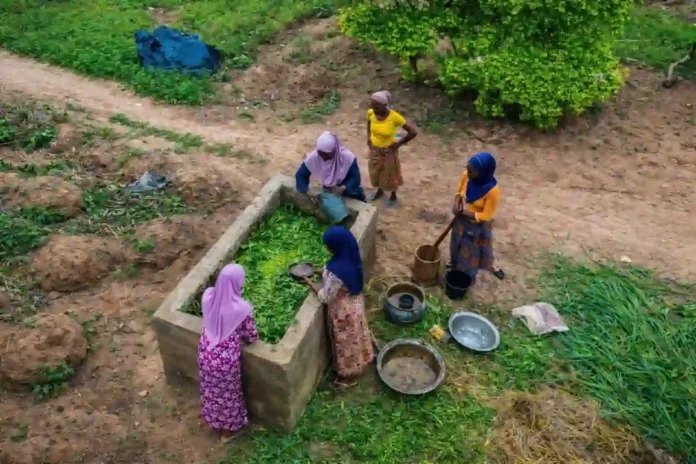
Employment creation remains central to the project’s impact. A total of 94,000 jobs have been supported on- and off-farm, including 44,400 jobs taken up by women. These opportunities span agricultural production, processing, and market-linked activities that directly support household incomes. Gender inclusion has also advanced, with 31,900 women and youth actively participating in agricultural production and value chains, surpassing the original target set at project design.
The approach combined sustainable land management, climate-smart agriculture, and value chain development. Farmers received training and input support to adopt improved seeds, composting methods, erosion control techniques, and agroforestry systems that improve soil fertility, water retention, and yields. Partnerships with private sector actors established offtake arrangements and market linkages, encouraging investment and reinforcing economic gains.
Institutional strengthening was pursued through policy harmonization and multi-stakeholder platforms that supported governance and knowledge sharing. Community-based extension workers played a key role in encouraging adoption of best practices, while demonstration plots and training centres provided hands-on learning to ensure techniques were scalable and replicable. “Demonstration sites helped farmers see results directly, which increased confidence and uptake,” the project noted.
Lessons from implementation show that integrating policy, institutional, and technical actions enables smallholder farmers to adopt and maintain improved practices. Early engagement during planning supported realistic scheduling and adaptive management in complex, resource-constrained contexts.
While private sector partnerships strengthened value chain participation, the project said continued coordination is needed to align commercial incentives with social objectives. Planned actions focus on scaling climate-smart practices, strengthening training centres as knowledge hubs, expanding access to finance and markets, and keeping women and youth central to resilient farming systems across regions.

