

The National Coordinator of the Human Capital Opportunities for Prosperity and Equity-Governance (HOPE-GOV) Program, a World Bank–assisted initiative of the Federal Ministry of Budget and Economic Planning, Dr. Assad Hassan, has said the Program is designed to incentivise implementing agencies, including State Governments, to institutionalise reforms in budgeting and expenditure management within Nigeria’s primary healthcare and basic education sectors.
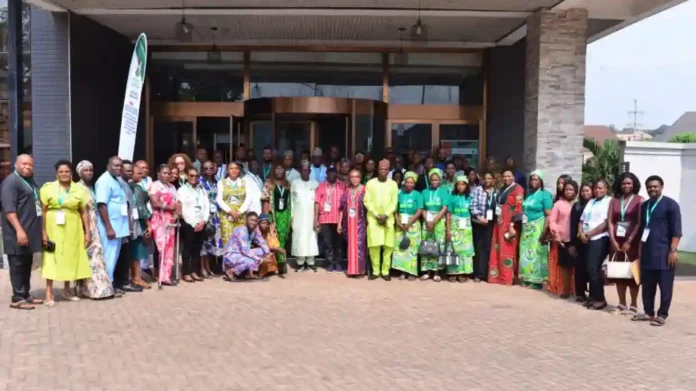
Dr. Assad made the statement in Abuja on Friday when he led the National Program Coordination Unit (NPCU) of the HOPE-GOV Program on an implementation coordination visit to the Ministerial Oversight Committee Secretariat of the Basic Health Care Provision Fund (BHCPF MOC).
“For us it is not just about dishing out the money but if you look at the scope of the Program, it’s talking about reforms. Beyond the incentives that our implementing agencies are going to get, the Health Sector in particular is going to benefit from the reforms that the Program is going to achieve,” he said.
According to Dr. Assad, the visit was part of efforts targeted at implementing agencies to strengthen coordination and provide the support required to achieve the Disbursement-Linked Indicators (DLIs).
“This is something we usually do for all our implementing agencies. It means the people that we are responsible for in terms of the Disbursement-Linked Indicators (DLIs) and the Disbursement-Linked Results (DLRs). Specifically, the States, BHCPF Ministerial Oversight Committee Secretariat as well as the Universal Basic Education Commission (UBEC) at the Federal level. From time-to-time we engage so that we provide implementation support, coordination as well as support to ensure that our implementing agencies are able to achieve their results.
“It is the wish and the vision of the NPCU that all our implementing agencies get to achieve all the incentives that are required,” he stated.
Dr. Assad added that the first Coordination Meeting with State HOPE-GOV Focal Persons would hold on Monday next week to bolster implementation of the Program and ensure alignment across participating states.
He also said the Program was currently evaluating the engagement of Independent Verification Agents to assess the performance of implementing agencies for the first year of reform implementation, as a step towards the disbursement of incentives.
In his presentation at the meeting, the HOPE-GOV Program Officer, Mr. Jamil Abdallah, said the Program is a $500 million package to be disbursed to implementing agencies upon the achievement of Disbursement-Linked Results.
“For the HOPE-Governance, as we are all aware, it’s a Program for Results (PforR), where $500 million is actually earmarked for the Program whereby $480 million is for the PforR that is going to implementing agencies and States and the remaining $20 million is for Investment Project Financing, which is going to be used for program coordination, fiduciary management, capacity building, which is the technical assistance as well as verification of results and Monitoring and Evaluation,” he said.
Mr. Abdallah listed the Results Areas required to qualify for disbursement as increased availability and effectiveness of financing for basic education and primary healthcare service delivery, enhanced transparency and accountability for basic education and primary healthcare financing, and improved recruitment, deployment and performance management of basic education teachers and primary health care workers by federal, state and local governments.
He further stressed that International Public Sector Accounting Standards (IPSAS)–compliant annual audited financial statements of implementing agencies must be published on their official websites within prescribed timeframes.
According to him, the financial statements must cover sources and uses of funds or receipts and payments, appropriations for the year under review, actual expenditures and balances against appropriations, comparative actual expenditures for the preceding year, and all required disclosure notes under the applicable financial reporting framework.
Mr. Abdallah added that all 36 states of the Federation and the Federal Capital Territory have signed on to participate in the Program.
In her remarks, the Acting Secretary of the Basic Health Care Provision Fund Secretariat, Dr. Aishatu Abubakar Bajoga, pledged to work with the HOPE-GOV Program to achieve the set objectives.
“We are ready to work together and hopefully, it’s a work in progress from now on. Thank you,” she said.
A major highlight of the visit was an interactive session between members of the HOPE-GOV National Project Coordinating Unit and officials of the Basic Health Care Provision Fund, led by its outgoing Secretary, Dr. Ogbe Oritseweyimi, where both sides compared notes on strategies for achieving the Fund’s Disbursement-Linked Indicators. The engagement focused on coordination.

