

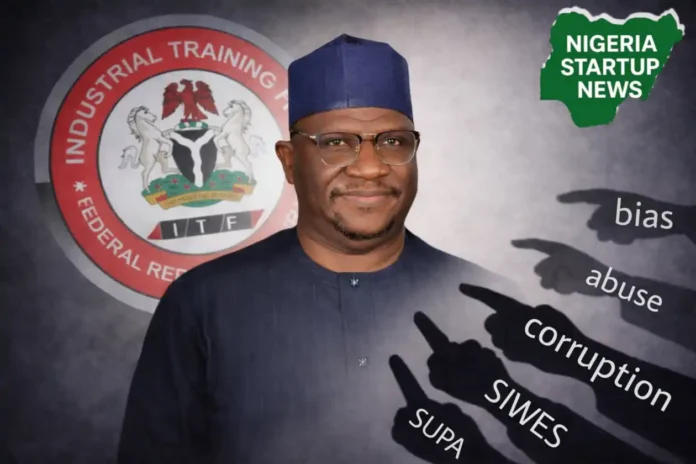
The Industrial Training Fund (ITF) has denied allegations of fraud and deliberate non-payment of artisans under the Skills-Upgrading Programme for Artisans, SUPA, describing the situation as a necessary effort to clean up long-standing financial lapses and stop public funds from vanishing without trace.
The denial followed a detailed statement by the ITF on Thursday amid public outcry over corruption and delayed payments to artisans. The post, written from the perspective of a concerned Plateau citizen and widely believed to reflect insider knowledge, defended the leadership of the Fund and its Director-General, Dr. Afiz Ogun, against what it described as a coordinated smear campaign.
According to the statement, the current ITF leadership inherited several programmes that were already bleeding funds before reforms began. It said SUPA is undergoing auditing and restructuring to ensure accountability and that training numbers are now being verified to confirm genuine beneficiaries. “You call it fraud; we call it cleaning a mess that was created. Before he came, money vanished without trace. Now, there’s a paper trail,” the post stated.
ITF explained that payments were being systematized to prevent abuse and diversion of funds, arguing that the process had angered individuals who previously benefited from weak controls. The statement insisted that the changes were designed to ensure artisans receive support in a transparent and traceable manner.
Addressing claims that the ITF Director-General prioritized personal benefits over workers’ welfare, the Fund dismissed comparisons between salary matters and the provision of official vehicles. It noted that official vehicles remain government property and are standard for chief executives. On salary issues, it stated that no chief executive can unilaterally increase pay without a government circular, approval, and budgetary provision, adding that the 2024 minimum wage is a national matter subject to due process.
The statement also responded to allegations of irregular procurement practices, stressing that ITF operates through a procurement unit and tender board. It said the Director-General does not award contracts alone and challenged critics to present evidence if wrongdoing exists. “Otherwise, stop confusing transparency with your loss of access to kickbacks,” the post said.
On accusations of ethnic bias and unfair staff transfers, the statement described them as misleading and harmful. It argued that staff deployment follows federal character principles and that transfers are routine civil service practices aimed at improving efficiency. “You shout 90 percent Yoruba? Show the staff roll. Prove it,” the writer said, accusing critics of attempting to poison public opinion in Plateau State.
The post further addressed claims that the Director-General was not working from Jos, the ITF headquarters. It stated that leadership responsibilities require engagement across multiple locations, including Abuja for government matters, Lagos for partnerships and revenue issues, and Jos for headquarters oversight. “Must he sit in one office to be effective?” it asked.
Defending the appointment of Dr. Afiz Ogun, the statement linked the controversy to political and ethnic sentiments following his appointment by President Bola Ahmed Tinubu. It alleged that opposition stemmed from prejudice and the loss of corrupt privileges rather than performance concerns.
ITF warned Plateau residents against supporting actions that could weaken the Fund or threaten its headquarters, citing past missed federal opportunities linked to internal divisions. It urged patience, saying ITF programmes are being reviewed, youths are being reached, and funds are now being accounted for.
“Dr. Afiz Ogun has stopped the free flow of illegal money. That is why you are in pain,” the statement said, calling on petitioners to embrace positivity and allow the reforms to continue for the benefit of artisans and national development.
The controversy was triggered by a petition addressed to President Bola Ahmed Tinubu by Abubakar Doma Haruna, chairman of Nigeria Advocacy for Transparency, accusing the Industrial Training Fund and its Director-General, Dr. Afiz Ogun, of corruption, abuse of power, and ethnic bias. The petition alleged mismanagement of funds meant for SIWES and SUPA, non-payment of beneficiaries, lack of transparency in procurement, refusal to implement the 2024 minimum wage while providing SUVs for directors, dominance of Yoruba staff through recruitment and transfers, and the DG’s limited presence at the Jos headquarters, while calling for an investigation, possible removal of the DG, and reforms to restore accountability in the Fund.
Only recently, the National Association of Nigerian Students (NANs) also gave the ITF DG 14 days to step down over delayed SIWES payments.
Read also: NYSC, SMEDAN boost partnership to empower Corps Members’ business skills

