

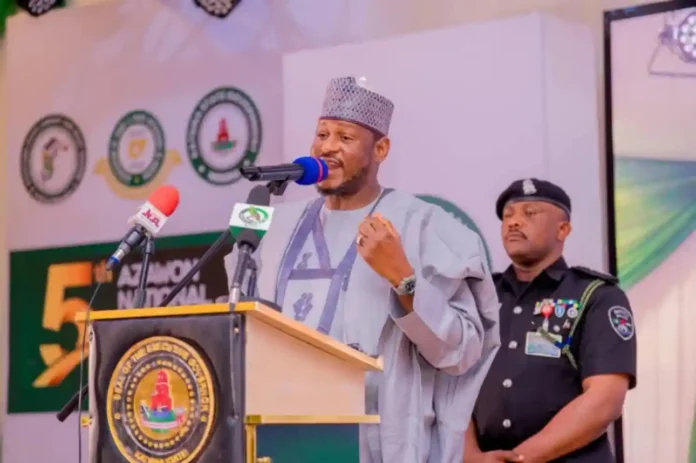
Katsina State Governor, Malam Dikko Umaru Radda, on Tuesday announced a personal donation of ₦10 million to the AZAWON Foundation before formally declaring open the 5th AZAWON National Conference of the Association of Zakat and Waqf Operators in Nigeria, describing the decision to host the event in Katsina as historic and timely for national development efforts.
Speaking at the opening ceremony held in Katsina, Governor Radda said the conference theme, “Harnessing Islamic Social Finance and Policy Innovation for Inclusive Development in Nigeria,” aligns closely with his administration’s development agenda and social welfare priorities, especially in addressing poverty and vulnerability across communities in the state.
“We are hosting this conference with a deep sense of responsibility and commitment to its ideals,” the Governor stated, noting that Katsina State views Islamic social finance as a practical tool for inclusive growth, social justice and sustainable development when properly structured and transparently managed.
He reaffirmed that Zakat and Waqf form central pillars of his administration’s poverty reduction strategy, explaining that the state deliberately established its Waqf system to confront poverty, injustice and vulnerability through organised and institutionalised Islamic social finance mechanisms that deliver direct benefits to the people.
“Zakat and Waqf remain powerful tools for social balance, economic justice and inclusive development,” Governor Radda said, adding that the moral and economic values embedded in these systems support community stability and shared prosperity when applied with accountability.
The Governor disclosed that within less than two years, the Katsina State Waqf has become fully operational, commending the Chairman, Board members and staff for their dedication, commitment and discipline in building a functional system that serves the poor and vulnerable segments of society.
He stressed that responsible governance requires clear policies that uplift the downtrodden, highlighting the establishment of the Katsina State Enterprise Development Agency as a policy innovation designed to support small businesses and expand economic opportunities for youths and women across the state.
Governor Radda revealed that Katsina State currently ranks first nationwide in MSME funding, with over ₦10 billion earmarked to support Micro, Small and Medium Enterprises, noting that access to finance remains critical to unlocking local productivity and reducing unemployment.
“We are investing deliberately in small businesses because they are the backbone of inclusive growth,” he said, explaining that MSMEs drive grassroots economic activity and create sustainable livelihoods when supported with the right policies and financing frameworks.
The Governor announced that the Goat Rearing Initiative, a women empowerment programme, has benefitted over 40,000 women across the state’s 361 wards, with a total investment of ₦5.7 billion aimed at boosting household income, food security and economic independence.
He disclosed that the government has also distributed food items to about 90,000 vulnerable households across the state, stressing that beneficiaries were selected based on merit and transparency to ensure fairness and reach those most in need of support.
“Our interventions are designed to reach those who truly need support,” Governor Radda noted, adding that social protection remains a core responsibility of government, especially during periods of economic pressure affecting low income households.
The Governor reiterated that agriculture remains the backbone of Katsina State’s economy, engaging between 90 and 95 per cent of the population, and revealed that over ₦70 billion was invested in the sector in the last year alone, resulting in a bumper harvest.
“When we invest in agriculture, we invest in livelihoods and stability,” he said, noting that increased productivity strengthens food supply, reduces poverty and supports peace in rural communities dependent on farming activities.
He acknowledged the positive impact of organised Zakat and Waqf collection on social welfare and security, noting that the state is gradually regaining peace with reduced criminal activities linked to improved livelihoods and social support systems.
“When poverty is addressed through structured Zakat and Waqf systems, social stability is strengthened,” the Governor added, stressing the need for collaboration among government, religious institutions and community leaders.
Governor Radda appreciated delegates from the Niger Republic, commended traditional rulers for their role in Zakat collection, and announced his personal donation of ₦10 million to the AZAWON Foundation before formally declaring the conference open.
The Association of Zakat and Waqf Operators in Nigeria honoured Governor Radda with an Award of Excellence in the Promotion of Zakat and Waqf Development in Nigeria, recognising his leadership and deliberate policies supporting Islamic social finance.
Earlier, AZAWON National Chairman, Dr. Muhammad Lawal Mai Doki, said the conference aims to strengthen Islamic social finance as a practical tool for inclusive development across Nigeria, especially amid rising poverty levels.
“Nigeria is facing deep poverty challenges, with over 133 million people living in multidimensional poverty. Zakat and Waqf, when properly institutionalised, can support education, healthcare, MSMEs and poverty alleviation,” he said.
Dr. Mai Doki disclosed that in 2024 alone, over ₦10 billion was collected as Zakat, ₦3.7 billion mobilised through Waqf, and ₦465 million raised as Sadaqah, calling for stronger frameworks and transparency.
“With stronger frameworks, transparency and collaboration, Zakat and Waqf can become strategic national development tools,” he stated.
In his welcome address, Chairman of the Katsina State Zakat and Waqf Commission, Sheikh Dr. Ahmed Musa Abdullahi, described the conference as timely and impactful, disclosing that in 2024 the Commission collected 86,819 bags of grain valued at ₦4.78 billion and ₦53.9 million in cash Zakat, distributed to over 269,000 beneficiaries.
Speaking virtually, Secretary-General of the World Zakat and Waqf Forum, Dr. Mohd Ghazali bin Md Noor, said Nigeria’s poverty challenge is due to weak institutional systems, noting that global Zakat potential exceeds USD 300 billion annually.
Representing the Sultan of Sokoto, the Emir of Hadejia, Alhaji Adamu Abubakar Maje, urged traditional rulers and scholars to support awareness and mobilisation for effective Zakat and Waqf administration, as the event attracted representatives of Kaduna, Kano and Jigawa States and key Katsina officials.

