

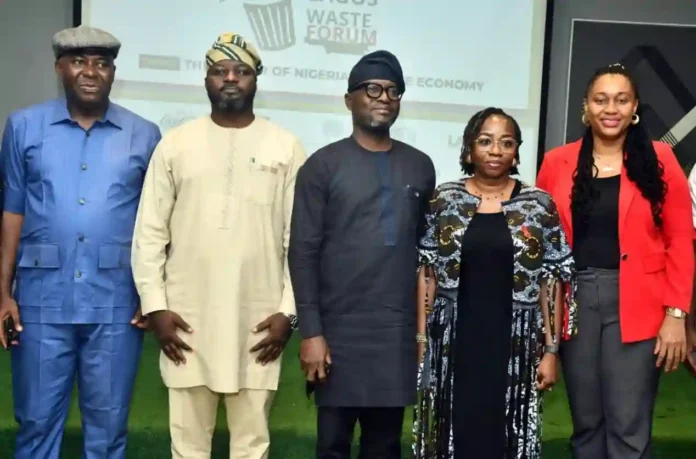
The Lagos State Government, alongside several key stakeholders, has reaffirmed its commitment to environmental initiatives aimed at unlocking Nigeria’s $250 billion green economy potential. This was the focus at the 6th Lagos Waste Forum held in Lagos, where leaders from both the public and private sectors discussed how waste can serve as a driver of economic growth and resilience.
According to a statement, the event was organised by SWEEP Foundation NG with support from UNIDO, the European Union, and Coca-Cola Nigeria. The theme of the forum was “The Power of Nigeria’s Waste Economy,” and it brought together government officials, industry experts, and development partners to explore strategies for sustainable waste management.
The Special Adviser on the Environment, Olakunle Rotimi-Akodu, who represented Governor Babajide Sanwo-Olu, highlighted the state’s pivotal role in advancing Nigeria’s circular economy. He said Lagos generates a large volume of waste but also presents vast opportunities for economic transformation.
“Lagos generates vast quantities of waste, but within this challenge lies a significant opportunity, one realised through structure, innovation, and entrepreneurial intelligence,” the Governor’s representative stated.
Rotimi-Akodu noted that agencies such as the Lagos Waste Management Authority, under the leadership of its Managing Director, Dr Muyiwa Gbadegesin, are working to establish an integrated waste management framework. He said the framework “positions Lagos as a hub of circular economy innovation.”
A representative of the Food and Beverage Recycling Alliance (FBRA) provided insights into the economic potential of the sector, referencing the Federal Government and UNDP’s Imagine Nigeria report. The report estimates that Nigeria’s green economy could yield up to $250 billion.
“Circularity is not just an ecological necessity but a strategic pathway to jobs, innovation, and environmental protection,” the FBRA official noted. The alliance revealed that Nigeria produces 32 million tonnes of waste each year, while Lagos alone generated about N18 billion in recycling value in 2021.
The President and CEO of SWEEP Foundation NG, Obuesi Phillips, described dumpsites as emerging “waste mines.” He proposed the establishment of a Ministry of Waste Resources and the creation of a Green Bank that would provide single-digit interest loans to waste-to-wealth entrepreneurs.
The Ogun State Commissioner for the Environment, Dr Ola Oresanya, delivered the forum’s lecture, urging governments to adopt evidence-based approaches to environmental management. “Solutions must be guided by research, innovation, and evidence-based interventions tailored to Nigeria’s local contexts,” he said. Oresanya also emphasized the need for a technically skilled environmental workforce at all government levels.
Other key attendees included the Special Adviser on Climate Change and Circular Economy, Titi Oshodi; the Executive Director of Circular Economy Innovation Partnership, Natalie Beinisch; and UNIDO Field Coordination and Gender Expert, Emem Umana. The forum ended with participants pledging to prioritise financing, technology adoption, and community engagement as core strategies for accelerating Nigeria’s shift to a resource-efficient and climate-smart waste ecosystem.

