

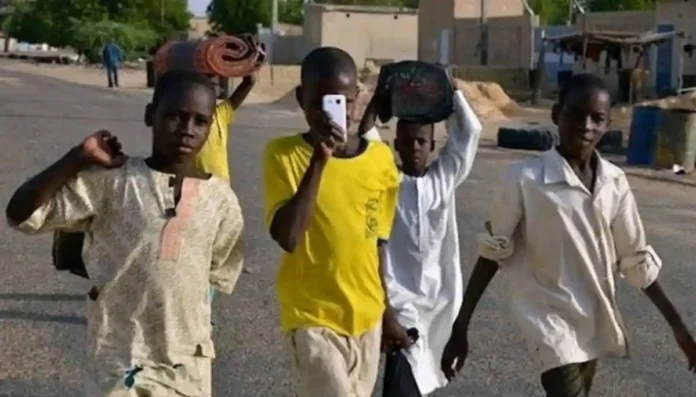
The National Commission for Almajiri and Out-of-School Children Education has announced that it is still waiting for state governments to take action on the enrolment of 700,000 out-of-school children recently mapped across the country. The executive secretary, Muhammad Idris, disclosed this on Saturday in Abuja while responding to questions from journalists. He explained that the commission had already written formally to all 36 state governors and the Federal Capital Territory authorities to begin the enrolment process, which he described as a major step toward reducing the number of children without access to education.
Mr Idris said the commission embarked on an unprecedented nationwide mapping exercise that involved reaching remote communities, documenting learners, and identifying children who had never been in school or who dropped out. He noted that poverty continues to be the major factor keeping children away from school. According to him, many families struggle to afford basic needs such as school uniforms and PTA levies, which discourages enrolment and creates long-term educational challenges.
He stated that the commission is fully prepared to submit the data of the 700,000 mapped children to states once the necessary steps are taken to begin implementation. He added that within the next three months, the commission would present an updated database containing information on an additional three million out-of-school children. He said this expansion would depend on states enrolling the current 700,000 learners already identified.
Mr Idris stressed that the assignment aligns with the directive of President Bola Tinubu, who has repeatedly stated that no Nigerian child should remain out of school before the end of his administration. He said, “The president was pressing on us that before the end of his 8 years, no Nigerian child should be out of school. And I just told you that I can make the number three million in the next three months only if I have someone who is ready to take them to school. And because the federal government cannot open schools across all the states, it has to be done by the states.”
He commended governors, noting that many were taking steps to strengthen the education sector, but he called for stronger partnerships. “I know that state governors are working hard to revitalise education in their states. And they are doing all that is required. But what we are saying is, let there be partnership,” he said.
Speaking further, the executive secretary welcomed the recent approval of the National Policy on Almajiri Education by the National Council on Education. He said the approval confirms that Almajiri children are entitled to the same quality of education, resources, and learning environment as every other child in the country. He described it as an important move toward integrating Almajiri learners into mainstream education systems.
Providing updates on key interventions, Mr Idris highlighted the progress made at the Tinubu Legacy Skills Training Institute in Kaduna. He revealed that about 200 Almajiri learners had completed a nine-month intensive programme. The training equipped them with English and Arabic language proficiency, Qur’anic interpretation skills, and the opportunity to take the National Board for Arabic and Islamic Studies examination, which qualifies them for further studies in Nigerian and foreign institutions. He said, “It was a nine-month training programme, and we were able to successfully accomplish this nine-month programme. I want to share with you that they were allowed to attempt the National Board for Arabic and Islamic Studies examination, and very soon they will be certified by NBIAS.”
He added that the commission had engaged authorities in Saudi Arabia and Malaysia, both of which indicated readiness to offer scholarships to successful learners. Beyond academics, the students were also trained in various vocational skills such as POP installation, CCTV maintenance, solar technology, tiling, GSM repairs, agriculture, and ICT, with some already becoming skilled web designers.
In Oyo State, he said another 150 out-of-school girls in Ibadan were undergoing training in vocational areas, including fashion designing, cosmetology, hair-making, makeup, shoemaking, leather works, school bag production, catering services, and event planning. The girls were also being supported through the Accelerated Basic Education Programme to help them reintegrate into formal schooling.
Mr Idris noted that the commission had established 106 learning centres across different states, where out-of-school children were receiving literacy and numeracy lessons while Almajiri learners were guided through the curriculum. He urged stronger cooperation from all stakeholders, emphasising that reducing the number of out-of-school children and reforming the Almajiri system required collective commitment from governments, communities, and partners.

