

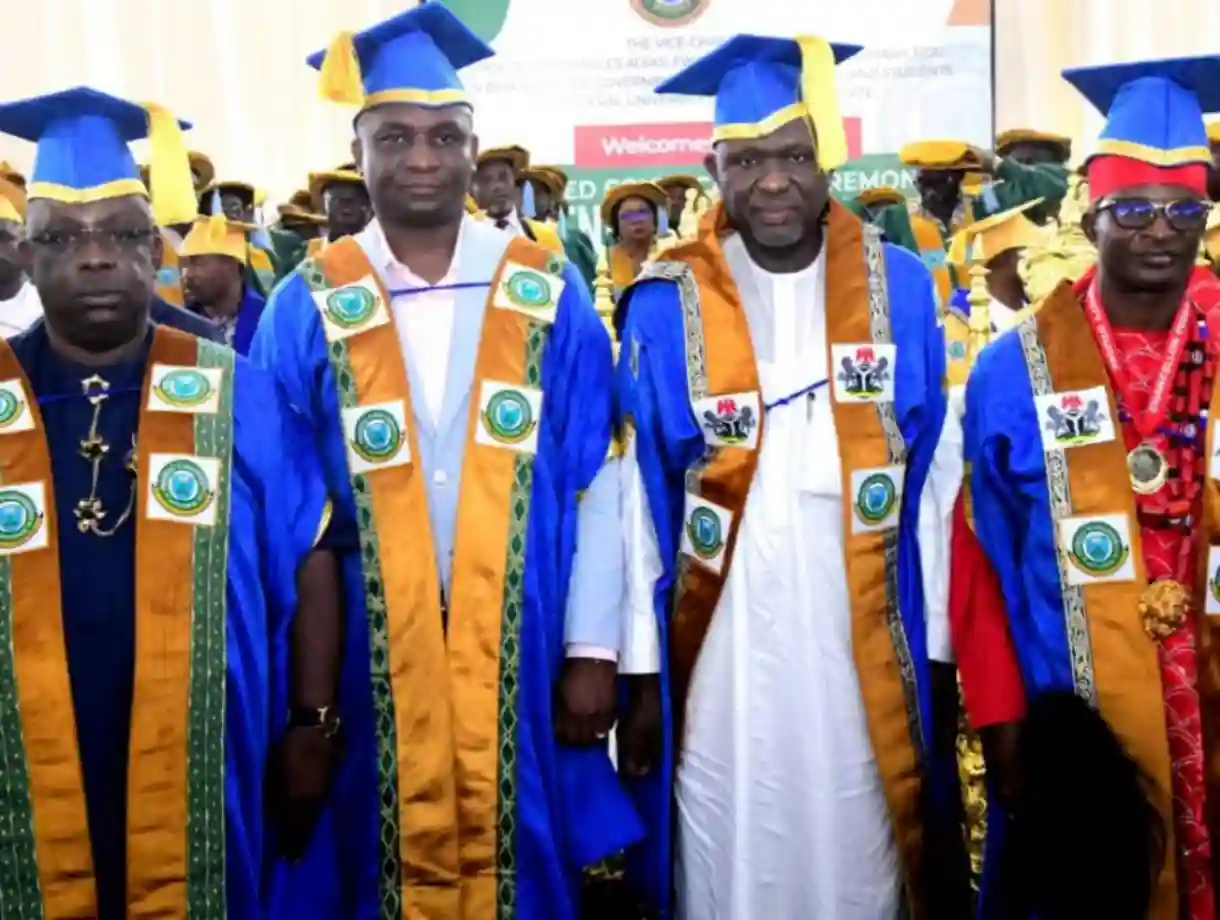
The Managing Director of the Niger Delta Development Commission, NDDC, Dr Samuel Ogbuku, has proposed a university system that focuses more on solving real-life problems while reducing excessive emphasis on awarding degrees.
Ogbuku made the proposal while delivering the keynote address at the 2nd Convocation Lecture of the Federal University Otuoke, Bayelsa State, where he questioned how universities had shifted from problem-solving centres to institutions driven mainly by certificates.
He spoke on the theme, “From Degree-Awarding to Problem-Solving Institutions: Retooling University Education for Nation-Building,” stressing that higher education must play a direct role in national development.
The NDDC Chief Executive Officer affirmed that “Education is the most powerful weapon which you can use to change the world,” urging universities to rethink their purpose and impact.
Ogbuku lamented the present academic culture, saying, “We have built an academic culture where promotion is often tied more to the number of papers published in journals, many of which have minimal bearing on local problems, than to the impact of research on society.”
He expressed concern about the growing gap between universities and the productive sectors of the economy, noting that “employers repeatedly complain that graduates lack critical thinking, creativity, digital skills, and practical experience.”
According to him, the challenge is linked to declining funding and infrastructure. He said, “We have witnessed a gradual decline in funding and infrastructure in the education sector. A system that is underfunded struggles to be innovative.”
Ogbuku added that poor learning conditions have affected quality, explaining, “When laboratories lack basic equipment, when libraries are outdated, when classrooms are overcrowded, and when staff are poorly motivated, the easiest thing for a university to do is to default to theory-heavy, exam-driven education.”
He proposed embedding practical learning into academic programmes, stating, “We can change this by deliberately inserting problem-solving contents into our programmes.”
Giving an example, he said “every final-year student, regardless of discipline, could be required to undertake a capstone project that addresses a real, identified problem in a community, industry, or government institution.”
Ogbuku also said universities must strengthen innovation and entrepreneurship structures. “Another strategic step is to build and strengthen innovation and entrepreneurship ecosystems within our universities,” he said.
He noted that although institutions like the Federal University Otuoke, FUO, have entrepreneurship centres, many are treated as peripheral units rather than core academic structures.
Highlighting regional challenges, Ogbuku said environmental and climate-related problems in the Niger Delta demand urgent attention. “We need to deal with oil spills, gas flaring, flooding, biodiversity loss, and land and water degradation,” he said.
On technology, he observed, “In a world driven by technology, Nigeria cannot afford to be a passive consumer of other people’s innovations.”
He asked, “What can we do to develop local manufacturing capabilities to reduce dependence on imported goods? What can we do to leverage digital technologies?”
The NDDC boss said Nigeria must “retool University Education for Sustainable Nation-Building,” adding that universities should be redefined as problem-solving institutions.
He stressed that research should not be for promotion alone, saying, “If we are serious about sustainable nation-building, university research must be more than a personal promotion ladder.”
Addressing graduands, Ogbuku urged them to see themselves as problem-solvers. “The degree in your hand is not a trophy; it’s a tool,” he said.
He added, “You must embrace the charge to learn and adapt continuously. The world you are entering is changing faster than any generation before you. Do not treat your degree as the end of learning.”
On development efforts, Ogbuku said the NDDC had moved from a transactional to a transformational development approach.
He announced the award of a contract for a five-kilometre internal road network within the university campus. “We will also build a modern convocation arena and a five-star Corpers’ Lodge inside the university,” he said.
In his personal capacity, Ogbuku pledged to sponsor two professorial chairs at the university, one in honour of his late father and another for cancer research.
The Vice Chancellor of the Federal University Otuoke, Professor Teddy Charles Adias, thanked President Bola Tinubu for appointing a new Chancellor for one of the country’s youngest federal universities.
Adias charged graduating students to continue learning, stating, “Learning never ends.”
The lecture also featured the installation of the Paramount Ruler of Idoma Worldwide, Dr Elaigwu Odogbo Obagaji, as the Chancellor of the Federal University, Otuoke.

