

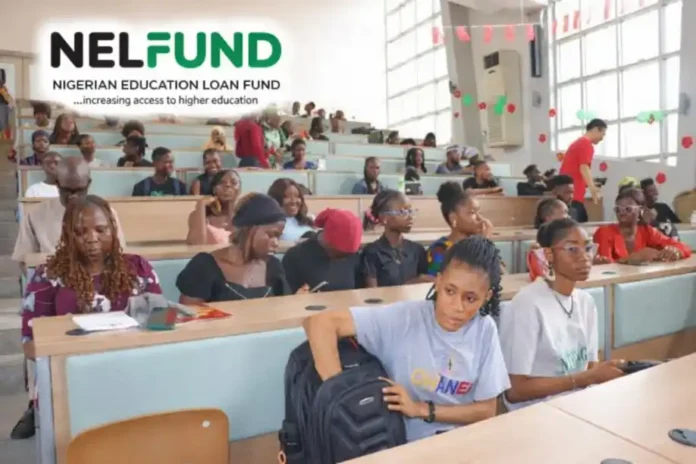
The Nigerian Education Loan Fund (NELFUND) has recorded strong progress since its launch, disbursing over N206 billion to more than 1.1 million students across 270 institutions, following over 1.7 million applications.
Latest figures from the Fund show that a total of 1,751,669 applications have been received since the portal opened in May 2024, with 1,164,222 students successfully benefiting from the scheme. This reflects a growing reliance on the programme as a critical support system for students facing financial challenges in accessing tertiary education.
A breakdown of the disbursement shows that N128.84 billion has been paid directly to beneficiary institutions as tuition fees, while N77.45 billion has been released to students as upkeep allowances. The structure of the funding is designed to cover both academic and living costs, ensuring that students are not only enrolled but are also able to sustain themselves throughout their studies.
The steady rise in applications further highlights increasing public trust in the scheme. In its most recent update, the Fund recorded 969 new applications, representing a 0.1 per cent increase. Though marginal, the growth signals sustained interest and continued awareness among students nationwide.
Speaking on the Fund’s performance, the Managing Director of NELFUND, Akintunde Sawyerr, emphasised that the initiative was created to remove long-standing financial barriers that have prevented many Nigerians from pursuing higher education.
“We started the scheme of His Excellency President Bola Ahmed Tinubu, GCFR, to provide students with loans, interest-free loans, with very, very soft terms, to ensure that the situation we’ve had in this country for so long, where so many cannot commence tertiary education or are forced to drop out because of lack of funds, is addressed,” he said.
Sawyerr also assured students that financial limitations would no longer stand in the way of their academic progress, particularly regarding examinations. According to him, “no eligible beneficiary of the education loan scheme would be barred from sitting for examinations due to financial constraints.”
He noted that while the Fund is committed to timely disbursement, the involvement of public funds requires strict institutional processes to prevent mismanagement and ensure accountability across participating institutions.
The growing impact of NELFUND is also being reinforced by cooperation from tertiary institutions. Recently, the management of Delta State University, Abraka, introduced a directive allowing students with “Verified” or “Disbursed” NELFUND status to sit for their first semester 2025/2026 examinations upon presenting proof of their application status.
Reacting to the development, Sawyerr described it as a practical demonstration of how institutions can support students while aligning with the objectives of the scheme.
“We warmly welcome this student-centred approach by Delta State University. It reflects a clear understanding of the purpose of the NELFUND scheme, which is to ensure that no Nigerian student is denied access to education because of financial constraints,” he said.
“At NELFUND, we are very pleased to see institutions taking practical, youth-friendly steps that allow students who have successfully completed the application process to continue their academic activities without disruption.”
He added that such measures strengthen the broader goal of expanding access to higher education while promoting fairness and inclusivity across the country.
The Tinubu Media Support Group also described the Fund’s performance within less than two years as a major milestone, noting that it represents a significant intervention in Nigeria’s education sector.

