Home Blog

Yobe Rolls Out Phase 3 Ramadan Support for 22,500 Beneficiaries

The Yobe State Emergency Management Agency (Yobe SEMA) has officially rolled out Phase 3 of Governor Mai Mala Buni’s Ramadan Support Initiative, extending assistance to 22,500 direct beneficiaries and vulnerable communities across the state.

This phase marks another significant step in the state government’s ongoing humanitarian intervention during the holy month of Ramadan. Designed to ease hardship and strengthen community-based support systems, the initiative targets organized groups and associations that are already providing feeding and welfare services to vulnerable residents.

Under Phase 3, a total of 225 groups and associations were selected to benefit from the intervention. These include orphanages, scholars’ groups, Persons with Special Needs (PWSN), and Ramadan feeding support organizations. The selected groups were drawn from over 500 applicants that sought government support to expand their outreach during Ramadan.

Through this structured distribution, approximately 22,500 individuals are expected to directly benefit. The approach ensures that assistance is channeled through trusted community-based platforms with established humanitarian footprints, thereby maximizing impact and reach.

Flagging off the distribution exercise, officials emphasized accountability, transparency, and proper monitoring. Post-distribution tracking mechanisms have been activated to ensure that the support reaches intended beneficiaries effectively and is utilized for its designated purpose.

The initiative reflects the Yobe State Government’s commitment to inclusive social support, particularly during periods of increased economic pressure. By complementing the efforts of grassroots organizations, the programme strengthens collaboration between government and community actors in delivering relief.

Beneficiary organizations expressed appreciation for the timely intervention, noting that the support will significantly boost their Ramadan feeding and welfare activities. The rollout of Phase 3 further reinforces the state’s broader humanitarian agenda focused on dignity, inclusion, and sustained community partnership.

Advertisement

ASPH, KSrelief Partner to Empower 970 Nigerians in FCT and Kwara

The Abibakr As-Sidiq Philanthropic Home (ASPH) has partnered with the King Salman Humanitarian Aid and Relief Centre (KSrelief) to empower 970 vulnerable Nigerians through a Transformative Skills and Livelihood Empowerment Programme in the Federal Capital Territory and Kwara State.

The collaboration is designed to provide practical, long-term support for internally displaced persons, refugees, widows, unemployed youths and individuals living below the poverty line. Rather than offering short-term relief, the initiative focuses on building sustainable economic independence through vocational training and entrepreneurship development.

According to ASPH President Abdulrazzaq Salman, the programme will equip beneficiaries with hands-on skills in tailoring and garment production, catering and food processing, ICT and digital literacy, photography, and other locally relevant trades. The goal is to help participants gain employable and income-generating skills that can immediately improve their livelihoods.

At the end of the training, beneficiaries will receive starter kits, tools and operational support to help them establish small-scale businesses. This approach ensures that participants are not only trained but also empowered with the resources needed to put their skills into practice.

The programme will be implemented in collaboration with relevant federal authorities and the Kwara State Government to guarantee transparency, accountability and fairness in the nomination and verification process. Special priority will be given to households facing severe economic hardship and displacement.

ASPH described the partnership as a major step toward poverty reduction and youth empowerment, noting that the initiative reflects a shared commitment to restoring dignity, strengthening resilience and creating lasting economic opportunities for vulnerable communities in Abuja and Kwara State.

Abia Partners AfDB on $200m SAPZ Tranche 2 Agro-Industrial Project

The Abia State Government is set to partner with the African Development Bank (AfDB) on a $200 million agro-industrial project under Tranche 2 of the Special Agro-Industrial Processing Zones (SAPZ) programme, marking a major step toward transforming the state’s agricultural and industrial landscape.

The partnership positions Abia as one of the prospective beneficiaries of the second phase of the SAPZ initiative, a flagship continental programme designed to boost agro-processing, attract private investment and create jobs. Governor Alex Otti has reaffirmed the state’s readiness to meet all conditions required for inclusion in Tranche 2, including the provision of counterpart funding and critical infrastructure.

Under the arrangement, the AfDB facility of $200 million for Tranche 2 will support selected states in developing agro-industrial hubs that integrate farmers, processors, logistics providers and exporters within a structured value chain system. For Abia, this presents an opportunity to move from primary agricultural production to value-added processing, thereby increasing revenue generation, reducing post-harvest losses and improving rural incomes.

Governor Otti has assured the bank that Abia will co-finance key infrastructure such as access roads and electricity to ensure the viability and sustainability of the project. The proposed agro-industrial site in Ukwa West Local Government Area has already been inspected, with the state indicating that additional sites could be made available if the full allocation is considered. Ukwa West’s proximity to the Abia Innovation and Industrial Park strengthens its suitability as a processing hub, enabling synergies between agro-processing and manufacturing activities.

The SAPZ programme operates under a multi-tranche financing model due to funding headroom constraints. Tranche 1, which covers 10 states, received board approval in December 2025. Tranche 2 will target eight states, with financing support not only from AfDB but also expected co-financing from the Islamic Development Bank. This blended financing structure underscores the scale and strategic importance of the initiative across participating regions.

Beyond infrastructure, the partnership emphasizes compliance with environmental and social safeguards, robust financial management systems, transparent procurement processes and strong private sector engagement. Agro-industrial processing zones are designed to de-risk agricultural investments by providing shared infrastructure and regulatory support, thereby making agribusiness more attractive to investors.

For Abia, the project aligns with ongoing efforts to diversify the state’s economy and strengthen agro-industrial capacity. Agriculture remains a significant employer within the state, but value addition has historically been limited. By hosting a structured processing zone, Abia stands to benefit from improved storage facilities, processing plants, packaging centers and logistics networks that can connect local producers to national and export markets.

The expected outcomes include job creation across farming, processing, logistics and ancillary services, increased foreign and domestic investment, enhanced food security and improved competitiveness of locally produced goods. Smallholder farmers, in particular, are projected to benefit from guaranteed off-take arrangements, better pricing structures and access to improved inputs and extension services.

As Abia positions itself for inclusion in Tranche 2, the proposed $200 million agro-industrial partnership with AfDB represents more than a financing arrangement. It signals a strategic commitment to building an integrated, investment-friendly agricultural ecosystem capable of driving sustainable economic growth and long-term development in the state.

AYGF trains Katsina farmers, distributes agribusiness kits

The Africa Youth Growth Foundation (AYGF) has trained 150 farmers and agri-preneurs in Katsina State on climate-smart agriculture and equipped them with essential agri-business kits to boost productivity and sustainability.

The initiative focused on strengthening farmers’ capacity to adapt to climate change while improving yields and income. Participants were trained on modern, climate-smart farming techniques designed to conserve soil, manage water efficiently, and increase resilience against unpredictable weather conditions. The programme also introduced practical agribusiness strategies to help beneficiaries move beyond subsistence farming into profitable value-chain activities.

Beyond crop production, livestock herders received guidance on improved animal rearing practices aimed at increasing productivity and reducing resource-based conflicts. By promoting better understanding between farmers and herders, the intervention supports peaceful coexistence within rural communities.

AYGF emphasized sustainable agriculture as a pathway to economic empowerment and community stability. The training sessions encouraged participants to apply environmentally friendly methods that protect natural resources while ensuring long-term food security. Beneficiaries were also exposed to business development skills, including market linkages and cooperative engagement, to strengthen their earning potential.

The distribution of agri-business kits further reinforced the hands-on nature of the programme, enabling participants to immediately apply what they learned. Community leaders and government representatives commended the intervention, noting that empowering farmers with knowledge and tools is critical to improving livelihoods across the state.

Through this effort, AYGF continues to advance youth empowerment, agricultural development, and sustainable economic growth in Katsina State.

Kebbi Flags Off Massive Farm Inputs, Ramadan Palliatives Distribution

The Kebbi State Government has commenced the massive distribution of farming inputs and Ramadan palliatives under the Kaura Agricultural Development Agenda, marking a major step in its drive to strengthen food production and support vulnerable households across the state.

The flag-off ceremony took place at the Haliru Abdu Stadium in Birnin Kebbi, where thousands of farmers and community representatives gathered to witness the rollout. The initiative combines large-scale agricultural support with targeted Ramadan relief, reinforcing the administration’s focus on both productivity and social welfare.

Governor Nasir Idris described the distribution as a defining moment in the state’s agricultural transformation agenda. According to him, the Kaura Agricultural Development Agenda is centered on empowering farmers with the tools and resources needed to increase output, improve incomes, and enhance food security at both state and national levels.

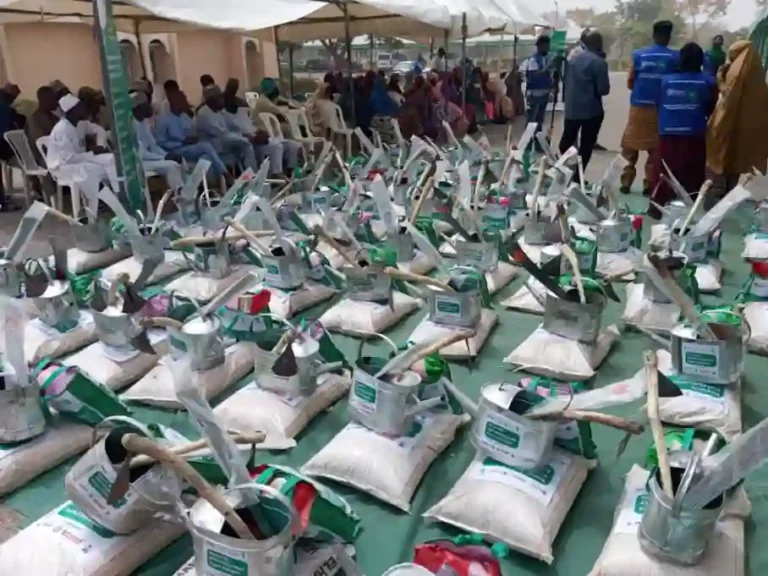
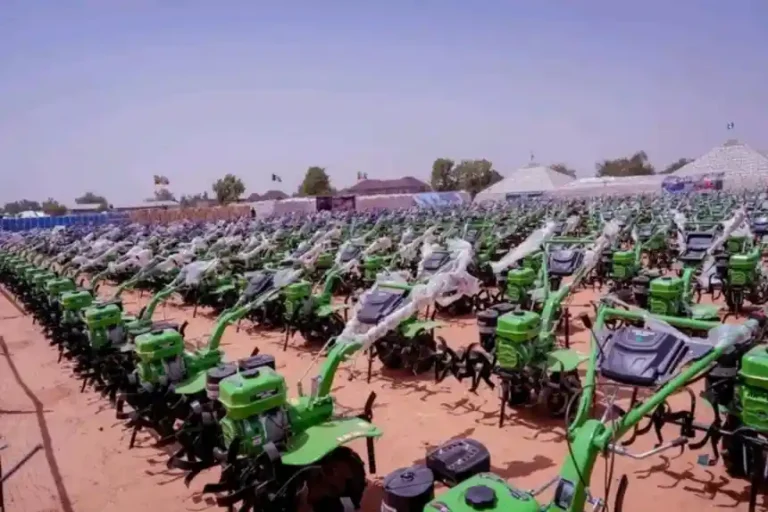
As part of the exercise, the government is distributing 2,000 solar-powered water pumps to support irrigation, particularly for dry season farming. In addition, 5,000 power tillers are being provided to ease land preparation, while 5,500 sprayers will help farmers manage weeds and pests more effectively. To complement these tools, 24,000 liters of herbicides, 70,000 liters of liquid organic fertilizer, and 5,000 tons of assorted fertilizers are being supplied to boost soil fertility and crop yield.

The Governor also announced the commencement of the 2026 dry season farming programme, explaining that Kebbi operates two production cycles within a single dry season in order to maximize output. This approach, he said, has contributed to the steady rise in rice production across the state. Annual rice output increased from 3.05 million tons in 2023 to 3.15 million tons in 2024, with projections for 2025 remaining strong. Kebbi continues to rank among Nigeria’s leading rice-producing states, while other staple crops have also recorded growth under the current administration.

Beyond agricultural inputs, the government is distributing 6,500 tons of assorted grains, including rice, maize, and millet, as Ramadan palliatives. The measure is aimed at cushioning the impact of economic hardship on poor and vulnerable residents during the holy month. By combining farm support with food relief, the initiative addresses both immediate household needs and long-term production goals.

Governor Idris emphasized that beneficiaries were carefully selected in collaboration with traditional rulers and recognized farmers’ groups to ensure transparency and fairness. He warned that substitutions would not be tolerated and directed security agencies to arrest anyone found diverting or selling the distributed items. He further instructed the distribution committee to prevent political office holders or intermediaries from cornering items meant for grassroots farmers and families.

Speaking at the event, the Honourable Minister of Agriculture and Food Security, Abubakar Kyari, commended the initiative and described Kebbi as a state where agriculture defines both the economy and daily life. He noted that more than 80 percent of the population is engaged in farming and related activities, underscoring the importance of sustained investment in the sector.

The Minister added that food security remains central to national stability and economic resilience, stating that President Bola Ahmed Tinubu has positioned agriculture as a strategic national priority. He praised Kebbi’s evolution from primary cultivation to structured value addition, highlighting the presence of major rice mills that process paddy into finished products for national markets.

With the commencement of this massive distribution, Kebbi State is reinforcing its commitment to agricultural expansion, farmer empowerment, and social support, positioning the Kaura Agricultural Development Agenda as a key pillar of its development strategy.

Data Lead Africa Field Enumerator Recruitment

0

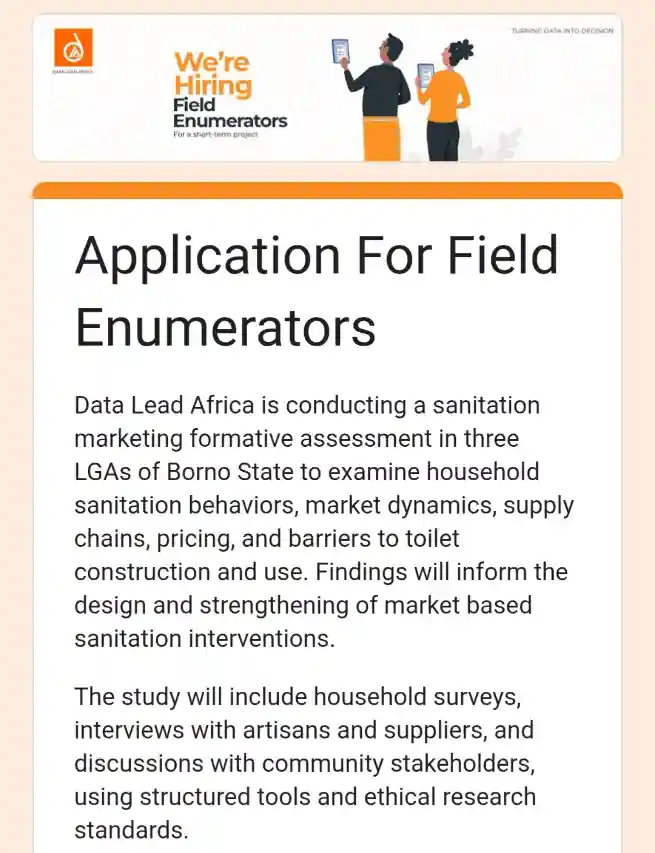
Data Lead Africa has opened applications for Field Enumerators to support a sanitation marketing formative assessment in three Local Government Areas of Borno State. The study aims to examine household sanitation behaviours, market dynamics, supply chains, pricing structures, and key barriers to toilet construction and usage. The findings will guide the design and strengthening of market-based sanitation interventions in the state.

The assessment will involve household surveys, interviews with artisans and suppliers, and engagement sessions with community stakeholders. All activities will be conducted using structured research tools and in line with ethical data collection standards.

Selected enumerators will administer questionnaires accurately, obtain informed consent from participants, ensure data quality, and submit reports to supervisors as required.

Applicants must have prior experience in field data collection, strong communication skills, and proficiency in digital data collection tools. Fluency in Hausa and English is mandatory, while knowledge of Kanuri will be an added advantage.

To apply as a Field Enumerator, interested candidates should visit https://docs.google.com/forms/d/e/1FAIpQLSfcmA3JJ8XIbW3lMQjxrV5MSf7K-xWX8kDCDC7oTKc8WtXK9g/viewform.

IAVE-RRA SkillsBuild Cohort 3 Application Now Open (Free Certificate)

0

Applications are now open for SKILLS BUILD Cohort 3 of the IAVE-RRA SkillsBuild Academy, a fully funded opportunity designed to equip young Nigerians with practical digital and professional skills relevant in today’s fast-changing world.

Participants in Cohort 3 will gain access to free, self-paced digital training through the IBM SkillsBuild platform, earning globally recognized IBM certificates upon completion. The programme also provides mentorship on CV development and guidance toward post-training career opportunities. It is completely free of charge.

This initiative is powered by the International Association for Volunteer Effort (IAVE) in partnership with IBM SkillsBuild and in collaboration with YASIF. It offers access to high-demand courses in Artificial Intelligence, Cybersecurity, Data Science and Management, Entrepreneurship and Startups, Climate Change and Sustainability, Digital and Social Media Marketing, Career Development and Employability, Project Planning and Management, Financial Literacy and Management, Leadership and Empowerment, Communication and Public Speaking, and Creative Thinking and Innovation.

Beyond certification, the academy focuses on real growth. Learners will build confidence, strengthen their employability, and gain practical knowledge that can be applied to real-life opportunities and career advancement.

The programme is open to young Nigerians who are unemployed, underemployed, students, graduates, or early-career professionals seeking to improve their skills and career prospects.

Limited slots are available, and interested applicants are encouraged to apply promptly.

To apply for SKILLS BUILD, visit:
https://docs.google.com/forms/d/e/1FAIpQLSfn2qg2tW91H9fLTYyg8eNyZGklcyxSXFPSexsTza57zSmdjg/viewform.

3MTT NextGen Knowledge Showcase 2026 Opens – Win a Laptop

0

Applications are now open for the 3MTT Nigeria NextGen Knowledge Showcase. This is your chance to move beyond learning and start building by solving a real-world problem that matters. If you have completed your training, this is the moment to demonstrate your skills and creativity.

Participants are required to choose one of four impact pillars: Financial Inclusion, Education, Environment, or Digital Inclusion. After selecting a pillar, identify a clear challenge within that space and develop a functional solution that showcases your technical ability and problem-solving skills. The goal is to present practical proof of what you have learned through the 3 Million Technical Talent (3MTT) programme, in collaboration with the Airtel Africa Foundation and NITDA.

Submissions must be individual entries only; team submissions will not be accepted. Each entry should include a working MVP, demo link, or mockups, a 2–4 minute demo video, and a clear explanation covering the problem, users, build process, impact, and scalability. Applicants must also disclose any AI tools used, where applicable.

Prizes will be awarded per state: first place receives a laptop, second place a tablet, and third place 20GB of data. The deadline is March 24, 2026. Submit your application through your 3MTT dashboard.

Lagos Neighbourhood Safety Corps Group B Recruitment Ongoing

0

The Lagos Neighbourhood Safety Corps has announced ongoing recruitment for the position of Neighbourhood Safety Officer (Group B) across all Local Government Areas in Lagos State. This full-time role supports community policing and grassroots security efforts.

LNSC applicants must possess SSCE/WAEC, be between 18 and 30 years old, physically fit, and have a clean criminal record.

To apply, interested applicants should visit https://lnsa.lg.gov.ng/career/apply/1.

Keystone-SMEDAN Women in Business Masterclass 2026 Opens

Applications are now open for the Keystone-SMEDAN Women in Business Training Programme, a two-day masterclass designed to help female entrepreneurs take their businesses to the next level. This transformative programme will equip participants with practical strategies, funding access, and valuable networks needed to scale successfully in today’s competitive market.

The masterclass features insightful sessions on business growth strategies, exclusive access to funding opportunities, practical training in digital marketing essentials, and strategic networking with industry leaders. It is scheduled to hold on March 11–12, 2026, from 9:00 AM daily at Keystone Learning Academy, 3 UAC Drive, Oregun, Ikeja. Spaces are limited, and interested participants are encouraged to apply early.

To apply for the Keystone-SMEDAN Women in Business Training Programme, visit:
https://www.keystonebankng.com/keystone-bank-smedan-women-in-business-masterclass/