

 Add us on Google
Nigerian Communications Satellite Limited (NIGCOMSAT) has set a target to generate ₦8 billion in revenue within the next three years, as the government-owned satellite communications company pushes a renewed growth strategy aimed at expanding commercial operations and improving service delivery.
The target was disclosed by the Managing Director of NIGCOMSAT, Jane Egerton-Idehen, during a news conference in Lagos, where she said the agency is already seeing strong financial momentum driven by increasing demand for satellite services, especially in the broadcast sector.
According to her, NIGCOMSAT recorded ₦2.2 billion in revenue in 2025, representing more than three times the earnings posted in previous years, signalling a sharp improvement in the company’s commercial performance.
Egerton-Idehen said the agency remains confident that the ₦8 billion projection is realistic, noting that the company is relying on a mix of stronger customer acquisition, better service quality, and fuller utilisation of its existing satellite capacity.
She explained that the revenue target is based on a gradual growth path rather than a one-time spike, reflecting a structured commercial roadmap designed to place the company on a more sustainable financial footing.
New satellites to expand capacity
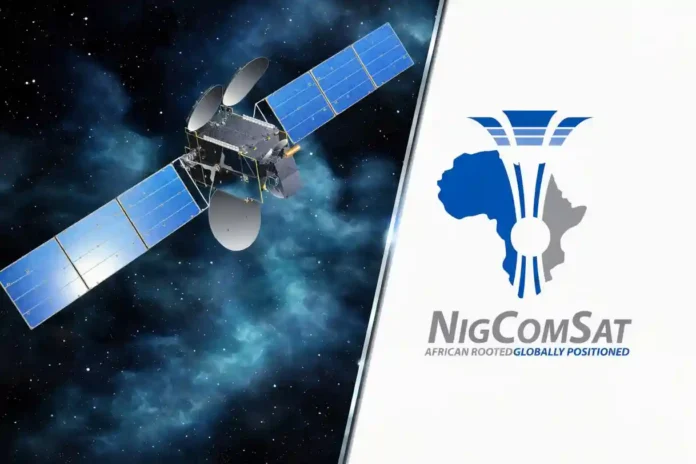
As part of its long-term expansion plans, NIGCOMSAT has also secured approval from the Federal Government for the launch of two additional satellites.
The new satellites are expected to become operational between 2028 and 2029 and are projected to significantly boost Nigeria’s satellite communication capacity, improve service reach, and strengthen the company’s competitiveness in both domestic and regional markets.
The expansion comes as demand for reliable satellite-based connectivity continues to rise in sectors such as broadcasting, defence, telecommunications, rural connectivity, and government communications.
Startup ecosystem and innovation drive
Beyond its satellite infrastructure ambitions, NIGCOMSAT is also deepening its role in technology innovation through its space accelerator programme.
The agency says it has supported more than 80 startups developing solutions in sectors including agriculture, healthcare, fintech, and defence, as part of efforts to build a broader technology ecosystem around satellite-enabled services.
Egerton-Idehen noted that while NIGCOMSAT has faced challenges in the past, including service reliability concerns that affected customer confidence, the company is now focused on rebuilding trust and regaining lost clients, particularly among public sector institutions.
With new satellite launches planned, rising revenues, and a stronger innovation pipeline, NIGCOMSAT is positioning itself to play a bigger role in Nigeria’s digital economy while seeking to establish itself as a major force in Africa’s growing space and communications sector.

