

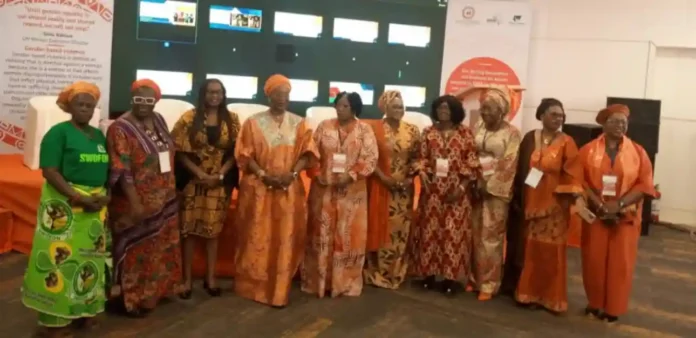
Activists, policymakers, and diplomats gathered in Abuja on Tuesday for the Beijing+30 Women’s Summit to review Nigeria’s progress and ongoing challenges in gender equality, three decades after the 1995 United Nations Beijing Conference. The summit was held as part of activities marking the 2025 16 Days of Activism Against Gender-Based Violence and focused on evaluating past efforts while setting new directions for women’s rights in the country. With the theme “Holding the Line for Women’s Rights: Looking Back and Marching Forward,” the event was convened by the Amandla Institute for Policy and Leadership Advancement in collaboration with the African Women Leaders Network and Womanifesto.
The Minister of Women Affairs and Social Development, Imaan Sulaiman-Ibrahim, called for stronger collaboration among women and stakeholders, stressing that collective effort is needed for meaningful progress. She said, “I can’t do it alone. We have to learn to work together. We have to learn to love each other.” She also cautioned against rivalry among women seeking political positions, encouraging consensus-building and unity as a path to increasing representation. Sulaiman-Ibrahim highlighted reforms in family and child welfare, adoption processes, and women’s access to finance, saying empowered women contribute significantly to societal stability.
In her address, the First Lady of Kwara State and Chairperson of the Nigeria Governors’ Spouses Forum, Olufolake Abdulrazaq, urged renewed efforts to strengthen women’s rights and expand political representation. She said, “This gathering allows us to discuss concerns hindering coordinated actions aimed at advancing women’s health, education, economic participation, and inclusion in leadership.” Abdulrazaq called for temporary special measures such as gender quotas and reserved political seats, noting that Kwara State has already implemented a 35 per cent accommodation bill and granted six-month maternity leave for working mothers. She also drew attention to period poverty, explaining that many girls miss school because they cannot afford sanitary products.
The co-founder of AIPLA and wife of former Ekiti State governor, Bisi Adeleye-Fayemi, reflected on her long involvement in the women’s movement, which began at the 1995 Beijing Conference. She described the conference as a defining moment that strengthened the push for feminist leadership on the continent. She recalled the creation of the African Women’s Leadership Institute in 1996, saying, “We needed a cadre of women across the continent who were grounded in feminist theory and practice. Guess what? We were right.” According to her, the programme has trained more than 10,000 women leaders. She also referenced the establishment of the African Women’s Development Fund in 2000, saying, “AWDF has funded over 4,000 women’s organisations in 42 African countries over the past 25 years with millions of dollars.”
Adeleye-Fayemi warned that despite progress, Nigeria’s gender indicators remain troubling. She stated, “Nigeria currently features poorly on most global indicators measuring Gender Equality and Women’s Empowerment,” citing the 2025 Global Gender Gap Index ranking of 124 out of 148 countries. She also pointed to high maternal and infant mortality, child marriage, female genital mutilation, and the growing number of out-of-school children. “All these issues and more continue to hinder the progress of Nigerian women,” she said. She contrasted these challenges with what she described as areas of progress, including increased awareness of gender rights, improved access to education, and existing legal frameworks such as CEDAW, the Violence Against Persons (Prohibition) Act, and the Child Rights Act. She noted that more women are also taking up leadership roles. However, she cautioned that these gains remain fragile, saying, “We did not get these gains overnight, and we did not get them easily, and some of them are slipping from our grasp. We cannot afford to be tired, because the forces of regression are never tired.”
She added that the current situation demands new approaches, saying, “The challenges Africa faces today require leaders who are prepared to think, build and operate differently.” During a panel session, the Chief Executive Officer of the Nigerians in Diaspora Commission, Abike Dabiri-Erewa, stressed that political parties must deliberately create opportunities for women in their structures. According to her, meaningful progress will be difficult without intentional inclusion. She said, “The political space is getting tougher as women are staying away. The role of mentorship is needed. Political parties have to be intentional about women. We need to support one another.”
Nigeria has recorded legal and policy gains in promoting women’s rights, but cultural norms, limited resources, and structural barriers continue to restrict women’s participation in politics, leadership, and the economy. Laws such as the Violence Against Persons (Prohibition) Act and the Child Rights Act offer protection, yet enforcement gaps still expose many women and children to harm. Women-led organisations and advocacy networks continue to play a significant role by providing mentorship, leadership training, and funding to support women’s inclusion across different sectors.

