

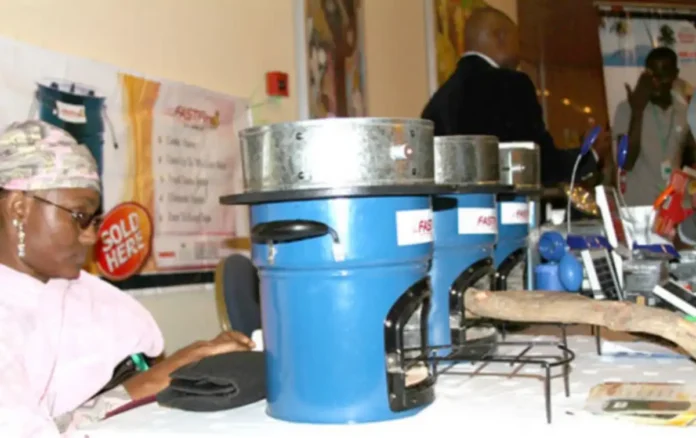
A carbon-credit-financed clean cooking project promoted by GreenPlinth Africa Limited and targeted at changing how households cook in Nigeria has moved closer to nationwide rollout, as stakeholders renewed their support at a media and sensitisation engagement held in Lagos on Wednesday.
The initiative plans to distribute 80 million highly efficient clean cookstoves free to households across the country. It is designed to cut dependence on firewood by more than 90 per cent, reduce deforestation, improve public health and support Nigeria’s Net Zero 2060 commitment. The programme also includes a plan to plant four billion economic trees nationwide and is projected to create about 3.5 million green jobs across the value chain.
Speaking at the engagement, former Deputy Governor of the Central Bank of Nigeria (CBN), Mr. Tunde Lemo, described the project as one of the most ambitious clean cooking and household energy transition programmes ever undertaken globally. He said the initiative is not a pilot scheme but a nationally endorsed and scalable intervention that has already been registered on the United Nations Framework Convention on Climate Change (UNFCCC) Climate Action Portal.
According to Lemo, full implementation of the project could eliminate about 1.2 billion metric tonnes of carbon dioxide annually, placing Nigeria in a strong position as a major contributor to global emission reduction through household energy reform. He explained that the intervention gives priority to women and children, who are most affected by indoor air pollution caused by traditional cooking methods that rely on firewood and other biomass fuels.
Lemo said the transition to clean cooking would be managed in a way that protects existing livelihoods. He explained that firewood sellers would not be displaced but retrained and absorbed into the clean energy value chain. He also disclosed that the programme was formally flagged off in Makoko, Lagos, in June, and that implementation would be phased across different states of the federation.
According to him, once fully implemented, the GreenPlinth Africa project is expected to “remove about 1.2 billion metric tons of carbon dioxide every year, making it the largest single clean cooking and household energy transition initiative globally.” He stressed that the programme is neither experimental nor speculative, noting, “This is not a pilot. It is not a promise. It is a nationally endorsed, structured, and scalable intervention.”
The Lagos State Government also expressed strong support for the initiative. The Special Adviser to the Governor on Environment, Engr. Olakunle Olamidosu Rotimi-Akodu, said challenges such as environmental degradation, flooding and air pollution are largely human-induced and require deliberate corrective actions. He described clean cooking solutions as interventions that combine environmental protection with social and economic benefits.
Rotimi-Akodu said Lagos State has consistently implemented policies aimed at reducing emissions and improving environmental outcomes. He cited the transition from diesel-powered generators to gas-powered independent power plants at the Alausa Secretariat, as well as the introduction of vehicular emission testing, as part of the state’s efforts to cut pollution and improve air quality.
On policy alignment, the Chief Executive Officer of Natural Eco Capital, Dr. Eugene Itua, said the clean cooking initiative directly translates Nigeria’s Long-Term Low-Emission Development Strategy into practical action. He noted that while climate-related policies and strategies already exist, implementation has often been the main challenge, which the cookstove project is helping to address.
Dr. Itua highlighted the public health benefits of the intervention, explaining that prolonged exposure to carbon monoxide and other pollutants from traditional cooking methods contributes to respiratory illnesses, fatigue and other health complications that are often misdiagnosed. He said clean cooking is therefore not only a climate solution but also a public health necessity.
Speaking on policy implementation, Itua said, “Perhaps without really realising it, you are supporting the on-the-ground implementation of what we call the Long-Term Low-Emission Development Strategy.” On the link between policy and action, he added, “The mitigation strategy in that document is what this project is solving, it serves as a wedge between policy announcements and actual implementation,” and noted, “I would like to commend and align with what is happening here today.”
From the legislative arm, the Chairman of the Lagos State House of Assembly Committee on Environment, Hon. Shabi Rasheed Adebola Adekola, said the state legislature would continue to support initiatives aimed at reducing carbon emissions. He recalled that Lagos was among the early adopters of emission control policies and said lawmakers were working on additional legislation to strengthen climate action in the state.
Adebola said the clean cooking initiative aligns with both state and federal priorities, especially as Nigeria seeks to show seriousness in addressing climate change following recent international engagements. He said the Lagos State Government views the project as timely and relevant to its broader environmental and development goals.
Making the position of the state government clear, Hon. Adebola said, “We definitely support this $800 million clean cooking stove initiative, because Nigeria, and especially Lagos, is serious about reducing carbon emissions and protecting our environment.”
Providing further insight into the broader scope of the project, the Chief Business Development Officer of GreenPlinth Africa Limited, Mr. Tony Ojobo, said the clean cooking programme is part of a wider effort to decarbonise major sectors of the economy, including telecommunications, banking and manufacturing. He said Africa is currently tapping into only about five per cent of available opportunities in the global carbon market.
Ojobo announced plans for a continental conference on decarbonisation and climate finance, which will be held in collaboration with the Office of the Vice President and the National Council on Climate Change. He said the conference is aimed at unlocking access to green finance, carbon credits and green job opportunities across the continent.
Also speaking at the event, the Managing Director of LAPO Microfinance Bank, Ms. Cynthia Ikponwosa, said the bank is supporting the initiative as part of its corporate social investment strategy. She disclosed that eight million out of the 80 million clean cookstoves planned for distribution nationwide have been allocated to Lagos State.
She said, “At the center of this initiative is the 80-million highly efficient clean cookstove project, a nationally significant intervention designed to improve health, protect the environment, and deliver measurable socioeconomic benefits at scale. Of the total units, 8 million are earmarked for Lagos State.”
Ikponwosa said the project would significantly reduce indoor air pollution, lower household fuel costs and free up time for women to engage in productive economic and educational activities. She added that beyond financing, LAPO Microfinance Bank plans to use its national network to support distribution, community engagement and sustained adoption of clean cooking solutions.
With implementation already underway, stakeholders at the engagement said the initiative shows how climate action, public health improvement and economic development can be pursued at the same time, particularly at the grassroots level, while delivering measurable benefits for households and the wider economy.

