

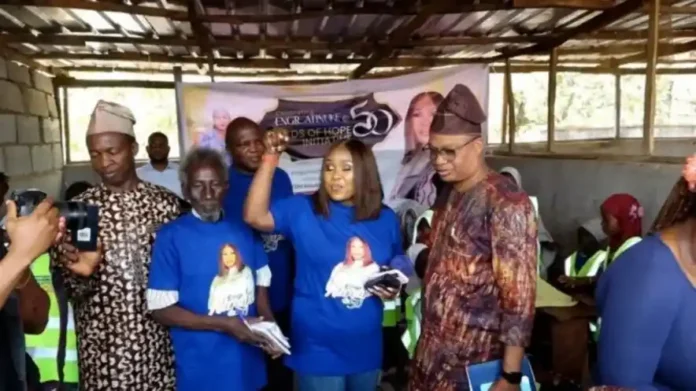
A Nigerian engineer, Atinuke Owolabi, has launched a long-term Science, Technology, Engineering and Mathematics (STEM) education programme aimed at training children living in an Internally Displaced Persons (IDP) camp in Abuja in science, technology, engineering and digital skills.
The initiative is designed to mentor the children, expose them to modern technology, and prepare them for future careers in engineering and other STEM-related fields.
Owolabi, who is a member of the North Central Development Commission representing the Southwest, announced the programme during an outreach to the camp. She explained that the project will run for ten years and will involve regular training sessions, mentorship opportunities, digital learning tools, and scholarships for outstanding participants.
According to her, the programme was created to ensure that children living in difficult circumstances are not excluded from the opportunities offered by science and technology.
“As you can see, most of the kids here are vulnerable kids that got here through all these terrorist attacks and insurgency,” Owolabi said while addressing participants at the outreach.
“But we want to inspire them, we want to mentor them. We want to let them know that the fact that they are in this IDP camp does not mean that this will define their future.”
The programme is titled “Seeds of Hope, Planting Today, Engineering Tomorrow,” and focuses on building foundational STEM knowledge among displaced children who may otherwise have limited access to modern educational resources.
Owolabi explained that when the outreach started, many of the children had little or no knowledge about STEM or engineering.
“If kids of today don’t know what is called engineering, who is going to build the future of our country and the world?” she said.
“The world needs them. And that is what we want them to know.”
The initiative aims to gradually introduce the children to various STEM disciplines through practical learning, mentorship from professionals, and exposure to global opportunities.
Part of the programme includes providing laptops that will allow the children to connect to international learning platforms and digital training tools. Through these resources, the children will be able to develop skills in areas such as digital literacy, coding, robotics, and basic engineering concepts.
Owolabi said the goal is to ensure that the children gain the same exposure and opportunities as students in more privileged environments.
“What we have started today is elementary,” she said.
“By next year, they will be able to go into competition with other girls in private schools and public schools.”
In addition to digital learning tools, the programme will also offer scholarships to participants who demonstrate strong academic performance and commitment to STEM education. The scholarships are expected to support students who wish to pursue engineering or related courses in higher institutions.
The programme also includes mentorship opportunities that will connect the children with innovators, engineers, and technology professionals both within Nigeria and internationally.
Owolabi noted that building such connections is critical in helping the children see real career pathways and develop confidence in their abilities.
“We want to integrate them into society. We want to connect them to innovators and professionals within this country and even outside the country,” she said.
During the outreach, the children participated in hands-on experiments and simple technology demonstrations designed to spark curiosity and creativity.
Facilitator Stella Ozochukwu-Dennis introduced the children to basic robotics projects using everyday materials. One of the activities involved building a simple “wiggle bot” capable of drawing shapes on paper.
Another project showed the children how to convert discarded plastic bottles into solar lamps that can provide light for studying at night.
The exercise demonstrated how science and engineering can be applied to solve real-life problems using locally available materials.
“We want them to enjoy the same exposure as children in privileged schools,” Ozochukwu-Dennis said.
“Today, they know what STEM means.”
She added that training sessions will take place regularly over the next decade as part of the long-term capacity-building plan.
“Every Saturday for the next 10 years, we will be here to build their capacity,” she said.
The programme has also attracted support from professional engineering bodies.
Felix Adegboye, President of the Nigeria Institute of Electrical and Electronic Engineers, commended Owolabi’s decision to celebrate her milestone birthday by investing in the future of vulnerable children.
“When I heard she was marking her 50th birthday by inspiring girls in an IDP camp to pursue STEM, I had to come and support,” Adegboye said.
He encouraged the children to remain focused on their education despite the challenges they face.
“They must be serious with their studies, ask questions in class and never think that where they come from limits them,” he advised.
Another supporter of the programme, Simeon Isibor, described the outreach as an important example of how professionals can contribute to social development through education.
According to him, the initiative highlights the need for stronger corporate social responsibility in supporting vulnerable communities.
“We are in full support of her programme,” Isibor said.
“The institute has donated N100,000 to support the children, and this is just the beginning. We will continue to come here.”
Owolabi also called on government agencies and stakeholders to support efforts to improve living conditions in the IDP camp, noting that better sanitation and infrastructure would create a healthier learning environment for the children participating in the programme.

