

 Add us on Google
Katsina State Governor and Chairman of the Northwest Governors’ Forum (NWGF), Malam Dikko Umaru Radda, has announced the establishment of a Social Development Unit within the NWGF Secretariat to strengthen coordination and drive lasting solutions to internal displacement across the region.
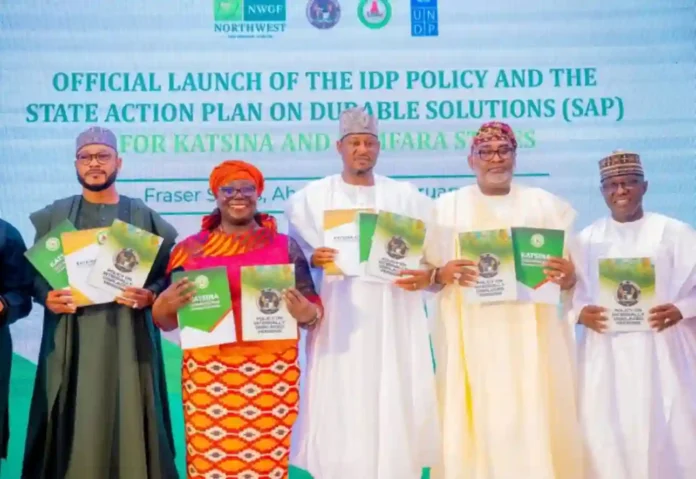
Governor Radda made the announcement on Monday during the official launch of the IDP Policy and State Action Plan on Durable Solutions (SAP) for Katsina and Zamfara States, held at Fraser Suites, Abuja.
In his address, Governor Radda explained that the new unit will coordinate policy alignment, oversee implementation, facilitate partnerships, and strengthen monitoring and peer learning among member states. He said the initiative reflects a collective resolve to tackle displacement through structured and sustainable measures.
He called on state governments, development partners, and other stakeholders to adopt coordinated and sustainable strategies to address internal displacement across the Northwest.
“This launch is more than the unveiling of policy documents. It represents a shared commitment by state governments, the Federal Government, and development partners to address displacement as a structural development challenge that requires long-term, coordinated solutions,” Governor Radda said.
He noted that insecurity, banditry, and communal conflicts have displaced thousands of families in the Northwest, disrupting livelihoods and placing pressure on social systems. According to him, the situation in Katsina and Zamfara is especially severe, making deliberate policy direction and strategic interventions necessary.
Governor Radda highlighted that both states have adopted a policy-driven approach aligned with the National Policy on Internally Displaced Persons, shifting attention from emergency relief to durable solutions that restore dignity, self-reliance, and social cohesion.
“The IDP policies and action plans provide a clear framework for coordinated action. They define institutional roles, establish coordination mechanisms, and outline priority interventions across protection, livelihoods, infrastructure, and social services,” he explained.
He emphasized that displaced persons and host communities remain central to recovery and reintegration plans, ensuring that their voices, needs, and rights guide all development initiatives.
“I commend the governments of Katsina and Zamfara for their leadership in bringing this framework to life. Their efforts demonstrate that displacement cannot be effectively addressed by any single state acting alone,” Governor Radda added.
Governor Radda also revealed that the initiative will extend beyond Katsina and Zamfara.
“The Northwest Governors Forum is committed to scaling this framework across all states of the region, ensuring a harmonized, region-wide approach to internal displacement and durable solutions,” he said.
He stressed that regional coordination is critical for policy coherence, operational efficiency, and greater impact across shared borders and communities.
Earlier, the Executive Governor of Zamfara State, Dr. Dauda Lawal, said years of insecurity had destroyed communities, emptied villages, forced farmers off their land, and kept children out of school. He disclosed that as of 2024, over 216,000 people, mostly women and children, had been displaced across all 14 local government areas of the state.
Governor Lawal explained that his administration is addressing the root causes of insecurity through key initiatives, including the establishment of the State Security Trust Fund, the deployment of volunteer protection guards, and the strengthening of governance systems to ensure accountability and effective service delivery.
He also highlighted efforts to address gender-based violence (GBV) and expand social and livelihood programmes aimed at restoring stability, supporting displaced persons, and empowering communities to rebuild their lives with dignity.
He further stated that the new IDP Policy and State Action Plan provide a structured framework for prevention, protection, coordination, voluntary return, reintegration, and long-term recovery, aligned with national laws and international standards.
“Durable solutions must include security, access to farmland and livelihoods, functioning schools and healthcare, restored infrastructure, and social cohesion,” Governor Lawal said.
Also speaking, the UN Assistant Secretary-General and Resident and Humanitarian Coordinator for Nigeria, Mr. Mohamed Malick Fall, noted that over 3.7 million Nigerians are currently displaced.
He stressed that displacement is not only about physical movement but about ensuring that every citizen can live in peace and contribute to national development.
“The Northwest is now stepping forward, following earlier efforts in Borno, Adamawa, Yobe, and Benue, showing that durable solutions are possible when security, development, and social services advance together,” Fall said.
Fall reaffirmed the UN’s commitment to supporting Nigeria under national leadership. He revealed that in 2025 alone, nearly 150,000 displaced persons accessed livelihoods, almost 200,000 benefited from education and skills training, and more than 38,000 received vital documentation.
In the same vein, UNDP Resident Representative Ms. Elsie Attafua described internal displacement as a major national concern affecting both stability and development. She noted a clear shift from short-term humanitarian assistance to state-led recovery, reintegration, and long-term development strategies.
She explained that displacement is not just about people moving from one place to another but about helping communities rebuild livelihoods and contribute meaningfully to growth and progress.
“The Northwest is progressing, building on lessons from the BAY states and Benue, demonstrating that durable solutions succeed when states lead, institutions are strong, and partnerships are sustained,” she added.
Delivering the vote of thanks, Maryam Yahaya, Director-General of the Northwest Governors’ Forum, observed that displacement in the region goes beyond the need for shelter, causing trauma, loss of dignity, and interrupted lives.
She warned that insecurity affects everyone and stressed the need for inclusive communities, strong governance, and deliberate development efforts to address the crisis.
The event was attended by the Minister of Humanitarian Affairs, Dr Bernard Doro; Minister of State for Education, Prof. Suwaiba Ahmed; Minister of Niger Delta Development, Hon Abubakar Momoh; and Alhaji Uba Maigari Ahmadu, Minister of State for Regional Development. Also present were the Chief of Staff to the Governor of Katsina State, Abdulkadir Mamman Nasir, as well as members of the Katsina and Zamfara State Executive Councils.

