

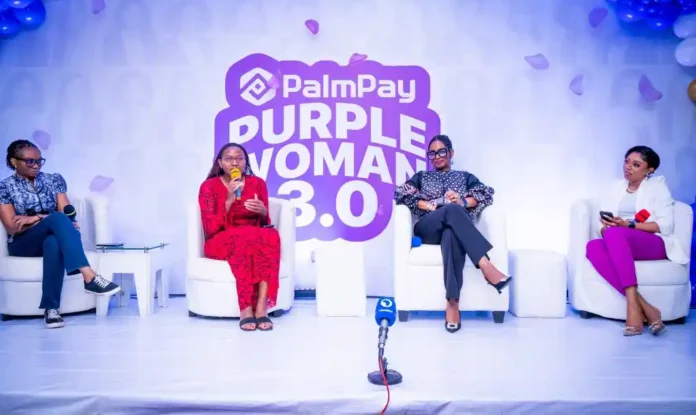
PalmPay Nigeria has trained young Nigerian women through its Purple Women Global Masterclass, a programme designed to equip participants with digital and professional skills while increasing women’s participation in the financial technology sector.
The initiative, which is part of PalmPay’s broader Purple Women programme, aims to address the low representation of women in fintech and the wider technology ecosystem by providing training, mentorship and career opportunities for women interested in technology-driven careers.
Speaking during the third edition of the Global Women’s Masterclass, Managing Director of PalmPay Nigeria, Chika Nwosu, explained that the programme was created after the company recognised a significant gender gap within the fintech industry.
“This initiative is because we noticed that there are not so many women in fintech and in the tech industry, and we intend to bridge that gap. We want to see a whole lot of women in leadership positions in fintech,” Nwosu said.
The training programme was organised in collaboration with the Global Women’s International Campaign Nigeria as part of activities commemorating International Women’s Day. Through the initiative, participants were introduced to practical digital skills and professional development training intended to prepare them for opportunities within the technology and fintech industries.
According to Nwosu, empowering women economically and technologically has far-reaching social and economic benefits that extend beyond individuals to families and communities.
“A money in the hand of a man feeds a family, but money in the hand of a woman feeds generations,” he said, adding that women’s financial empowerment often leads to improved education, stronger households and better opportunities for children.
Although the masterclass was hosted in Lagos, participation was open to women from across Nigeria through an online registration system, allowing interested participants from different parts of the country to join the programme.
“Our head office is in Lagos, but we invite women from all over Nigeria. They register through a link for Purple Women. It is not only for people in Lagos; it is for all Nigerians,” Nwosu said.
At the end of the training programme, PalmPay selected the top ten participants for a six-month internship at the company, where they will gain practical experience working across different departments within the organisation.
Head of Human Resources at PalmPay, Anthony Iwuala, said the selection process for the internship programme followed a merit-based system designed to identify participants with the strongest performance during the masterclass.
“For us at PalmPay, we believe in equity and equality and following the right process. As a company, we believe in people who have skills and talent, so we ensure that we select people who are qualified,” Iwuala said.
Participants in the programme were assessed through classroom activities and written tests conducted throughout the training sessions. According to Iwuala, many participants performed well, but the company had to rank them and select the top ten candidates for the internship.
“Participants went through the classes and wrote tests for every class. A lot of people passed, but we still had to rank them and select only the top ten,” he said.
The selected interns will be deployed across several departments at PalmPay where they will receive mentorship and hands-on experience from industry professionals.
Iwuala explained that the interns will work in departments such as marketing, human resources, administration, product development, sales and business intelligence. Each participant will also be paired with mentors who will guide them throughout the internship period.
“We assign mentors to them, and these mentors will provide on-the-job training for six months,” he said.
He added that the company intends for the internship programme to go beyond training by creating long-term employment opportunities for the participants.
“We are not just taking them to train them; we train them to employ them,” he said.
Iwuala noted that earlier editions of the Purple Women programme have already produced tangible employment outcomes for participants.
“The Purple Women 2.0 programme saw the ten women we trained offered full employment at PalmPay, and they are still working with us currently,” he said. “These ones will not be different.”
Also speaking during the event, Chief Executive Officer of Hydrogen, Kemi Okusanya, encouraged women to pursue careers in technology, particularly in areas such as product development where female representation remains limited.
“The only thing that can stop you is yourself. From a product perspective, the world needs us more,” she said.
Okusanya explained that when digital products are designed primarily by men, certain user experiences relevant to women may be overlooked.
“We cannot keep having men develop products that women use. If that continues, there will always be a gap. Women need to enter that space and start developing products from our own experiences,” she said.
She also encouraged women participating in the technology ecosystem to think beyond local markets and build solutions that can compete globally.
“There is nothing stopping us from becoming global. But we must start locally, take the lessons from our environment and build solutions that can scale globally,” Okusanya said.
During the masterclass, Director of the Enterprise Development Centre at Pan-Atlantic University, Nneka Okekearu, delivered a session focused on helping women build confidence and recognise their abilities in professional environments.
Okekearu explained that many women face unconscious biases that can influence their career choices and limit their confidence in pursuing opportunities within industries such as technology.
“A lot of women have grown up being told they cannot do certain things. Unlike their male counterparts, they are sometimes discouraged from pursuing opportunities,” she said.
According to her, the session focused on helping participants develop self-awareness and confidence while encouraging them to take ownership of their skills and capabilities.
“A lot of women have so much to give, but they are shackled by unconscious bias. The session focused on self-awareness, building confidence and realising that we know it and should own it,” she added.
Okekearu noted that progress has been made in increasing women’s representation in leadership positions within Nigeria’s corporate sector, particularly in the banking industry.
“Today we have more than 30 percent of commercial banks with female CEOs. We now have women serving as bank chairpersons and more women on corporate boards,” she said.
However, she also pointed to what she described as the “missing middle”, where many women leave the workforce during key stages of their careers, particularly after marriage or childbirth.
“When women enter the workforce, by the time they get married and have children, many leave. We need systems that allow them to return without losing their career progress,” Okekearu said.
Nwosu said PalmPay plans to continue expanding the Purple Women initiative through future editions of the Global Women’s Masterclass in order to reach more women across Nigeria.
“The fourth edition will definitely come and we are going to make it bigger and better,” he said.
He added that the long-term objective of the initiative is to see more Nigerian women actively participating in the fintech industry and occupying leadership roles across the technology and financial services sectors.

