

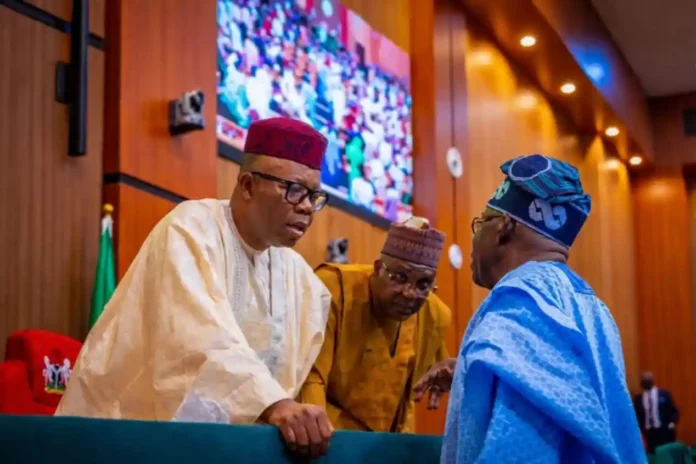
The Senate on Tuesday approved President Bola Ahmed Tinubu’s request to secure $6 billion in foreign loans aimed at supporting Nigeria’s 2026 budget and funding critical infrastructure projects, marking a significant step in the Federal Government’s fiscal and economic strategy.
The approved financing package consists of $5 billion to be sourced from First Abu Dhabi Bank and an additional $1 billion backed by United Kingdom Export Finance (UKEF). While the larger facility is designed to address budgetary shortfalls and refinance existing debt obligations, the $1 billion component is targeted at the rehabilitation and modernisation of Lagos ports, a key pillar of Nigeria’s trade and logistics system.
In his communication to the Senate, President Tinubu explained that the $5 billion facility would be structured under a Total Return Swap (TRS) external financing programme. According to him, the arrangement is intended to provide flexible funding in tranches, allowing the government to respond to pressing financial needs while maintaining sustainability in debt servicing.
“The purpose of this letter is to request the approval and resolution of the National Assembly to establish a structured Total Return Swap (TRS) external financing programme of up to $5 billion,” the President stated.
He further explained that the facility, to be arranged with First Abu Dhabi Bank, would play a multi-functional role in stabilising public finances. “The programme is intended to support budget implementation, fund key infrastructure projects, and refinance more expensive domestic and external debts,” he said.
Beyond addressing immediate fiscal gaps, the government also indicated that the loan would help reduce the pressure associated with high-cost borrowing. Tinubu noted that the drawdown would be executed in phases to ensure that Nigeria’s debt profile remains manageable.
“The drawdown will be done in tranches to ensure sustainability in debt stock and servicing,” he added, while also requesting legislative approval to authorise the issuance of Federal Government securities as collateral for the facility.
The approval comes against the backdrop of Nigeria’s rising debt profile, which the President put at $110.3 billion as of December 31, 2025. He also projected a debt service obligation of about ₦20.5 trillion for 2026, underscoring the urgency of securing more favourable financing options.
Alongside the budget-support loan, the Senate also approved a $1 billion UKEF-backed facility dedicated to the reconstruction and upgrade of the Lagos Port Complex and Tin Can Island Port. The project is expected to be implemented under an Engineering, Procurement and Construction plus Finance (EPC+F) model by the Nigerian Ports Authority.
According to the President, the ports rehabilitation initiative is a strategic intervention aimed at reversing decades of infrastructure decay and positioning Nigeria as a competitive maritime hub.
The letter noted that many of the port facilities have been in operation for between 50 and 100 years and are now in advanced stages of deterioration, affecting efficiency and safety.
The government emphasised that the upgrade would address long-standing infrastructure deficits, improve operational performance, and align Nigerian ports with global standards. It also projected that the modernisation would enhance trade flows and support the country’s drive towards economic diversification, particularly through increased non-oil exports.
A detailed breakdown of the financing shows that $429.7 million will be allocated to the Lagos Port Complex, including $373.2 million for commercial contract financing and $56.5 million for the UKEF premium. Tin Can Island Port is set to receive $571.1 million, comprising $496 million for commercial financing and $75.1 million for the UKEF premium.
The facility is structured with a tenure of up to 14 years and an availability period of 48 months. The UKEF premium, estimated at 1.07 per cent per annum, is payable upfront but can also be financed as part of the loan arrangement.
Senate President Godswill Akpabio, who read the President’s letters during plenary, commended Tinubu for securing the financing arrangements, describing them as a product of Nigeria’s renewed international engagements.
“This development is one of the gains of the recent engagement with the United Kingdom. I was present when the agreement was signed, and I must commend the President for his efforts. The results are beginning to show,” Akpabio said.
He also highlighted the urgent need to rehabilitate the country’s port infrastructure, particularly Tin Can Island Port, which he described as severely outdated.
According to him, some of the infrastructure at the port dates back to the early 20th century, including breakwaters constructed as far back as 1901, which have contributed to operational inefficiencies.
“The implication is that the current is too strong, and ships experience delays. Many now prefer to berth in neighbouring countries, making Nigeria less attractive for maritime business,” he stated.
The Senate’s approval follows earlier clearance by the Federal Executive Council, signalling alignment within the executive arm on the borrowing plan. The government maintains that the loans are part of a broader strategy to strengthen fiscal capacity, address infrastructure deficits, and improve the overall competitiveness of the Nigerian economy.
By combining budget support with targeted infrastructure investment, the approved financing is expected to play a central role in shaping Nigeria’s economic direction in the coming years.

