

The Federal Government says structures are being strengthened to support Nigeria’s long-term goal of becoming self-sufficient and competitive in sugar production, following reforms at the Nigeria Sugar Institute aimed at repositioning it as a national centre of excellence for the industry.
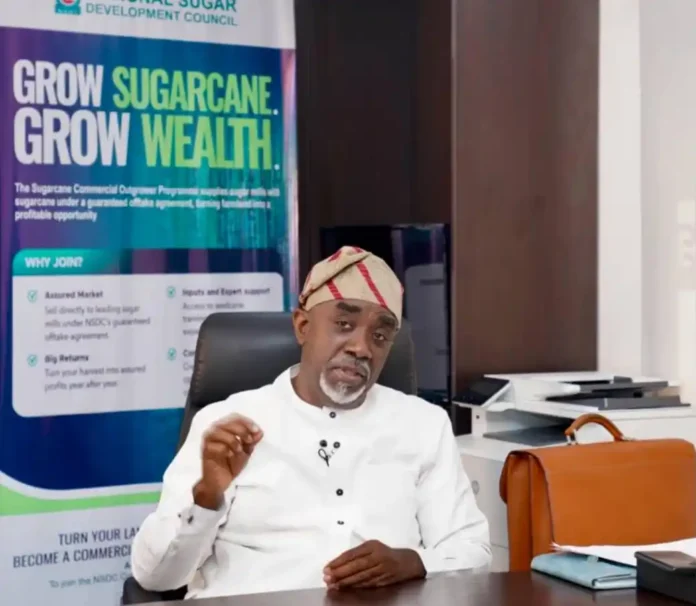
The Executive Secretary and Chief Executive Officer of the National Sugar Development Council, Mr. Kamar Bakrin, clarified the institutional status of the Nigeria Sugar Institute, dismissing public misconceptions and outlining reforms designed to support the country’s sugar sector. He spoke during a recent interview with journalists, where he explained that the Institute was established as a purpose-built national institution to serve as the research, training and technical backbone of the industry, operating under the strategic oversight of the Council.
According to Bakrin, the Nigeria Sugar Institute was incorporated in June 2019 and formally commissioned in January 2021, with its headquarters located in Ilorin, Kwara State. He said the Institute was deliberately designed as a shared, industry-wide platform to consolidate research, manpower development and technical support in a single national hub serving all segments of the sugar value chain.
“The Nigeria Sugar Institute is a purpose-built national institution established to serve as the research, training and technical backbone of Nigeria’s sugar industry,” he said. “It operates under the strategic oversight of the NSDC and exists to ensure consistent access to quality planting materials, skilled manpower and credible technical expertise for the industry.”
Bakrin explained that the Institute houses specialised bio-factory and tissue culture laboratories that play a critical role in varietal development, seedcane multiplication and applied research. He noted that these facilities support both the sugar and ethanol value chains and directly address one of the sector’s long-standing challenges, which is limited access to high-quality planting materials for commercial cultivation.
He stressed that contrary to some public perceptions, the Institute was not created to serve a narrow group of operators. Rather, it was established as an industry-wide resource accessible to all players across the sugar sector. According to him, sugar operators are already making use of NSI services, including seedcane supply, technical support and structured capacity building programmes.
“As the Institute continues to scale and demonstrate value, discussions around broader industry participation and long-term support will naturally evolve,” Bakrin said. He added that NSI is “functioning exactly as intended—as a national centre of excellence strengthening the growth, resilience and competitiveness of Nigeria’s sugar industry.”
On reforms implemented since his appointment, Bakrin said the Council embarked on a deliberate and systematic rebuilding of the Institute, starting with governance and institutional structure. He explained that the objective was to reposition NSI into a fully functional, industry-facing centre capable of delivering practical research, training and technical support to the sector.
“We set out to reposition NSI into a fully functional, industry-facing centre for research, training and technical support,” he said. “With the support of KPMG, we strengthened governance systems, clarified roles and aligned the Institute with global best practices.”
Beyond governance reforms, Bakrin disclosed that the NSDC prioritised human capacity development. He said more than 60 NSI staff members have undergone targeted managerial and technical training over the past two years. According to him, the training covered project management, stakeholder engagement, laboratory instrumentation, soil analysis and equipment maintenance, among other areas critical to the Institute’s mandate.
He added that NSI has also been repositioned as a national training hub through the NSDC/NSI Boot Camp initiative. The programme delivers hands-on training in sugar processing, refining, quality control, industrial safety and environmental compliance, with the aim of raising technical standards across the industry.
Bakrin said significant investments were also made in curriculum development and standard operating procedures covering the full sugar production cycle, from cane preparation to refining and by-product utilisation, with strong emphasis on safety and sustainability. He noted that the strengthened capacity at NSI is already translating into direct industry impact.
He cited joint technical training programmes conducted for Golden Sugar Estate in Sunti, Niger State, as well as comprehensive field-to-factory training delivered for new hires at the BUA-owned Lafiagi Sugar Company in Kwara State. According to him, these engagements reflect how the reforms are laying a solid foundation for the Institute to fully deliver on its mandate and support Nigeria’s long-term drive towards self-sufficiency and competitiveness in sugar production.
“When we speak about progress at NSI, we are talking about a systematic rebuilding of institutional capacity,” Bakrin said. “These reforms are positioning the Institute as a credible national centre of excellence for the sugar industry.”
Read also: FG says over 100,000 vehicles run CNG, targets one million by 2027

