

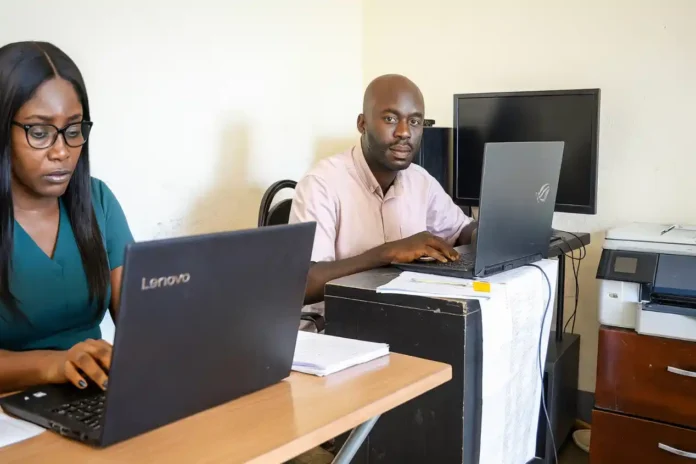
By 2030, Sub-Saharan Africa is expected to generate 230 million digital jobs, driven by the rapid expansion of digital services, according to a World Bank report that places Africa’s youth at the center of the continent’s economic future. With about 60 percent of Africa’s population under the age of 25, the report says the region holds vast human potential that could be unlocked through inclusive digital transformation.
The report argues that Africa’s greatest wealth may not be its minerals, oil, or land, but its young people. It notes that millions of young Africans remain disconnected from the digital economy, not because they lack interest, but because they lack access, skills, and opportunities. In a global economy increasingly shaped by digital technologies and artificial intelligence (AI), this gap represents both a serious challenge and a major opportunity.
The World Bank describes the situation as a call to action. It says Africa is at a pivotal moment in its digital journey, with digital services expanding rapidly across the continent. If current efforts are strengthened and scaled, the expected 230 million digital jobs by 2030 could transform livelihoods, reduce poverty, and support long-term growth across Sub-Saharan Africa.
One of the central issues highlighted in the report is the digital divide. In 2024, internet penetration in Africa reached 40 percent, a sharp increase from just 3.2 percent in 2005. More than 600 million people now use mobile broadband internet. However, progress remains uneven. Over 900 million Africans are still offline, and about 76 percent face what the report calls a “usage gap.” These people live in areas with network coverage but cannot afford data, devices, or do not have the skills needed to use digital services. In rural areas, internet access drops to just 28 percent.
The report stresses that bridging the digital divide is both a social and economic priority. Digitalization is expanding access to education, healthcare, financial services, and markets. It helps reduce inequality, empowers communities, and supports job creation. The arrival of international submarine cables and mobile broadband has already increased labor force participation and incomes in several African countries. According to the World Bank, these changes also create spillover benefits for agriculture, industry, and tourism.
Local success stories show what is possible. In West and Central Africa, countries like Benin have made significant progress. In Benin, more than 250 public services are now available online. Fiber optic connections have reached 68 municipalities, and mobile network coverage now extends to 92 percent of the country’s territory. Community-based digital training programs have helped thousands of people gain new skills. The report highlights the example of Awa, a high school student who can now access online learning and mentorship platforms, opening new opportunities in education, entrepreneurship, and civic participation.
The World Bank notes that such successes should not be isolated cases. Despite growing network coverage, nearly 700 million Africans still do not use the internet. The report says this shows that access alone is not enough. Data must be affordable, digital services must be relevant to daily needs, and digital education must be strengthened to help people fully participate in the digital economy.
The report also points to a key moment ahead. Leaders, policymakers, private sector actors, and civil society groups are expected to meet in Cotonou, Benin, on November 17 and 18, 2025, for the Regional Summit on Digital Transformation in West and Central Africa. Discussions will focus on closing the usage gap, opportunities linked to AI, and building a single digital market for the region.
Africa’s AI market is estimated to be worth $2 billion by 2025, driven largely by startups and the use of optimization tools and consumer services. The World Bank says the goal should go beyond adoption to include adaptation and local creation. Ethical and locally relevant AI solutions are already emerging. In Benin, AI is being used in agriculture, health, education, and public services, including a Fon language speech recognition model designed to improve access for rural and elderly populations. Similar innovations are taking place across the continent.
To scale these efforts, the report calls for more investment in STEM education, basic digital infrastructure, and enabling regulatory frameworks. It highlights the African Union’s Digital Transformation Strategy (2020–2030) as a roadmap toward a harmonized digital marketplace. Africa’s e-commerce market, valued at more than $50 billion in 2024, is expected to grow by at least 10 percent each year. Achieving this growth will require better regional connectivity, cross-border data flows, interoperable platforms, and strong rules on cybersecurity and data protection.
The World Bank says the Cotonou summit will offer a chance to renew commitments to inclusive digital progress, digital job creation, and deeper regional integration. It notes that governments, the private sector, civil society, and development partners, including the World Bank itself, are working through new partnerships and digital compacts to mobilize investment.
The report adds that the summit will ensure “everyone has a voice,” with governments leading reforms, businesses investing in innovation, and youth contributing creativity and resilience.

