

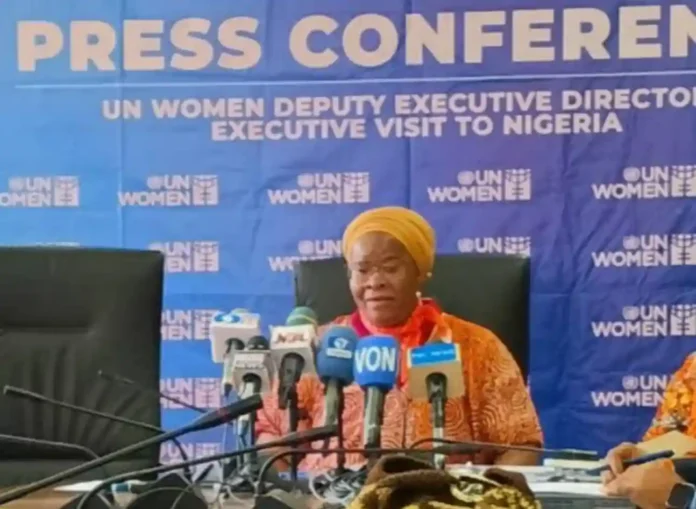
The UN Women Deputy Executive Director, Ms. Nyaradzayi Gumbonzvanda, has said that economic empowerment of women and girls is central to sustainable development, noting that sustained progress, predictable funding, and innovative financing remain essential to achieving positive results. She made the statement in Abuja at a press conference held to brief journalists on her tour of rural communities and strategic engagements with government, development partners, civil society, and the private sector. According to her, “empowering women is key to strengthening communities and enhancing resilience.”
Gumbonzvanda explained that targeted investments such as WASH facilities and the Kwali agro-processing centre help reduce unpaid care burdens, enhance productivity, and expand income opportunities for women. She added that gender-responsive budgeting plays a vital role in ensuring that resources are allocated to programmes that support women in agriculture, enterprise development, and skills acquisition. She further noted that “empowering women economically is not charity; it is innovative development with benefits that extend to entire communities.”
She expressed concern that nearly one in three women globally experiences physical or sexual violence in their lifetime, stressing the need for effective legal frameworks and inclusive governance to reverse the trend.
Gumbonzvanda highlighted her meetings with members of the National Assembly, diplomatic partners, the United Nations Country Team, civil society organisations, and grassroots women leading change in their communities. She commended Nigeria’s lawmakers for their commitment to strengthening laws that protect women and girls as well as advancing actions that expand women’s participation in governance.
“My discussions with ambassadors accredited to Nigeria also underscored the importance of enhanced regional cooperation, particularly across the Sahel and West Africa, where women’s leadership and peace building efforts are indispensable for stability and sustainable development,” she said.
The UN Women Deputy Executive Director also reflected on her visits to rural communities, stating that the engagements enabled her to witness firsthand the impact of UN Women’s work. She said, “The commissioning of new WASH facilities and a rehabilitated agro-processing centre in Kwali demonstrates how targeted investments improve women’s safety, reduce time burdens, and expand income-generating opportunities.”
According to her, global evidence shows that access to safe water and sanitation reduces the time women spend on unpaid care work, allowing greater participation in economic activities. She reiterated UN Women’s commitment to strengthening coordinated, multi-sectoral action, particularly in gender-based violence prevention, women’s economic empowerment, and the Women, Peace and Security agenda in Nigeria.
Gumbonzvanda stated that integrated approaches improve outcomes by up to 40 percent compared to isolated interventions, adding that stronger joint programming, harmonised advocacy, and shared accountability are needed.
She raised alarm over increasing cases of technology-facilitated gender-based violence, noting that the problem is rising globally and nationally. Gumbonzvanda stressed that UN Women is supporting Nigeria to strengthen policy frameworks, enhance digital safety, and promote accountability for online harms. She noted that “between 16 percent and 58 percent of women worldwide experience some form of online or technology-facilitated GBV, depending on the region (UN Women, 2022). UN Women will continue to mobilise partnerships to ensure that frontline organisations and national institutions have the resources required to deliver lasting change.”
Gumbonzvanda also praised Nigeria for demonstrating strong leadership and a clear commitment to advancing the rights of women and girls. She assured that UN Women stands ready to continue supporting national efforts and working with partners to translate commitments into measurable and transformative results.
Speaking on women’s representation in leadership, she emphasised that under-representation undermines gender equality and slows development. She stated that “as of January 2025, women hold only 27.2 percent of parliamentary seats worldwide. This under-representation undermines gender equality and slows structural change.” According to her, quotas and special measures are globally recognised as effective ways to accelerate women’s participation in governance.
She welcomed Nigeria’s proposed Special Seats Bill, noting its alignment with international best practices. Gumbonzvanda said its adoption would ensure that women’s voices influence legislation, budgets, and national priorities. She stressed that affirmative action is not symbolic but strategic, as it strengthens democracy, improves accountability, and ensures that issues affecting women and girls receive appropriate attention.
For her part, the UN Women Representative to Nigeria and ECOWAS, Beatrice Eyong, commended the media for driving advocacy against gender-based violence. The Deputy Executive Director was accompanied by the Deputy Executive Director, UN Women Central and West Africa, Maxime Hounato, on her engagements.
The visit aimed to deepen partnerships, reinforce national leadership, and accelerate collective efforts to advance gender equality and economic empowerment of women and girls in Nigeria. The tour formed part of activities marking the 16 days of activism against gender-based violence and highlighted UN Women’s continued support for national actions that create safer, more inclusive, and more prosperous communities for women and girls across the country.

