

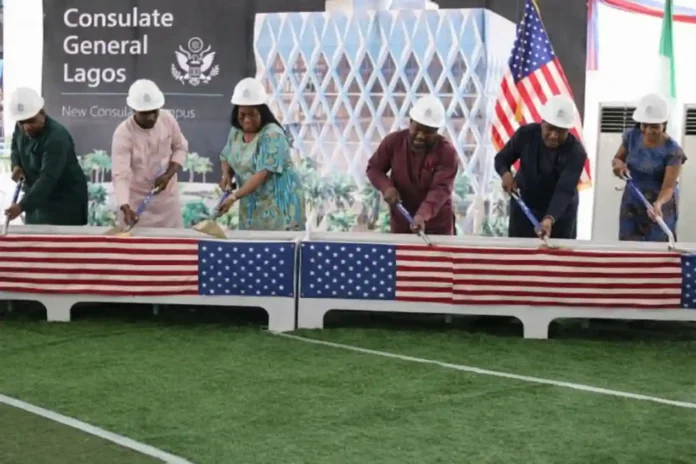
The United States is set to employ about 2,500 Nigerians as part of its plan to open a new consulate complex in Eko Atlantic City, Lagos, by 2028, according to a US Mission official. The project, valued at $537m, is one of the largest diplomatic construction efforts currently underway outside the United States.
The 10-storey consulate project is located on 12.2 acres within Eko Atlantic City. It is expected to provide an estimated $95m investment directly into Nigeria’s local economy while creating jobs for engineers, architects, artisans, construction workers and administrative staff. Construction activities were ongoing during a visit by our correspondent to the site in late January 2026.
During the visit, workers wearing reflective jackets were seen operating on different floors of the building, while trucks transporting building materials moved steadily in and out of the area, indicating the scale of work being carried out.
The project is advancing at a time when the United States is tightening its immigration policies under President Donald Trump’s administration. On his inauguration day as the 47th President of the United States, Trump signed executive orders aimed at strengthening immigration enforcement, including changes affecting citizenship by birth for children of illegal immigrants.
These policy shifts have raised concerns among Nigerians and other African nationals living illegally in the United States, with many expressing fear of possible deportation. Despite these developments, the US investment in the Lagos consulate project has continued.
When completed, the new US Consulate is expected to be the largest in the world, reflecting the importance of diplomatic ties between Nigeria and the United States. Construction began in 2022 and was initially scheduled for completion in 2027 before the timeline was adjusted.
Workers at the site told newsmen that about four contractors are handling different parts of the project, with some focusing on the main building and others working on road and bridge infrastructure.
“They are probably on the last floor,” a security officer at the site said on condition of anonymity. “They are doing concrete casting for the fences,” he added, praising the quality of the work.
Another construction worker, who declined to give his name because he was not authorised to speak, said work is carried out daily except Sundays. “Some are doing roads, some are doing the bridge. You can see the bridge over there,” he said.
Efforts to get comments from the contractors during the visit were unsuccessful, as some officials who identified themselves as managers said formal approval would be required before speaking.
A private driver, who gave his name simply as John and operates within Eko Atlantic, said he did not believe recent US immigration policies would affect American investments in Nigeria. “It will not affect investments,” John said. “Is there any country that will not allow investments?”
When contacted, a US Mission official confirmed that the New Consulate Compound project remains on schedule, with occupancy expected in early 2028. According to the official, the project represents more than physical construction.
“It is a tangible expression of the longstanding bilateral partnership that has defined our journey together for over 65 years,” the official said.
“The New Consulate Compound will provide a modern space for us to continue working together, building on foundations laid in areas such as health cooperation, cultural exchanges, security cooperation and bilateral commercial partnerships,” the official added.
The official said the project is contributing to Nigeria’s economy, with about $95m being spent locally to support employment for approximately 2,500 Nigerian professionals.
“In addition to creating jobs, the project is equipping workers with new technical expertise and enhanced safety skills that will strengthen their competitiveness in the local labour market long after construction is complete,” the official said.
Construction activity across the site suggests steady progress, with visible coordination among teams and ongoing delivery of materials supporting the project timeline as planned there.

