

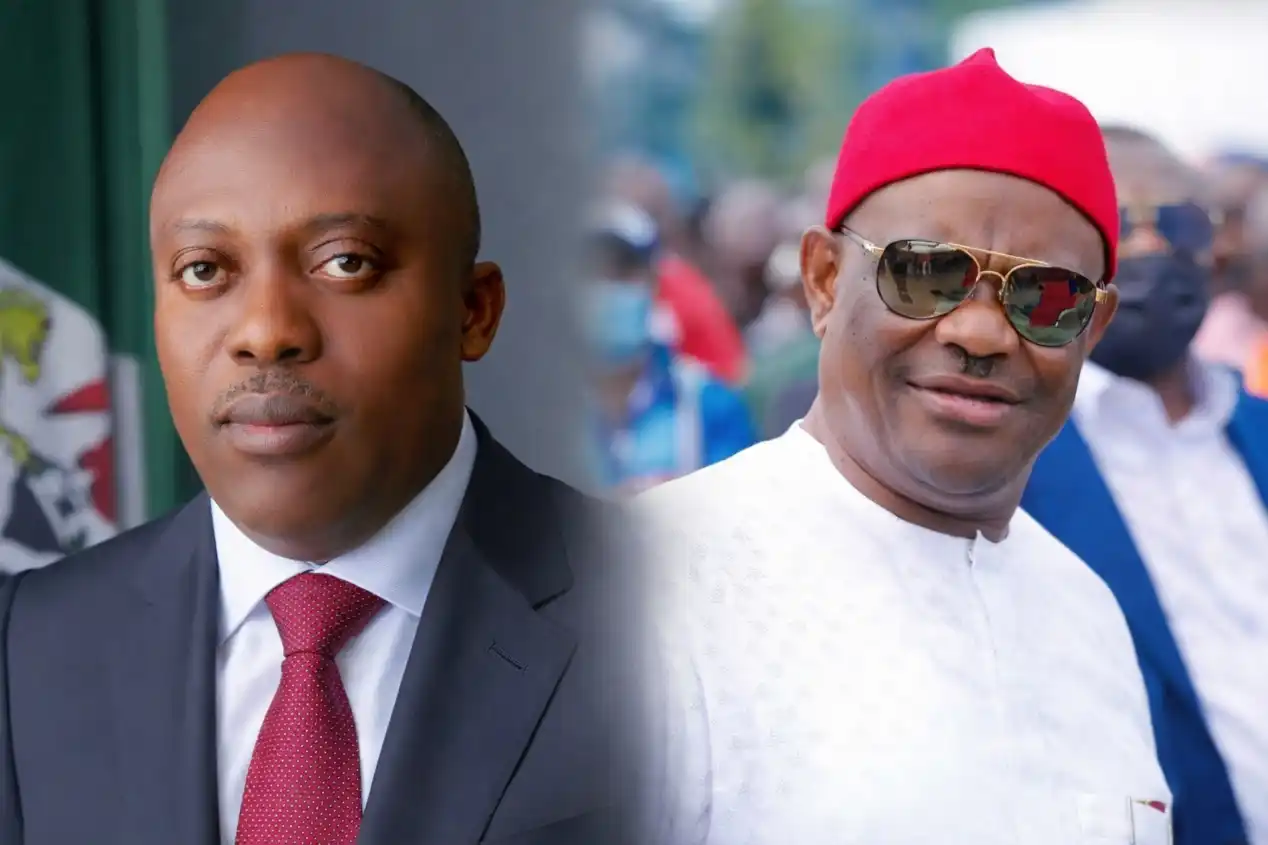
The Minister of the Federal Capital Territory, Nyesom Wike, has accused his successor and Governor of Rivers State, Sir Siminalayi Fubara, of cancelling the employment of 10,000 youths engaged by his administration shortly after assuming office.
Wike made the allegation on Wednesday in Ahoada main town during the Renewed Hope Family thank you visit to Ahoada East Local Government Area of Rivers State, where he addressed party supporters, community leaders, and residents.
The former Rivers governor criticised Fubara for allegedly taking credit for major road projects initiated by his administration in Ahoada and Emohua, describing the governor as a bad child for failing to sustain what he called his legacies in office.
According to Wike, his administration deliberately invested in youth employment and critical infrastructure to reposition Rivers State as one of the most respected states in the federation and to create economic stability for young people.
“I employed Rivers State youths, 10,000 of them. The person we handed over power to, instead of allowing the 10,000 youths to continue working, cancelled the employment. Ten thousand youths. A bad child is a bad child,” Wike said.
He expressed displeasure that projects he said were substantially funded before he left office were now being publicly claimed by the current administration without acknowledging the groundwork already completed by his government.
“When I decided to dualise this Ahoada road, people thought it was impossible. But today, Ahoada East and Ahoada Town are coming back to be the cities they are supposed to be,” he said.
Wike explained that before leaving office, his administration completed Phase One of the Ahoada road dualisation and formally flagged off Phase Two, which would extend the road project to Omoku.
He added that the Emohua–Kalabari Road project was awarded around the same period, with clear payment arrangements designed to ensure steady progress and timely delivery of the projects.
“The job was given to Julius Berger. We signed an agreement for them to collect ₦4 billion every month from our Internally Generated Revenue. The total cost of the Ahoada–Omoku and Emohua–Kalabari roads was over ₦80 billion,” he said.
According to him, the payment structure was carefully planned to ensure the completion of the road projects within two years, despite the high cost and scale of the infrastructure works involved.
Wike further stated that on some other road projects handled by Setrako, his administration had already paid about 70 per cent of the total contract sum before leaving office.
“Today, I hear people are making noise. They have forgotten who laid the foundation. What is continuity?” Wike queried during his address to the gathering.
He also lamented that Rivers State, which he said enjoyed national respect and recognition during his tenure, had allegedly lost its standing since the change in leadership.
“When I handed over, I said, ‘See where I stopped; please continue with this programme that will make our state one of the most respected in this country.’ When I was governor, Nigeria respected Rivers State. I don’t know what it is today,” he said.
Also speaking at the event, the Leader of the Renewed Hope Family in Ahoada and Chairman of the South-South Development Commission, Chibudom Nwuche, said Governor Fubara emerged based on political instructions, just as Rivers people voted for President Bola Tinubu.
Nwuche, a former Speaker of the House of Representatives, maintained that Ahoada would continue to support President Tinubu and the Renewed Hope political structure across the South-South region.
He commended Wike for what he described as numerous development projects attracted to Ahoada and for the political sacrifices he made in backing Tinubu and the emergence of the Rivers governor.
“No governor has ever shown the kind of commitment to the development of Ahoada that Chief Wike has shown,” Nwuche said, pledging continued loyalty to the FCT minister and his political leadership.
He warned individuals he described as interlopers to stay away from Rivers State politics, stressing that political dynamics differ across states and must be understood locally.
“Politics is local. Go to your states and show your strength. Leave Rivers State alone. Rivers has its peculiar politics which we understand,” he said.
Nwuche added that leadership requires unity and gratitude, warning that internal division weakens political structures and undermines collective political goals.
“When a leader chooses one of us, the person is expected to show gratitude and work with the entire team. When you divide a team, that is not how to show gratitude,” he said.

