

 Add us on Google
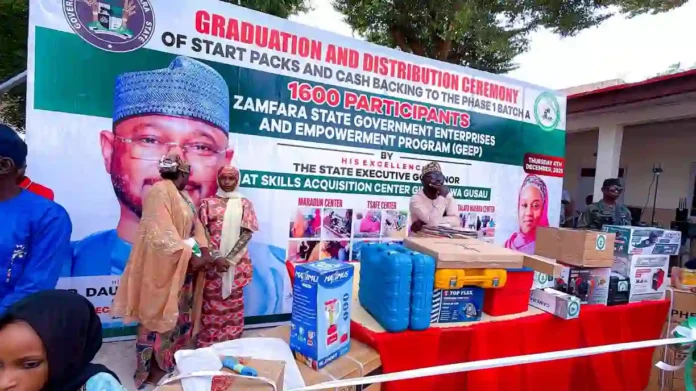
Zamfara State has graduated 1,600 trainees under the Government Enterprises and Empowerment Programme (GEEP) Skills Acquisition initiative, as Batch B preparations also begin. The event marked the completion of Phase One, Batch A of the scheme, where beneficiaries received cash grants and working tools to start their businesses. The initiative is part of President Bola Ahmed Tinubu’s Renewed Hope agenda aimed at empowering Nigerians through practical and sustainable skills.
The graduates completed three months of intensive training across 21 specialized trades, including tailoring, welding, ICT, hairdressing, and other vocational fields. Governor Dauda Lawal, accompanied by the Minister of State for Humanitarian Affairs, presented the start-up support to the trainees in Gusau. The governor said the initiative was designed to reduce unemployment and give youth practical pathways to financial independence.
“We are gathered here not just to mark the end of the training program but to witness the unfolding of a new chapter in the lives of our young citizens — one where they will contribute positively to the economic progress of our dear state. We recognize from the beginning that sustainable peace, economic revival and social harmony cannot be achieved when a large proportion of the population — especially the youth — remain without productive engagement. I encourage you to seek opportunities to network, to collaborate and to continue learning. The knowledge you have gained is just the foundation,” Governor Lawal stated.
The programme is widely seen as a key part of Zamfara’s development drive. Officials say it aligns closely with President Tinubu’s Renewed Hope policy, which emphasises inclusive growth and job creation. They also believe it will strengthen economic participation among young people and improve community livelihoods.
Sadiya Bello, the Zamfara State coordinator of GEEP, praised the beneficiaries for their commitment and emphasised that their journey symbolised resilience. “You have walked a journey that began with uncertainty but ends today with hope, purpose, and opportunity. Your presence here is a testimony of your dedication, your discipline and your desire to build a better future for yourself, your family and your communities,” she said.
She described the initiative as a major step forward in the state government’s Rescue Mission agenda. According to her, the programme seeks to help youths and women become self-reliant through skills and access to capital.
Bello noted that the training covered areas like tailoring, barbing, welding and fabrication, electrical repairs, mechanical work, and computer skills, ensuring participants could specialise according to their interests.
During her tour of Gummi and Anka communities to inspect skill acquisition centres, Bello commended trainers and urged participants to make the most of the knowledge and resources given to them. She appealed to traditional leaders, traders, women associations, and religious stakeholders to support the scheme, saying such support was necessary to reduce unemployment, fight poverty and improve small businesses in Zamfara.
A major highlight of the ceremony was the announcement of Batch B, which the governor directed to begin immediately. The new phase is expected to enroll 3,500 beneficiaries drawn from all local governments in the state. Officials say the success recorded in Batch A encouraged the government to expand the programme so more young people can be reached.
Public reaction to the selection process has been positive, with many describing it as transparent. Programme officials explained that the 1,600 Batch A graduates were chosen from wards in seven local governments, and only youth applicants were considered. Beneficiaries were given the freedom to choose trades that matched their interests, with no reported complaints throughout the selection or training period.
The GEEP programme seeks to equip youths and women with practical skills and technical knowledge to help them avoid idleness or dependence on others. It also provides working tools and post-training support so that beneficiaries can begin their businesses immediately after training. Officials emphasised that the programme creates special opportunities for women by establishing dedicated training spaces that respect local cultural and religious values, allowing them to participate freely and develop competence.
As Batch A graduates move into the business space, the government says monitoring and support will continue, while Batch B registration begins to offer similar opportunities to thousands more.

