The Federal Government has disbursed cash transfers to over 8.3 million vulnerable Nigerians under the National Social Safety Net Programme as civil society organisations released the 2025 monitoring report on how the intervention is being implemented across states. This disclosure was made on Thursday in Abuja during the official launch of the Third Party Monitoring report, which reviewed progress, challenges, and impacts of the programme across communities where beneficiaries reside.
 Follow us on Google News
Speaking at the event, the National Grievance Redress Mechanism Manager, Ichado Eleojo, explained that only individuals verified and captured in the National Social Register are eligible to receive payments. She said the register is managed and mined by the National Social Safety Net Coordinating Office, which ensures that only genuine beneficiaries are recognised.
According to Eleojo, “What we do is we try to facilitate payments to already targeted beneficiaries that have been validated into our data from the National Social Register. This National Social Register comes from NASSCO, they do all the mining and everything.”
Eleojo stressed that payments are now strictly tied to the National Identification Number as part of efforts to improve transparency and accountability in the system. She stated, “So when the data comes, we validate that it goes with our NIN because now we have to use the NIN of beneficiaries to pay them for transparency and accountability. So when everything has been confirmed and all the approvals have been done, then payment is made to the respective beneficiaries.”
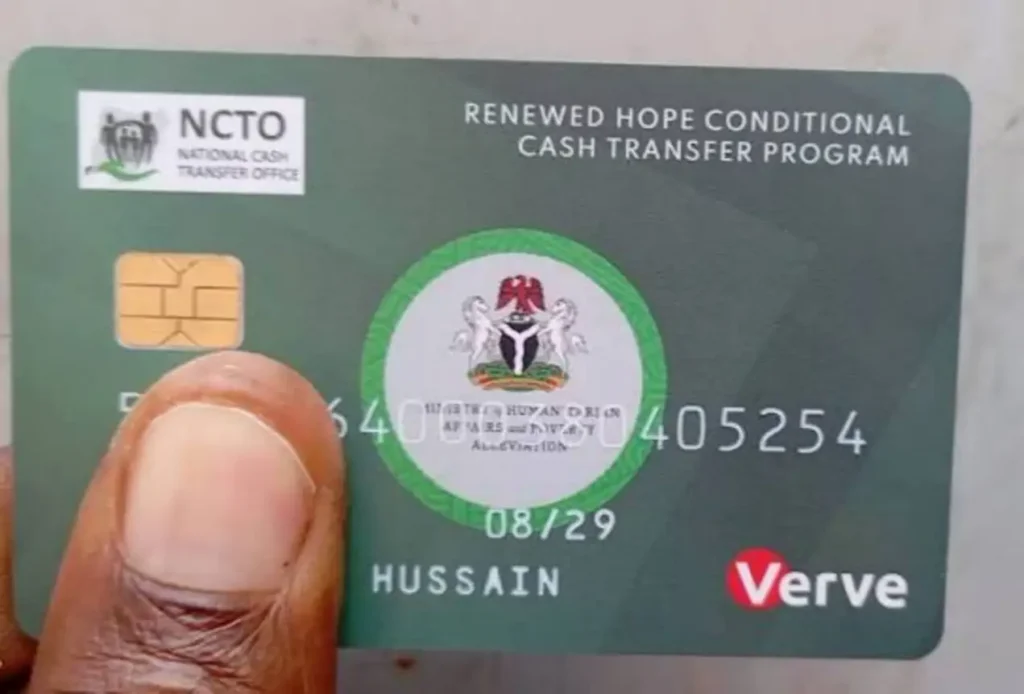
She revealed that President Bola Ahmed Tinubu approved an increase in the value of the cash transfers, which were previously pegged at N10,000 but now stand at N25,000 paid in three cycles. She said beneficiaries now receive a total of N75,000 in three installments.
According to her, “Thanks to our President, His Excellency Bola Ahmed Tinubu. Initially, it was N10,000 but now he has moved it up to N25,000 which is paid three times, so a beneficiary gets N75,000 three times. Once the beneficiary gets N75,000, that is all for that beneficiary. So far, we have paid up to 8.3 million beneficiaries.”
Eleojo also noted that the programme has been expanded beyond its initial target due to economic shocks caused by fuel subsidy removal and COVID-19. Before now, the goal was to reach 10 million people, but the government has increased coverage to 15 million beneficiaries. She added that the programme’s monitoring and grievance redress system remains active nationwide. “We have the Monitoring and Evaluation Unit, we have payment officers. You know, at the cash transfer, it is not just a payment, there are other officers who run it to be sure that everything falls into place. So from time to time there are monitoring activities, when grievances come, there are grievance officers to manage them at the state level, at the LGA level and we have officers that are ready to redress and resolve the grievances. So we monitor them, we get their feedback, we know where they are because we have their data.”
Also speaking, Lead Consultant of Muryar Fulani Peace Initiative Network, Hassan Ibrahim, said the monitoring work has shown real impact, especially among women in northern states such as Kano, Jigawa, and Katsina. He explained that despite the amount being less than N100,000, beneficiaries are pooling funds to start small businesses like petty trading and food processing.
Ibrahim said, “To be honest, though the amount received is less than 100,000, you can see that some of the women are pulling resources together to start small businesses, like food processing, like petty trading. And some were able to offset very important expenses, the medical bills with the grant. The cash transfer is really touching lives, and it’s making an impact within the part of the country where we covered. That is Katsina, Kano, and Jigawa states.”
He recommended that the government further review the cash amount in line with rising inflation. “Considering the inflation rate, I would strongly advise that the government should increase the amount. You should consider reviewing the amount upwards. Instead of less than 100,000, let the households get close to 100,000. That will help a lot.”
Senior Monitoring, Evaluation, Research and Learning Officer at the Foundation for Resilient Empowerment and Development, Amina Danjuma, said the field assessment confirmed that beneficiaries are receiving support as intended.
She said, “This assessment was very necessary. So far, we have gone into the communities to ensure that the ultimate objective, which was to ensure accountability of this project, was met. And we didn’t meet directly with the beneficiaries to ensure that what this whole coordinating the National Safety Net Coordinating Office set out to is actually achieving, which is to ensure that the vulnerable population is being served and given, like, some kind of level of cushion effect to manage their hardship in the country.”
She added that the feedback gathered during monitoring was mostly positive. “And so far, from what we’ve seen, from what we assessed, indeed, the beneficiaries did give positive feedback. They are happy about their experiences, that they’re being supported by the government of Nigeria, and even though they hope for more. So, yes, the objective is being met, and hopefully we will do better than as a country generally,” she noted.
Gender and Communications Lead at the International Climate Change Development Initiative, Oloruntobi Adejare, said the launch of the report reflects renewed government focus on supporting citizens hit by economic hardship. According to her, “This event is about the renewed agenda of cash transfer, ensuring that Nigerians who do not have the wherewithal to survive in Nigeria, have the means being supported by the government, one way or the other, to alleviate the present situation of the country.”
She explained that multiple civil society organisations were commissioned nationwide to serve as third-party monitors. “Several CSOs were put together and they were taken to different states to carry out this project. The report of that project being done by all the CSOs is what we have launched today.”
Adejare noted that ICCDI acted as an independent monitoring body for the programme. “ICCDI has acted as a third-party monitor on this project, monitoring the activities of all the CSOs worldwide. We are launching that project today, which is what we just did. The report is an activity of everything that has been carried out by all the different CSOs across several states.”
She highlighted implementation challenges, including distrust among residents and security concerns. “We look forward to going into other states. Some of the challenges we encountered were people not trusting the process and wanting to participate, but along the way, we were able to get them to come on board with the programme. Also, some of the places where we encountered security challenges due to the current insecurity happening in the country, we tried as much as possible to work with locals so that we were able to reach some of these places.”
According to Adejare, inclusivity was prioritised regardless of disability or gender. “Our major findings were that there were people who were indisposed, people physically challenged who could not reach some of these places. We tried as much as possible to make the process very inclusive. We tried as much as possible also to have more women on board and persons living with disability on board to ensure that the exercise got to everyone. As I said earlier, security challenges were encountered. Working with the locals and the chiefs, we were able to sum up some of these challenges.”
The National Social Safety Net Programme is one of Nigeria’s largest poverty alleviation initiatives aimed at cushioning the impact of inflation, fuel subsidy removal, and the economic effects of COVID-19. It is coordinated by NASCO and targets poor households captured in the National Social Register across the 36 states and the Federal Capital Territory. The programme includes conditional and unconditional cash transfers to help vulnerable Nigerians meet basic needs, improve household income and build resilience against hardship.