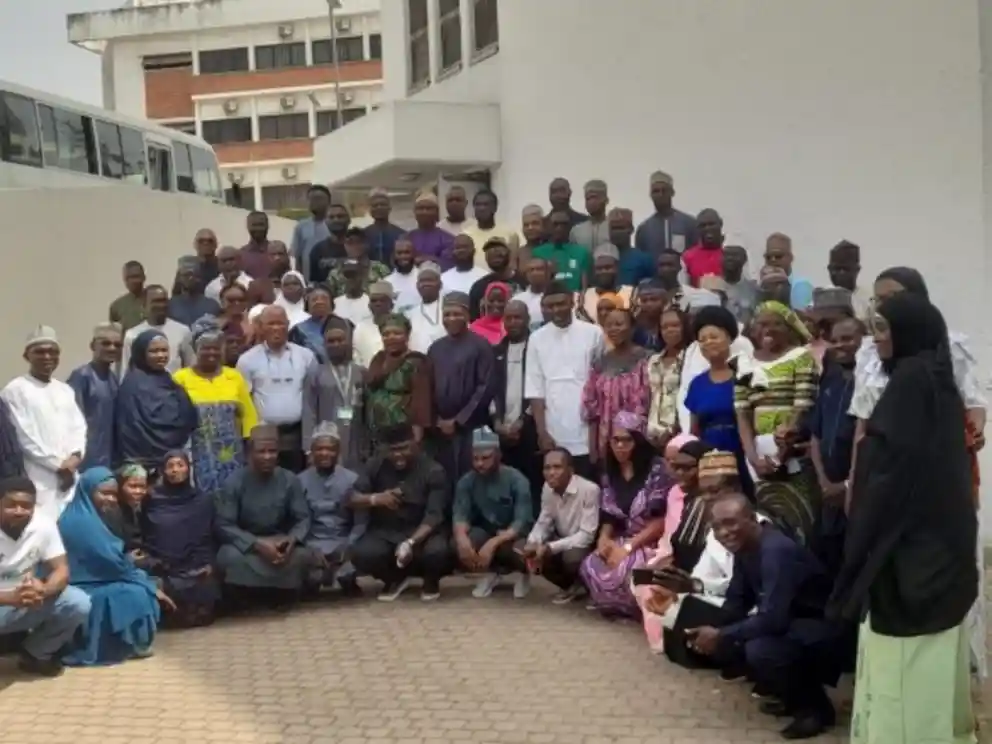
The Association of Organic Agriculture Practitioners of Nigeria (NOAN) has commenced training on organic seed production and certification for 300 farmers drawn from different states across the country.
 Follow us on Google News
The training was announced by the President of NOAN, Prof. Jude Obi, at the opening ceremony of the programme on seed production and Participatory Guarantee System (PGS) certification in an organic system, held in Abuja.
According to Obi, the initiative is designed to train 100 farmers in each of three selected locations, namely Abuja, Ibadan and Aba, to ensure regional balance and wider participation.
He explained that the Abuja training would cater to participants from the northern part of the country, while the Ibadan centre would host farmers from the South-West. The Aba location, he said, would serve participants from the South-East and South-South regions.
The two-day Abuja training brought together farmers, seed producers, extension agents and other actors along the organic agriculture value chain from various northern states.
Speaking on the benefits of organic agriculture, Obi said the practice promotes healthier food consumption, protects the environment and enhances the shelf life of agricultural produce.
He said, “We produce and eat food that is healthier. When organic agriculture is practised, the environment and soil are sustained.
“More importantly, the produce of organic agriculture has longer shelf life and is more nutritious.”
Obi noted that smallholder farmers in Nigeria continue to face serious challenges such as declining soil fertility, rising costs of synthetic farm inputs, climate variability and increasing pressure on ecosystems.
He said despite these challenges, smallholder farmers remain the backbone of Nigeria’s food systems and the custodians of agricultural biodiversity.
“At NOAN, we firmly believe that agroecology and organic agriculture offer practical, locally adapted, and sustainable solutions to these challenges.
“Central to this transition is seed: seed that is locally adapted, farmer-managed, organically produced, and supported by systems that guarantee quality, integrity, and trust,” he said.
Obi, who is a lecturer at the University of Uyo, explained that participants would receive practical and theoretical training covering varietal selection, seed multiplication, quality control, storage, traceability, organic standards and the Participatory Guarantee System.
He described PGS as a credible, inclusive and community-based certification approach that helps build trust among farmers and consumers of organic products.
On the expected outcomes of the programme, Obi said the training would strengthen food security, improve farmer incomes, increase consumer confidence in organic products and stimulate organic value chains.
He added that the initiative would also support related sectors, including organic poultry and livestock production, which depend heavily on quality seed and feed inputs.
“Ultimately, this training is a catalyst for scaling agroecology as both a practice and a movement,” he said.
In his remarks, the Director General of the National Agricultural Seeds Council (NASC), Muhammad Fatuhu, commended NOAN for organising the training and described it as timely.
Fatuhu, who was represented by Mrs. Esther Mahdi, expressed optimism that the programme would significantly improve the availability of quality and improved seeds in Nigeria.
She said the initiative would also contribute to better livelihoods for seed producers across the country.
She assured participants that NASC would continue to intensify efforts to promote the availability, accessibility and affordability of quality seeds in Nigeria.
The NASC Director General further urged participants to make effective use of the opportunity, noting that they would be guided through the technical processes involved in quality seed production and certification.
Also speaking at the event, the Director of Farm Input Support Services at the Federal Ministry of Agriculture and Food Security, Abana Waziri Abba, said the training was very important to Nigerian farmers.
He noted that the focus of the Federal Government has shifted towards achieving food and nutritional security nationwide.
Abba stressed the need for farmers to adopt both organic and inorganic agricultural practices to attain food sovereignty in the country.
He added that the Federal Government has continued to provide a 50 per cent subsidy on farm inputs as part of measures to boost food production.
NOAN is a non-governmental organisation established as an umbrella body for stakeholders involved in organic agriculture in Nigeria.
Its membership includes farmers, scientists, processors, exporters, individuals, institutions, non-governmental organisations and other key players in the organic agriculture sector.
The association also serves as a link between organic agriculture stakeholders in Nigeria and international bodies with interest in organic agriculture.