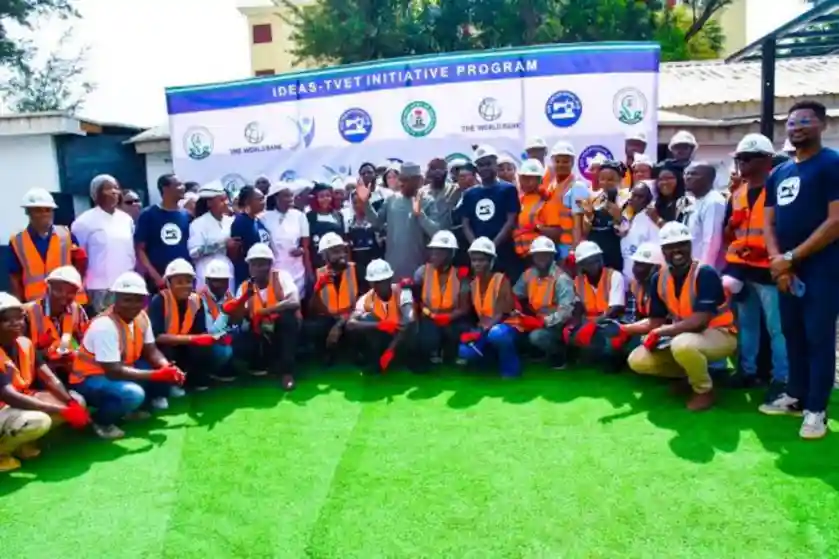
The Federal Government, in partnership with the World Bank, has officially launched the Innovation Development and Effectiveness in the Acquisition of Skills (IDEAS) – Technical and Vocational Education and Training (TVET) initiative to strengthen skills acquisition and tackle youth unemployment across Nigeria.
 Follow us on Google News
The flag-off ceremony, held in Ibadan, marked the formal commencement of the programme, beginning with Oyo State as one of the take-off points. The initiative is designed to improve the quality, relevance and effectiveness of technical and vocational education, ensuring that young Nigerians acquire industry-aligned, practical skills required in today’s labour market.
Speaking at the event, the Minister of Education, Maruf Tunji Alausa, who was represented by Mrs. Gbemisola Olaniyan, described the launch as a significant milestone in the government’s drive to empower young people with employable competencies.
“The crux of this initiative is to have youth in Oyo State and across Nigeria trained to have hands-on skills to ensure that none of them is roaming about the street,” the minister stated. He explained that the programme is a deliberate intervention aimed at equipping participants with practical knowledge that translates directly into employment and entrepreneurship opportunities.
According to him, the IDEAS-TVET initiative under the World Bank-funded programme focuses largely on the informal sector, while complementary efforts are ongoing within the formal education system. He noted that technical colleges are also being repositioned to fully implement TVET reforms, with government support covering students’ needs from TVET 1 (equivalent to SS1) through SS3.
“This is not being done only in the informal sector,” he said. “There is also a programme going on through the formal sector to ensure all our technical colleges are handling this TVET initiative whereby students come to school and the government takes care of all their needs.”
The minister further disclosed that trainees would be linked directly with industries for practical exposure through structured industrial training. “They will be trained and they will be connected to industries in order to have industrial training,” he added, stressing that the goal is to produce graduates who are better equipped than previous cohorts.
Highlighting the broader vision behind the reform, he remarked, “The nation and other countries of the world are shifting from certificate to ‘sabiticate’ which simply means it is what you know that matters.”