
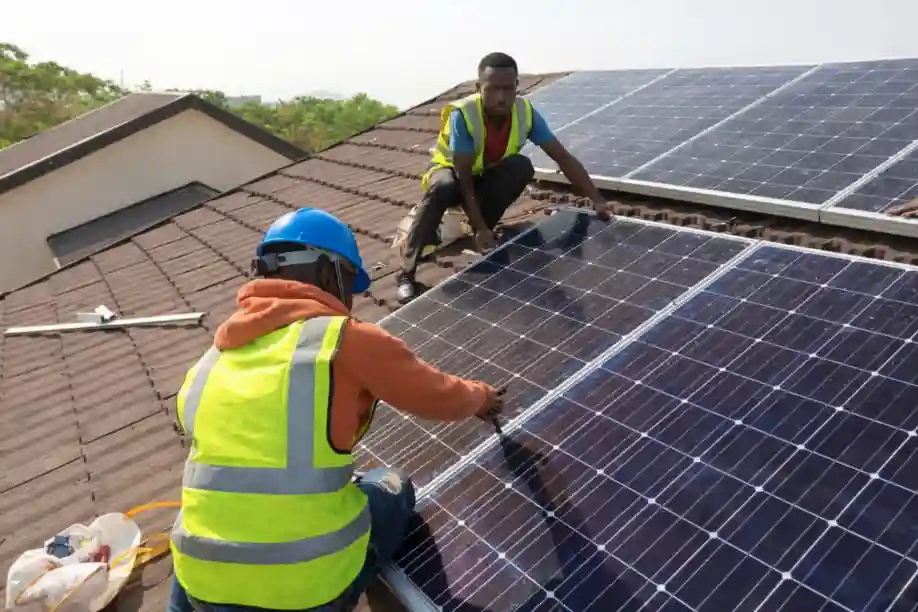
The Federal Government has approved ₦100 billion to install solar power systems in public institutions across Nigeria as part of efforts to improve electricity supply and reduce energy costs.
 Follow us on Google News
The initiative, known as the National Public Sector Solarisation Initiative (NPSSI), will provide renewable power solutions for government facilities that currently struggle with unstable electricity or high power bills.
Managing Director of the Rural Electrification Agency (REA), Engr. Abba Aliyu, disclosed the development during a visit by the Administrator of the National Judicial Institute (NJI), Justice Babatunde Adejumo, to the agency’s headquarters in Abuja.
Aliyu explained that the programme was approved by President Bola Tinubu to help government institutions move away from unreliable grid supply and expensive diesel-powered generators.
“President Bola Tinubu approved ₦100 billion for the National Public Sector Solarisation Initiative,” Aliyu said.
According to him, the solar installations will ensure steady electricity in critical public institutions while reducing the cost of running government facilities.
He noted that many public agencies spend significant amounts on fuel and electricity, making renewable energy a more sustainable option.
Aliyu added that several government establishments have already been selected for the first phase of the project.
He said the programme is currently being implemented in key institutions including the Department of State Services, the Economic and Financial Crimes Commission, the Independent Corrupt Practices and Other Related Offences Commission, the National Hospital Abuja, and several educational institutions across the country.
“These institutions either face inadequate electricity supply or spend heavily on energy, and the initiative is designed to address those challenges,” Aliyu explained.
As part of the implementation process, the REA will conduct energy audits in participating institutions to determine the appropriate capacity of solar mini-grid systems required for each facility.
“Once the energy audit is completed, we will determine the size of the mini-grid and the distribution network that will be deployed,” he said.
Justice Adejumo welcomed the initiative, stressing the importance of stable electricity for institutions responsible for training judicial officers.
He noted that modern judicial training, digital research systems and administrative operations require reliable power to function effectively.