

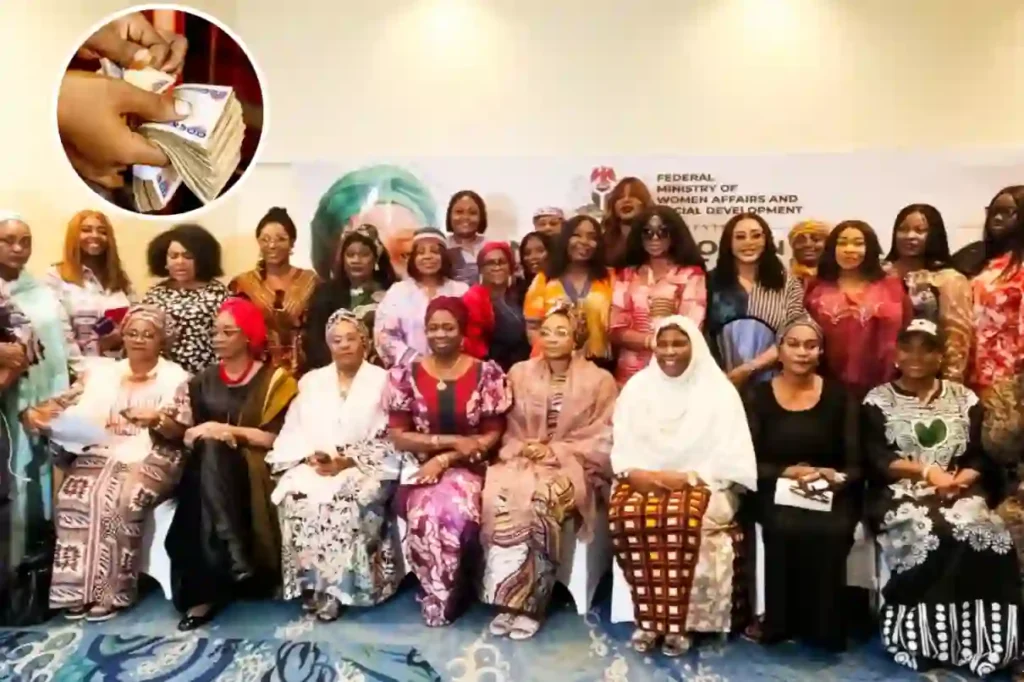


The Federal Government has announced plans for the 2026 Women Mega Empowerment and Rally, a nationwide mobilisation effort aimed at activating 10 million Nigerian women around political engagement, policy advocacy and grassroots economic inclusion.
Minister of Women Affairs, Imaan Suleiman, disclosed this at a press briefing in Abuja, describing the initiative as a structured intervention rather than a symbolic gathering. According to her, the rally is designed to consolidate women’s participation into organised influence across Nigeria’s governance and economic systems.
Themed “The Power of 10 million: One Voice, One Movement, One Choice,” the event is scheduled to hold on May 5 at the Moshood Abiola National Stadium. It will bring together representatives from Nigeria’s 9,410 wards, with participation coordinated through decentralised networks rather than physical mass attendance.
“This rally is not symbolic, it is strategic. It is a demonstration of the collective strength of Nigerian women,” Suleiman said. She outlined three core deliverables: a public endorsement of Bola Ahmed Tinubu ahead of the general election, the presentation of a unified national women’s charter of demands, and the integration of women-led groups into a sustained national framework for action.
She further positioned the initiative as a shift in power dynamics. “This represents a transformative shift. It signals a movement from participation to power, from inclusion to influence and establishes women not just as stakeholders but as organised constituents with voice, structure and agency,” she said.
The minister noted that the mobilisation strategy prioritises reach over physical turnout. The rally, scheduled from 9am to 5pm, will rely on delegates and volunteers across wards to drive engagement at the grassroots level. “It’s not about bringing 10 million women into one stadium. It is about mobilising 10 million voices and ensuring empowerment reaches the grassroots,” she explained.
The initiative is aligned with the administration’s Renewed Hope Agenda, with a focus on women, children and vulnerable populations. Suleiman emphasised that women are central to national development outcomes, not passive beneficiaries. “Women are not beneficiaries, they are drivers of transformational change,” she said.
She also acknowledged the role of Oluremi Tinubu in advancing women-focused advocacy, noting that her interventions reflect sustained commitment beyond ceremonial responsibilities.
On the economic front, the rally is positioned as an entry point into broader empowerment programmes, particularly the Renewed Hope Social Impact Intervention 774 Programme. The initiative targets women across all 774 local government areas with grants, skills development and enterprise support.
“Empowerment of women is not a social gesture, it is an economic imperative. When women are empowered, the nation multiplies its productivity,” Suleiman stated.
Supporting stakeholders reinforced the scale of the mobilisation. Abike Dabiri-Erewa described the rally as unprecedented and urged stronger narrative ownership around government reforms. “We are not telling the story enough. But when women come together, they can speak more powerfully than anyone,” she said.
Organising Committee Chairman, Zainab Ibrahim, added that the initiative is intended to unify women across social and political divides. “This is not just a rally, it is a movement. It will allow women to think, plan and act as one for collective progress,” she said.