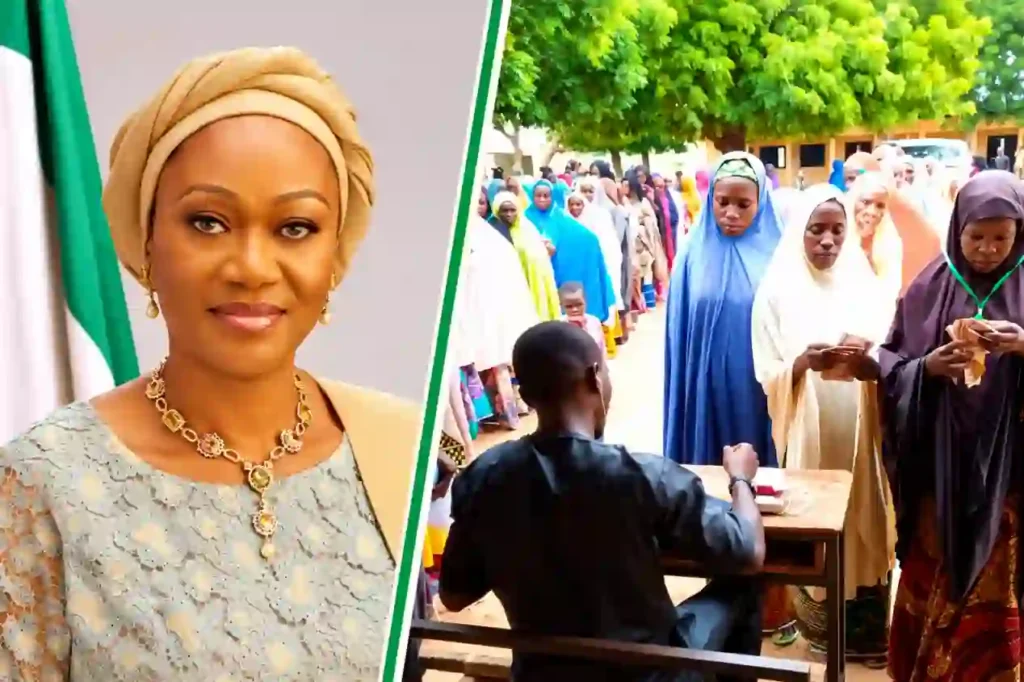
The First Lady, Oluremi Tinubu, launched a ₦2bn Learners Retention Support Programme targeting 100,000 pupils, alongside the distribution of two million packs of sanitary towels to girls in public basic education schools nationwide.
 Follow us on Google News
Under the first phase, each selected beneficiary is expected to receive ₦20,000 to ease financial pressures that can force children from disadvantaged households out of school. However, the report did not announce a public application portal or direct registration process for parents and pupils.
Sanitary towels will be distributed alongside school bags, shoes, exercise books and other learning materials to help prevent menstruation and the cost of basic supplies from disrupting girls’ education.
Speaking at the flag-off ceremony at the State House Conference Centre, Abuja, to mark the 2026 International Day of the Girl Child, Tinubu said every Nigerian girl deserved the opportunity to learn and contribute to national development, regardless of her family’s financial circumstances.
The initiative, known as Flow with Confidence 2.0, is being implemented by the Universal Basic Education Commission (UBEC) in partnership with the Federal Ministry of Education.
Tinubu said it builds on an intervention launched by her Renewed Hope Initiative on October 2, 2025, which provided a one-year supply of disposable sanitary pads to 370,000 schoolgirls in rural communities.
She welcomed the decision to institutionalise and expand the intervention through UBEC, urging state first ladies, commissioners for education and chairmen of State Universal Basic Education Boards to ensure supplies reached beneficiaries transparently. She also called on traditional rulers, religious leaders and parents to challenge menstruation-related stigma and prioritise girls’ education.
Tinubu urged pupils to stay focused, work hard, believe in their dreams and speak up when they need help. The Minister of Education, Dr Tunji Alausa, said the Federal Government was working to make menstrual hygiene support a sustained part of basic education interventions rather than a one-off distribution.
Alausa said UBEC would make annual budgetary provisions for sanitary towels for girls in public basic education schools, while the World Bank-supported Adolescent Girls Initiative for Learning and Empowerment (AGILE) project would sustain menstrual hygiene support throughout its duration.
“Today, we are translating that pledge into practical action. UBEC will make provision within its annual budgets to support the supply of sanitary towels to girls in public basic education schools,” he said.
He added that the earlier target of reaching 370,000 adolescent girls had been achieved, with the latest distribution expected to extend support to more beneficiaries nationwide.
UBEC Executive Secretary, Aisha Garba, said a girl’s future should not be determined by circumstances that practical interventions could address. She cited the example of a rural pupil who aspires to become a teacher, doctor, engineer or lawyer but misses classes because her family cannot afford sanitary towels.
“Sometimes, the key that unlocks that remarkable future is something as simple as a sanitary towel,” she said.
Garba said the two million packs would be distributed alongside school bags, shoes, exercise books, mathematical sets and writing materials to girls in public basic education schools across the 36 states and the Federal Capital Territory (FCT).
Chairman of the UBEC Governing Board, Tanko Al-Makura, said the intervention was intended to reduce school dropout rates and address factors that could expose girls to early marriage. He noted that girls from low-income households were often the first to lose access to education when families faced financial difficulties.
In a goodwill message, the Education Lead at the British High Commission, Ian Attfield, said investing in girls’ education brought economic and social benefits. He cited estimates that each additional year of schooling increased women’s earnings by an average of 12 per cent.
Attfield said United Kingdom-supported programmes had helped more than 1.5 million additional girls access schooling in northern Nigeria since 2012. He called for continued efforts to end child marriage, improve access to education and health services, and strengthen protection against gender-based violence and abuse.