

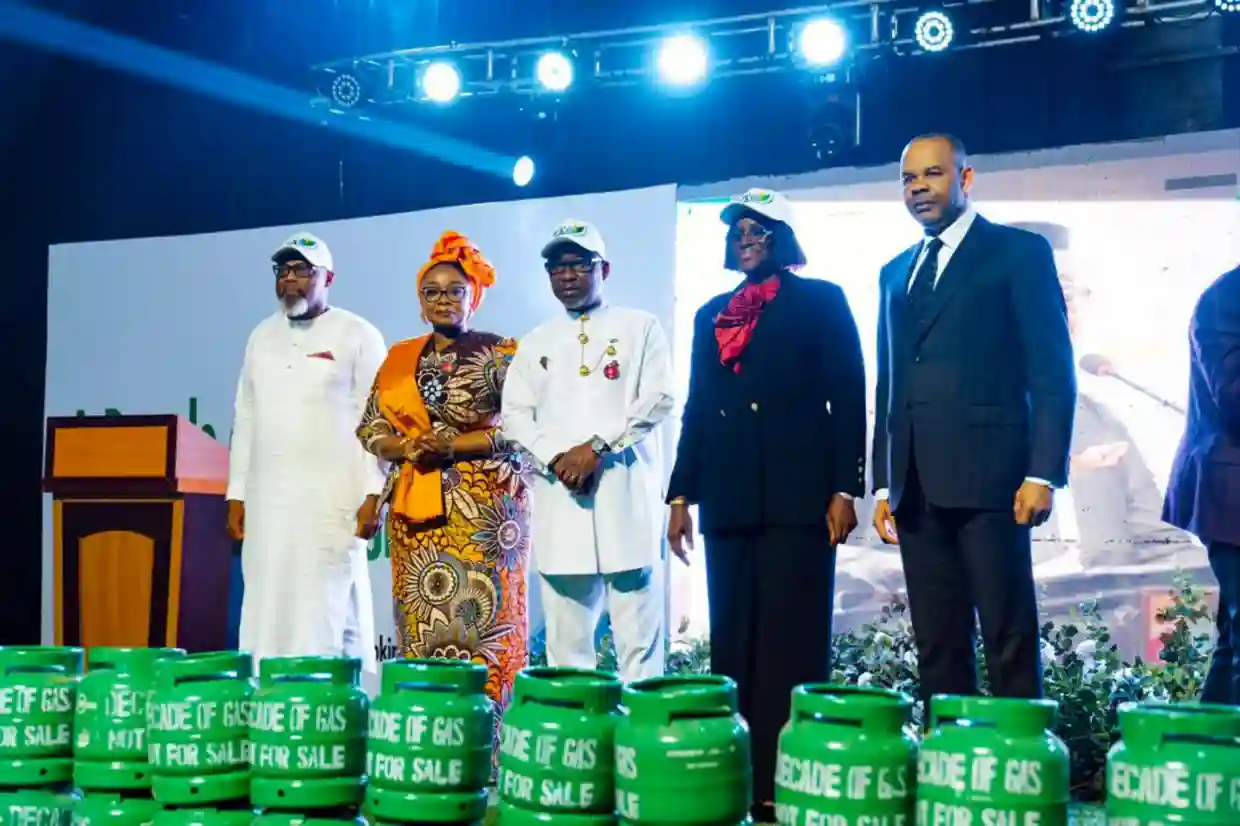
The Federal Government has announced a new push to expand the Decade of Gas programme by increasing Liquefied Petroleum Gas (LPG) penetration across all six geo-political zones. This move became more visible in the South-East as the government launched a cooking gas outreach targeting one million homes per year. The Minister of State, Petroleum Resources (Gas), Ekperikpe Ekpo, made the announcement in Owerri, the Imo State capital, during the Flag-Off of the LPG Penetration Programme and the distribution of LPG cylinders in the region.
Speaking at the event, the Minister said he was pleased to be in the South-East to officially begin the programme in partnership with the Imo State Government. He described the launch as another milestone in the Federal Government’s Decade of Gas Initiative led by President Bola Tinubu. Ekpo explained that clean cooking is more than an energy decision, stressing that it is a life-changing intervention for families across the country.
He noted that for many years, Nigerian households have depended on firewood, charcoal, and kerosene, which he described as fuel sources that harm health, damage the environment, and create extra burdens for women and children. With the shift to LPG, he said the Federal Government aims to eliminate exposure to dangerous smoke that leads to respiratory diseases, reduce the hours women and girls spend gathering firewood, and free up time for education and economic activities.
The Minister added that the transition supports forest conservation and biodiversity by reducing the need for firewood. He said it will also increase household savings by providing a more efficient and reliable cooking energy source while improving safety with modern, regulated fuel options. According to him, clean cooking improves health, protects the environment, and allows families to live with greater dignity and convenience.
Ekpo highlighted that the project aligns with the United Nations Clean Cooking Agenda and directly contributes to global Sustainable Development Goals, including SDG 7 on clean energy, SDG 5 on gender equality, and SDG 13 on climate action. He explained that over 17 million Nigerian households still rely on biomass for cooking, calling it one of the largest drivers of deforestation and greenhouse gas emissions. He said, “By transitioning these households to LPG, we significantly reduce carbon emissions while safeguarding our forests and the climate.”
The Minister noted that in recent months, the programme has been launched across several geopolitical zones, starting from the North-Central and extending to the South-South, South-West, North-East, North-West, before arriving in the South-East. He reminded the public that the Federal Government’s goal under the Decade of Gas is to transition 5,000,000 Nigerian homes to clean cooking gas by 2030.
Ekpo emphasised that strong partnerships have been key to the progress achieved so far. He recognised the Imo State Government for its enthusiasm and support, and also appreciated the Coordinator of the Decade of Gas Programme and private sector partners for their technical and logistical contributions. Addressing women and youth beneficiaries, he said, “The cylinders you receive today are tools of empowerment. Clean cooking creates opportunities across the value chain, from cylinder distribution and maintenance to retail supply and safety training.”
According to him, expanding LPG use will create jobs, boost local enterprise, and build a safer and more economically vibrant region. He added that the South-East, known for its strong entrepreneurial spirit, stands to benefit greatly from new opportunities in the gas sector.
The Minister encouraged the region to move forward with a shared commitment to health, safety, environmental protection, and national development. He assured the public that the Federal Government, through the Nigerian Midstream and Downstream Petroleum Regulatory Authority (NMDPRA), will continue to strengthen LPG safety awareness and expand distribution networks.
He stated that “together, we are building a Nigeria where no child grows up inhaling harmful smoke, where women cook with dignity and safety, where forests are preserved, and where gas truly becomes a catalyst for national prosperity.”

